

AgenticSky ControllerCore for Agentic AI-Based Industrial Robot Safety


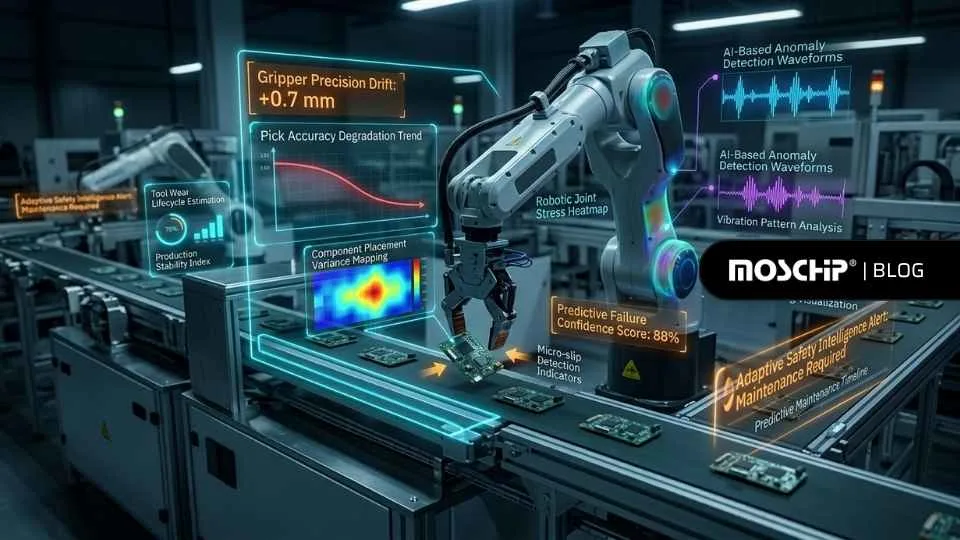
At 1:49 am, during a night shift in a factory, a robotic pick-and-place arm, running on line-2, is feeding components to a high-speed assembly station. Throughput is steady. No concerns, alarms or notifications. Everything appears normal. But in a couple of hours a subtle issue creeps in.
The gripper tool has experienced slight mechanical wear and a minor offset in its position. Small variations in how the components are placed can be seen. They may look like minor changes, but they affect the precision of the pick.
The robot continues to operate according to its original calibration. Some picks succeed while some are off, eventually leading to slipping once or twice. You see minor deviation but nothing to trigger an alert or stop production. Accuracy continues to degrade slowly.
In a conventional system, the faulty process continues until it hits a threshold. At that point, production stops and corrective action is performed. However, this would not be the case in the future. The way robots operate will be completely transformed. In the future, systems will behave differently. They begin by perceiving. Data from encoders, force sensors, and control signals are continuously monitored. Over time, a pattern emerges which points to small but consistent mismatches between expected motion and actual interaction at the gripper.
The system then interprets. Instead of treating these as isolated anomalies, it correlates them and identifies a likely cause. This is calibration drift in the tool center point combined with part variability.
Next, the system decides. It determines that the deviation is recoverable and does not pose an immediate safety hazard. It initiates corrective or self-healing action. The robotic arm recalibrates its position, adjusts the tool center point, refines the approach vector, and restores accuracy. All of this happens without disrupting production.
A timeline report is generated and sent the supervisor. The system did not stop. It corrected itself while operating.
By now you may think how this is possible? And that exactly what we are going to talk about.
What we just saw as an example is how Agentic AI operates on a factory floor. Industrial robots always work on pre-defined limits, and when those limits are breached, they stop operating. Such breaches lead to production breakdown. What if the system could assess probable faults and start initiating action? That will basically ensure maximum uptime.
This is not just an improvement in how systems operate today. It sets the foundation for how industrial systems will function going forward, continuously adaptive, self-healing, and capable of maintaining stability in environments where variability is the norm. But the question how do you build agentic intelligence into your robotic arms.
This is where MosChip AgenticSky comes in.
AgenticSky is a solution accelerator suite designed to fast-track the development of intelligent industrial systems. It enables up to 40 percent faster product development. It provides pre-engineered building blocks for perception, decision-making, system coordination, and real-time response.
At its core is the PIDE loop, which stands for perceive, interpret, decide, and engage. This ensures that systems continuously align with real-time conditions.
ControllerCore is one of the foundational cores of AgenticSky. It transforms control systems from reactive systems into adaptive orchestrators. Instead of reacting to faults, systems interpret signals, guide corrective actions, and stabilize operations automatically.
Deployed directly within robotic arms and production environments, ControllerCore continuously evaluates expected versus actual behavior. When deviations occur, it determines whether they can be corrected within the safety limits. If so, it recalibrates and adjusts in real time. If not, it escalates the issue to enable human intervention.
Instead of operating on fixed parameters and reacting to failure, the system continuously aligns itself with reality. This helps maintain stability, accuracy, and safety without interruption.
This shift directly translates into measurable outcomes. It improves performance, increases uptime, and enables more intelligent control over system behavior.
Robotic arms are designed for precision, but that precision depends on stable assumptions. But in real-world environments, those assumptions constantly shift. Mechanical wear introduces offsets. Fixtures vary. Parts are not always perfectly aligned. Sensors drift over time.
Traditional control systems cannot adapt gradually. They operate on fixed calibration and predefined thresholds. When thresholds are exceeded, they stop.
This creates a gap in how systems respond to change.
Agentic AI completely changes manual configurations.
Instead of treating calibration as a one-time setup activity, the system constantly validates its internal model against actual outcomes. When drift is detected, it updates parameters in real time. This includes adjusting tool position, alignment, and motion.
This enables self-configuration. The robotic arm adapts dynamically and maintains accuracy even as conditions change. This leads to consistent performance without manual intervention.
Self-healing defines how a robotic arm responds when something begins to drift during execution.
In traditional systems, deviations accumulate until failure. The system cannot respond in between.
With ControllerCore, the system continuously validates execution through active loops. When a deviation is detected, it evaluates whether it can be corrected within safe limits. If it can, it recalibrates parameters, adjusts motion, and restores accuracy while continuing the task.
Correction happens during execution. If a deviation cannot be safely resolved, the system records the event and escalates it for intervention.
The result is not just fewer failures, but fewer interruptions. This improves uptime, performance consistency, and intelligent control over system behavior.
| Capability | What It Does | Impact on Performance, Uptime, and Control |
|---|---|---|
|
Self-Configuration |
Continuously aligns system parameters |
Eliminates manual setup and improves performance |
|
Self-Healing |
Corrects deviations during execution |
Maintains uptime and prevents interruptions |
|
Real-Time Adaptation |
Adjusts behavior based on feedback |
Ensures consistent accuracy |
|
Goal-Driven Control |
Aligns actions with system objectives |
Enables intelligent control decisions |
|
System Coordination |
Synchronizes components |
Improves overall system efficiency |
|
Context-Aware Decisions |
Interprets deviations intelligently |
Reduces unnecessary interventions |
Industrial robot safety is no longer just about stopping systems when something goes wrong.
With Agentic AI, systems continuously adapt, recover, and stay aligned with real-world conditions. This drives measurable improvements in performance, uptime, and intelligent control. The system does not wait for failure. It stays stable and keeps running.
Want to know how ControllerCore can transform your robotic operations? Drop a line to us and we will reach out to you.
ControllerCore is one of the foundational cores of AgenticSky designed for control systems powered by Agentic AI. It enables systems to continuously perceive operational behavior and understnad the deviations, adapt to changing conditions, and maintain stability in real time.
ControllerCore supports agentic ai capabilities such as self-configuration and self-healing, allowing systems to automatically recalibrate, correct deviations during execution, and remain aligned with real-world conditions without depending entirely on manual intervention.
The PIDE loop stands for Perceive, Interpret, Decide, and Engage. It is the continuous operational loop that enables systems within AgenticSky to sense real-time conditions, understand deviations, make decisions, and execute corrective actions.
Yes. ControllerCore is designed to operate within industrial environments alongside robotic arms, sensors, and production systems, enabling intelligent adaptation and orchestration without replacing the existing control infrastructure.

Smishad Thomas is a Technical Marketing Manager at MosChip. He has over 13 years of experience in technology marketing, branding, and content leadership. He has a keen interest in product engineering and loves developing convincing stories that translates technical innovations into clear, engaging messaging that resonates with business audiences
Only 1 in 4 companies drive business value from their IoT mission, the rest 75% are still figuring out a…

I have always thought that a surveillance system is only as good as its ability to quickly turn vision into timely insights…
For several years, industries have used traditional AI/ML systems that could classify, predict, and automate, but only with the limits of the data they were taught…
Many factories and industrial systems were built for reliable, long-lasting operations that deliver…
Integration of AI, cloud computing, and edge technologies is driving a new wave of innovation in industrial automation. While most…
As the automotive industry is emerging with Software-Defined Vehicles (SDVs) and autonomous vehicles, Advanced Driver Assistance Systems (ADAS) are encountering serious challenges day by day…
Android has evolved beyond an operating system into a foundation for building connected, intelligent...
FPGA products are no longer just about getting the RTL right. Building a production-ready FPGA platform...
Today’s consumer products respond after something has happened. Your wearable tells you your heart rate is elevated.…
Designing an FPGA-based product can look straightforward when working within the FPGA development environment…