

The Role of Agentic AI in Shaping Tomorrow’s Intelligent Systems

For several years, industries have used traditional AI/ML systems that could classify, predict, and automate, but only with the limits of the data they were taught. These systems were fundamentally reactive; they did not respond until coached via input. They were comprised of static and fixed models, limited in their application when the environment altered.
Even with their advanced sophistication, they did not represent true autonomy. The emergence of Generative AI has simply shifted this boundary forward slightly, as it can offer creativity and produce content, but only after a human stroke, human input, or nudge prompts it to do so.
However, today’s organizations no longer function in stable, predictable environments as they once did. Industrial automation lines must reroute when machines fail. Smart energy systems must rebalance loads in real-time. Healthcare devices must reason through anomalies and not wait for a technician. The world needs systems that can compute, think, plan, and adapt.
This has created a significant gap: companies require intelligence that can initiate on its own, grasp context, and learn continuously, rather than just relying on pre-programmed responses.
Enter Agentic AI: the future of machine intelligence, where systems transition from being passive models to autonomous agents capable of reasoning, goal pursuit, and independent action.
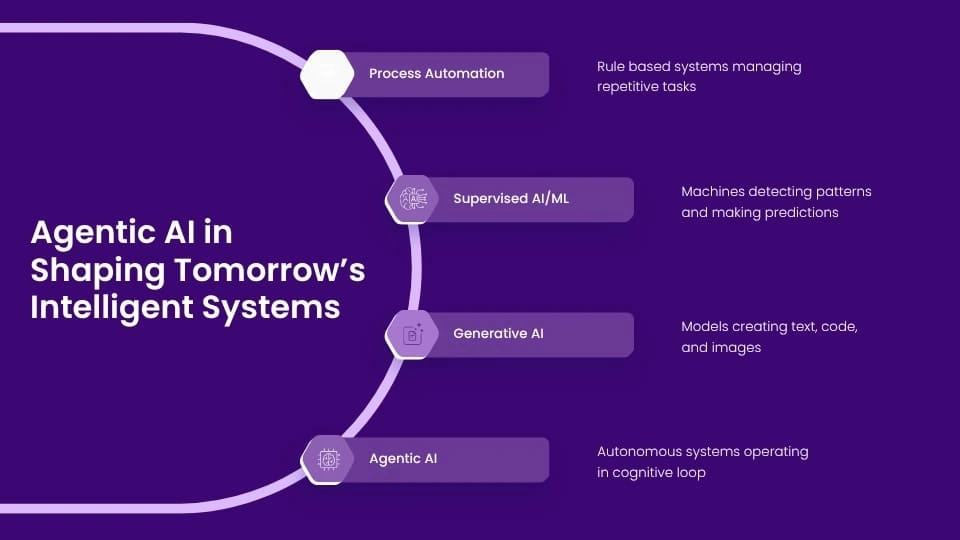
The progression toward Agentic AI has unfolded over many years, as systems have become more adept at functioning with less human input. It all started with Process Automation, where repetitive tasks were managed by rule-based scripts. Although these systems were effective, they operated solely within the boundaries defined by engineers.
The emergence of Supervised AI/ML represented a major transition, moving from fixed rules to enabling machines to detect patterns. These models could classify defects, predict failures, and identify anomalies, but they lacked proactivity and relied on new data to make predictions.
The next big advancement was Generative AI, which opened up new directions for creativity and reasoning by using models that can create text, code, images, and simulations. However, even in this case, a prompt was necessary; the intelligence was expressive but not fully autonomous
Progression to Agentic AI
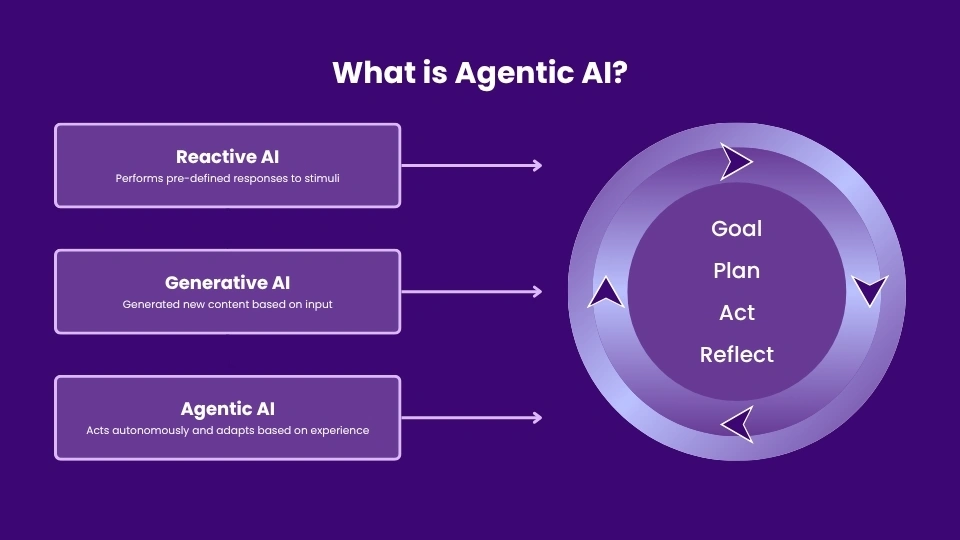
This is where agentic AI begins to be a paradigm shift. Rather than waiting for a command, these systems operate in a constant cognitive loop composed of:
Goal → Plan → Act → Reflect → Learn.
They accept objectives, develop multi-step plans, carry out tasks across tools and/or contexts, reflect on the results, and improve their behaviours without human support.
We are now seeing a transition from AI as an auxiliary to AI as an agent of autonomous decision-making that can drive real-time industrial workflows with intent and self-direction.
Agentic AI is more than just an innovation; it is a recalibration of intelligence. Agentic AI refers to AI systems that establish goals, determine actions, act upon execution, and incur adaptability. Traditional models of AI wait for you to tell them what to do, whereas a system of Agentic AI decides its own goals, understands the context, sequences its actions, and re-strategizes as the situation changes.
To clarify the transition being observed, let us look at the timeline:
What is Agentic AI?
Its core mechanism is a cognitive loop: Goal → Plan → Act → Reflect → Learn. This closed-loop process provides artificial intelligence with the ability to improve continuously, shifting it from a reactive to a proactive agent. What distinguishes it is the blend of autonomy, adaptability, and trust within the decision-making process, ensuring decisions are transparent, auditable, and balanced with the organization’s long-term general intentions.
To gain a comprehensive understanding of the key factors and design principles necessary for creating effective Agentic AI models, such as clear goals, high-quality data, and adherence to ethical standards, check out this in-depth guide: Factors You Should Consider Before Developing an Agentic AI Model.
In the industrial environment, this repositions AI away from a reinforced passive implementation into an intelligent colleague, one that can self-optimize production in response to real-time conditions, identify hazards ahead of time, and self-heal without human oversight.
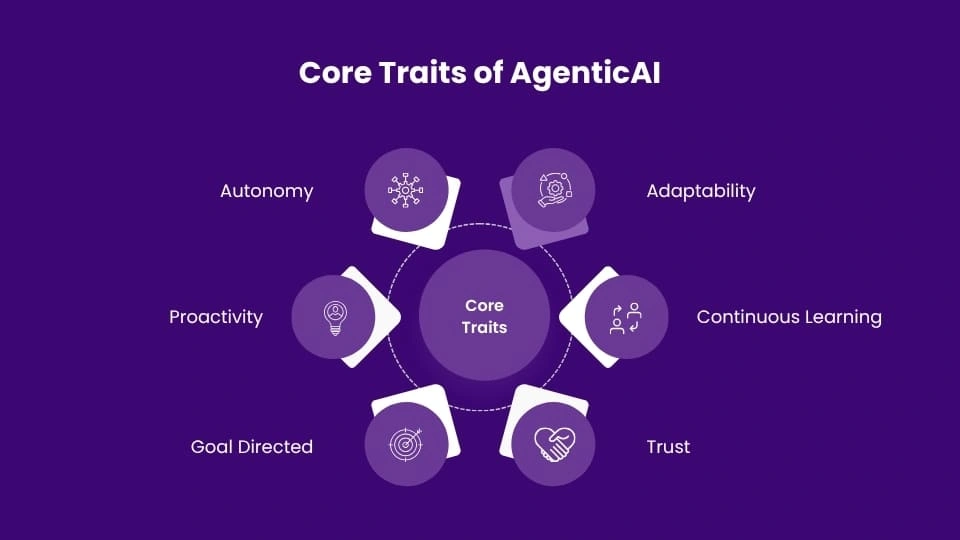
What truly makes Agentic AI revolutionary is not only its intelligence but also its behaviour. These systems are built on a core set of traits that transform AI from a mere computational tool into an active participant in industrial processes.
1. Autonomy – The Core of Independent Intelligence
Agentic AI’s autonomy refers to its ability to sense its surroundings, make decisions, and execute actions without human intervention. It relies on real-time data from IoT sensors and uses methods such as constraint-based optimization and reinforcement learning to effectively manage workflows.
In manufacturing, this leads to flexible production scheduling, where algorithms evaluate machine availability, energy costs, and delivery priorities to modify operations as needed. This level of independence is supported by closed-loop feedback systems, which ensure that decisions are in line with key performance indicators such as throughput and efficiency. Autonomy turns AI into a self-managing orchestrator, minimizing downtime and facilitating resilient, real-time optimization.
2. Proactivity – Intelligence That Foresees
Being proactive in Agentic AI means predicting disruptions before they take place. This is achieved through predictive analytics, anomaly detection, and time-series forecasting, all driven by machine learning.
By continuously examining sensor telemetry, vibration patterns, and thermal signatures, the system can detect early warning signs of equipment stress. It utilizes Bayesian inference and probabilistic failure models to predict breakdowns and schedule maintenance proactively. This foresight helps to avoid unplanned downtime, enhances resource allocation, and maintains seamless production cycles, transforming AI from a reactive tool into a strategic overseer of operational health.
3. Goal-Directed – Precision in Purpose
Agentic AI operates with strategic intent thanks to goal-directed intelligence, rather than relying on random optimization. This involves using advanced algorithms that handle multiple objectives and ensure that decisions are in line with the organization’s key performance indicators (KPIs).
For instance, during peak energy hours, the system utilizes linear programming and predictive load balancing to reduce energy costs while keeping production levels steady. Reinforcement learning agents are always evaluating the trade-offs between cost, speed, and quality, ensuring that every action is purposeful. This structured approach turns AI into a focused engine, aligning operational efficiency with long-term business objectives.
Core Traits of Agentic AI
4. Adaptability – Manufacturing’s Agile Backbone
The adaptability of Agentic AI allows for quick changes in fast-paced manufacturing settings and new system advancements. This is accomplished through real-time adjustments in production, utilizing advanced scheduling algorithms, coordination among multiple agents, and models that relax constraints. When urgent orders come in, the system swiftly reallocates resources, modifies machine sequences, and enhances material flow through state-space optimization. Integrated feedback loops help maintain quality standards while increasing output. This adaptability transforms conventional assembly lines into systems that can self-organize, allowing manufacturers to effectively respond to unexpected changes in demand, supply chain disruptions, and customization requests, while still maintaining efficiency and compliance.
5. Continuous Learning – Intelligence That Evolves
The concept of Continuous Learning in Agentic AI involves refining performance through iterative feedback loops. This process makes use of supervised learning pipelines, reinforcement learning agents, and adaptive neural networks that retrain on actual data streams. For instance, in manufacturing, defect detection systems take in inspection results and update convolutional models to lower false positives and boost precision.
This approach relies on gradient-based optimization and experience replay, ensuring the AI gets better with each cycle. Eventually, the system shifts from a rigid rule-based detection method to a self-improving expert, enhancing accuracy and operational resilience.
6. Trust – The Foundation of Responsible Autonomy
Building trust in Agentic AI relies on clear explanations, thorough audits, and governance that meets compliance standards. This means using Explainable AI (XAI) frameworks, maintaining unchangeable audit trails, and implementing decision-making policies. In the manufacturing sector, every autonomous action, like predictive maintenance or dynamic scheduling, is recorded using blockchain technology and checked against ISO standards.
Tools such as SHAP (SHapley Additive exPlanations) and LIME (Local Interpretable Model-agnostic Explanations) help provide transparency at the feature level, allowing stakeholders to grasp the reasoning behind decisions. This level of accountability turns AI from a mysterious entity into a reliable partner in operations, promoting ethical independence and adherence to regulations.
In summary, Agentic AI is poised to serve as the cognitive backbone of Industry 5.0, transitioning from simple automation to fully autonomous orchestration. Future developments will likely feature neuro-symbolic reasoning, allowing systems to merge deep learning with logical reasoning for more complex decision-making.
With federated learning, factories will securely exchange intelligence, and self-healing architectures will be able to anticipate and fix system issues without any downtime. When combined with quantum optimization for real-time scheduling and ethical-AI principles, Agentic AI will make an enormous difference in how we manufacture. Agentic AI will lead to much more flexible, transparent, and robust manufacturing environments that enable both autonomy and accountability to create sustainable innovation.
The AgenticSky accelerator by MosChip provides businesses with innovative AI technology for developing next-generation systems and processes. It is designed with four specialized cores: HMICore, WearableCore, ControllerCore, and VisionCore, all running on the PIDE Fabric (Perceive, Interpret, Decide, Engage). This design allows for the independent orchestration of predictive intelligence and adaptive automation, which helps organizations speed up product development by cutting down on complexity, shortening design cycles, and enhancing time-to-market without compromising on quality.
This positions AgenticSky to continue developing the next phase of Industry 5.0. AgenticSky enables companies to create smart and resilient, but also ethically responsible ecosystems to prepare for the future of manufacturing.
To know more about MosChip’s capabilities, drop us a line, and our team will get back to you.

Darshil is a Marketing professional at MosChip creating impactful techno-commercial writeups and conducting extensive market research to promote businesses on various platforms. He has been a passionate marketer for more than four years and is constantly looking for new endeavors to take on. When He’s not working, Darshil can be found reading and playing guitar.

The Artificial Intelligence of Things (AIoT) is revolutionizing industries by combining the power of Artificial Intelligence (AI) and the Internet…

Engineering teams building connected products spend a significant amount of time solving the same foundational problems…

The Industrial Internet of Things (IIoT), through distributed systems, autonomous control, and real-time intelligence, has transformed…

Today’s wearables sense and notify while tomorrow’s wearables reason and adapt. Agentic AI enables a layered intelligence model where sensing, near-edge reasoning, and cloud-based agents work together to deliver proactive, personalized outcomes. This marks the transition from threshold-driven tracking to continuous, context-aware companionship…

In contrast to traditional mass media, such as printed material or audio recordings, which feature little to no interaction between…

Large language models are transformed from general AI to specialized solutions through fine-tuning on domain-specific data to establish accuracy…
Join us at India’s premier semiconductor ecosystem event – SEMICON India 2026 to explore our comprehensive...
How can manufacturers transform fragmented operational data into real-time intelligence...

Today’s consumer products respond after something has happened. Your wearable tells you your heart rate is elevated.…

Recently, AI processors have seen significant improvements in computing power due to specialized units such as NPUs…