DevSecOps: Integrating Security at Every Stage of the SDLC
Modern software ecosystems are intricately connected, largely thanks to cloud-native architectures, containerization, and microservices. While these advancements provide greater scalability and flexibility, they also amplify the risk of cyberattacks, widening the attack surface.
In such environments, even a single misconfiguration or vulnerability can result in swift data breaches, allow lateral movement between services, and lead to serious compliance challenges. Future Business Insights reports highlight this urgency, indicating that the global DevSecOps market is valued at USD 8.93 billion in 2024 and is expected to grow from USD 10.10 billion in 2025 to USD 26.21 billion by 2032, with a compound annual growth rate (CAGR) of 14.6%.
Traditional software development life cycle (SDLC) models, like Waterfall and Agile, have often prioritized functionality over security, deferring security checks to later stages. This reactive strategy has resulted in expensive fixes, vulnerabilities to zero-day exploits, and issues with regulatory compliance. As companies have rushed to deliver products, these problems have become increasingly difficult to address.
This requires security to be addressed early in the development process. DevSecOps integrates security into the entire software development lifecycle (SDLC) through the processes of developing, testing, deploying & maintaining applications, enabling the automation & continuous integration of Security Testing, Compliance Auditing, Automated Security Controls & Threat Intelligence. Security as an ongoing activity leads to a proactive approach towards Threats and an automated means of ensuring that Frameworks are compliant with current regulations and Standards.
To fully grasp how critical the term “DevSecOps” is, we first need to define what DevSecOps means and the differences between it & its predecessors (Waterfall/Agile/Scrum).
What is DevSecOps? What does it offer?
Before understanding DevSecOps, it is essential to first look at DevOps, the foundation it extends.
DevOps in brief
DevOps is a collaborative approach that unifies development and operations to deliver software faster through automation, continuous integration, and continuous delivery. It focuses on:
- Faster, more frequent releases
- Improved collaboration between teams
- Automated builds, testing, and deployment
However, in traditional DevOps, security often sits outside this fast pipeline, which creates gaps that DevSecOps is designed to close.
What is DevSecOps?
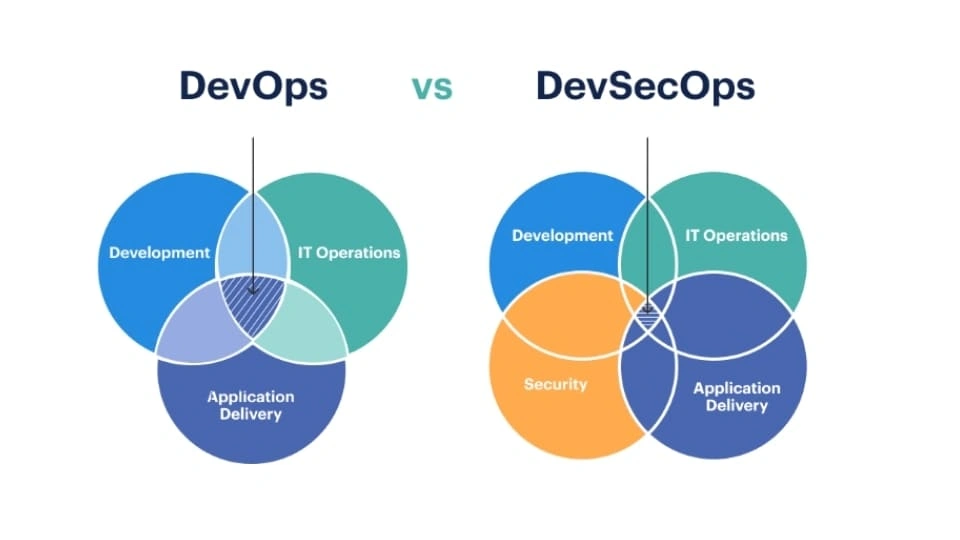
DevSecOps builds on the principles of DevOps by incorporating security into every stage of the development and operations processes. This approach ensures that security is a collective responsibility and does not slow down the speed of delivery. Unlike traditional security methods that function as a separate checkpoint at the end of the process, DevSecOps integrates automated security checks during planning, coding, testing, and deployment.
This method helps to spot vulnerabilities early on, which lowers risks and keeps compliance in check. The main idea is straightforward but impactful:
“Everyone is responsible for security.”
Let us understand this difference clearly below:
Key Differences Between DevOps and DevSecOps

The “Shift Left” Approach
One of the key strategies in DevSecOps is the Shift Left approach, which emphasizes integrating security practices earlier in the software development lifecycle (SDLC). Rather than waiting until the testing or release phases, security checks are initiated during the planning, coding, and building stages. By taking a proactive approach to security, you can achieve:
- Lower remediation costs: Fixing Security issues during the design and development process will be less expensive than trying to fix them after they have been identified, after the product has been produced and made available for sale.
- Improved time-to-market: emphasizing security from the start of an application development will decrease the product creation to delivery time to end users.
- Increased developer productivity: when developers have access to automated tools and the knowledge of secure coding techniques enables developers to seamlessly include security as part of the development process, reducing the amount of rework and enabling developers to be more effective overall.
- Stronger security posture: this is done by developing security as part of the design process, thus providing a stronger architecture for an application, resulting in a better developed application while serving as one of the driving reasons to reduce the probability of unauthorized access and/or data breaches.
- Proactive risk mitigation: an organization should look to take control of the security and compliance processes at the beginning of the development lifecycle, as opposed to waiting until issues begin to surface at a later point in time.
Integrating DevSecOps turns security into a facilitator of agility, enabling teams to deliver secure and reliable software quickly, in perfect alignment with the fast-paced demands mentioned earlier.
DevSecOps offers key advantages for organizations, including:
- Proactive Vulnerability Management: Instead of waiting for the conclusion of a project development cycle to identify security vulnerabilities, proactively managing these vulnerabilities through a DevSecOps approach enables you to continuously scan your environment (using tools such as vulnerability scanners, SASTs, DASTs, etc.) to identify any potential security concerns and correct them before an application is deployed into production. The proactive management of security vulnerabilities results in improved timeframes to resolve any identified vulnerabilities, as well as better overall security posture.
- Enhanced Collaboration and Shared Responsibility: DevSecOps also promotes an environment where everyone works together toward the same goal of ensuring a secure software delivery process, thereby allowing for greater cooperation, collaboration, and accountability among Development, Security, and Operations Teams. It fosters an environment where security is viewed as a team responsibility rather than being assigned solely to one team, thus enabling better communication and faster resolutions of issues.
- Continuous Security Monitoring and Compliance: Automated security process monitoring and compliance with applicable laws and regulations is achieved using the DevSecOps process framework. Security processes are continuously monitored in real-time for regulatory compliance throughout the development, testing, deployment and operations phases.
- Faster and More Secure Delivery: To improve the speed-to-market for secure applications, DevSecOps leverages CI/CD pipelines with automated security gates to identify and address security vulnerabilities without introducing any undue impediments into the agile, iterative development process of DevOps.
- Improved Risk Management: Organisations can significantly reduce their exposure to attacks by identifying and controlling security weaknesses as early as possible in the SDLC. This proactive approach will help to reduce the potential for a successful cyberattack against an organisation, and therefore protect its brand/reputation, as well as the integrity of its data.
DevSecOps Best Practices
Adopting the DevSecOps philosophy involves blending various strategies and moving away from conventional thinking. Here are some practical tips to enhance the process right now:
- The amount of time you spend fixing vulnerabilities because of merging code should help you find patterns of the types/sources of security issues occurring. Once you identify the patterns in the types/sources of security issues, adjust to help improve security.
- Pain points & risks in the software development process between dev & security, create a strategy to fix those pain points & risks, and then execute on that strategy.
- Incremental code updates are best, as they allow for easier code reviews, defence, and faster deployments than large-scale changes.
- Automate and integrate security scans to check every modification, ensuring that code is secure and that vulnerabilities are identified at the source.
- Security scanning needs to be integrated into the developer’s workflow, enabling developers to identify and fix issues before releasing their code. This process will also reduce the total amount of open-source vulnerabilities for the security team to review.
- Developers should have access to Static Application Security Testing (SAST) and Dynamic Application Security Testing (DAST) reports, as these tools are key for addressing issues as they arise, as well as an excellent resource to promote secure coding techniques and practices.
- Streamline or remove any unnecessary security processes in your Software Development Life Cycle (SDLC). It’s important to remain flexible and ready to pivot when needed, while still maintaining your organization’s security measures.
- Ensure that the security team has visibility into both resolved and unresolved vulnerabilities in the code, including their locations, the individuals responsible for them, and their status regarding remediation.
Simplify your tools so that employees can work from a single interface, creating a unified source of truth.
DevSecOps in the SDLC: Stage-by-Stage Integration
1. Planning:
Planning is where the true journey of DevSecOps starts. The Security of your application should be part of your entire development life-cycle and not an afterthought; therefore, you need to integrate Security into all planning activities so that the Development, Operations, and Security teams will work together from the start.
Integrating DevSecOps:
- Threat Modelling Early in the Planning Process: Using existing frameworks such as STRIDE or PASTA, teams will perform early threat modelling to assess the level of security risks that may exist within an application during the early stages of developing the application, before they begin to code.
- Security Requirements in Sprint Zero: In addition to developing functional specs, the team will define both security specifications (i.e., encryption standard; access control) as well as compliance requirements (i.e., GDPR; HIPAA). This helps ensure that security is considered during the design phase.
- Automated Efficiency: ThreatModeler and IriusRisk are examples of tools that automate the risk assessment process so that teams can perform their risk assessments much more quickly and with less manual effort than traditional methods, thereby allowing for a quicker and more thorough secure planning process.
- Collaboration Platforms: The combination of tools such as Slack or Microsoft Teams with project management tools such as Jira or Asana allows teams to work together while ensuring an environment of transparency and accountability.
Incorporating DevSecOps during the planning phase helps organizations avoid expensive redesigns, ensures they meet regulatory requirements, and lays the groundwork for proactive security throughout the software development lifecycle (SDLC). This early integration shifts the focus to a security-first mindset, allowing for quicker and safer delivery.
2. Code:
To improve the security of code at the Coding phase, static Code Analysis, Code Review, and Pre-commit Hooks can be used. Tools: These Security features are built into a Git Workflow and enable automated security validation of every commit and merge.
Some of the most popular tools for this phase are:
- SonarQube for static analysis
- Semgrep for lightweight code scanning
- FindSecBugs for Java security checks
- Checkstyle for enforcing coding standards
These tools can be used with a variety of Programming languages and can be integrated into IDEs such as IntelliJ, Visual Studio Code, and Eclipse.
3. Build:
Building the software begins when the code has been reviewed and approved for production. At this point, automated security scanning of the legal build artifacts will be our focus. Automating the testing process will help identify static, or code-level vulnerabilities, using Static Application Security Testing (SAST), Unit Testing, and Software Composition Analysis (SCA), both for their own proprietary code and for any third-party dependencies used. By integrating Security Development Tools into Automated CI/CD Processes, we support Continuous Testing/Validation of Development Teams. Popular tools for this purpose are:
- Snyk
- OWASP Dependency-Check
- Sonatype Nexus
- Checkmarx
- SonarQube, and
- js
These tools will identify any Vulnerabilities in Open Source Libraries and aid in promoting Secure Build Methodologies.

Security-First DevSecOps: Stage-by-Stage Integration
4. Test:
The testing process begins when the build has been moved to the staging environment. The primary objective of the testing phase is to identify runtime vulnerabilities, e.g., SQL Injection, Authentication Issues, or API Misconfigurations. To identify these types of vulnerabilities, Dynamic Application Security Testing (DAST) and various fuzzing techniques can be used. By integrating DAST Testing into their CI/CD pipeline(s), organizations will have access to rapid feedback and be able to continuously validate the security of their software. Some of the top tools in this area include:
- OWASP ZAP (Zed Attack Proxy), that’s an open-source DAST tool
- Burp Suite, which is used for penetration testing
- Gauntlt, which is focusing on Behaviour-Driven Development (BDD) security testing
- Boofuzz, this is designed for fuzzing.
Furthermore, applications such as JBroFuzz or IBM AppScan, or Arachi allow users to utilise these resources across multiple platforms and programming languages.
When working with extreme levels of Artificial Intelligence and Machine Learning implementations, it is extremely important that security testing is performed against the unique threat vectors associated with these technologies, e.g., prompt injections and data poisoning. Check out the OWASP LLM Top 10 practices along with MosChip’s cybersecurity strategies to ensure the safety of large language models and AI-driven workflows.
5. Release:
The runtime Architecture should be secure before being released. All environmental configurations, user access control, and network policies have been validated using the principle of least privilege (PoLP). The PoLP is an essential tool because it limits each user, process or service to only the access they need at the time of access. Additionally, auditing API keys and tokens is vital to preventing unauthorised use. Immutable Infrastructure best practices also make security easier by keeping Infrastructure Configurations the same. Tools like,
- Terraform
- Ansible
- Chef, and
- Puppet
All these tools aid in reducing the opportunity for human error and ensuring that an organization remains compliant with its various environments.
6. Deploy:
One of the most important parts of the deployment process is ensuring that the production environments are configured identically to how the application was built in staging. All deployment stages check that the TLS Certificate(s), API Key(s), and Encryption Configuration were all configured correctly prior to moving to the next stage of the Deployment.
The security checks are designed to find and fix problems before a deployment takes place. The security checks will provide information about configuration drifts and any unexpected changes that occurred while the application was running.
Several tools exist to support security teams with visibility and compliance requirements, including:
- Falco: A runtime threat detection tool
- Tripwire: A file integrity monitoring tool
- Osquery: A system auditing tool for systems.
More advanced organizations may use dysfunction engineering techniques to create scenarios (e.g., server crashes or network outages) to help build an organization’s confidence in its ability to create operational resilience. Implementing these practices properly will result in the organization establishing a highly secure and reliable deployment process, thus decreasing the possibility of deploying misconfigured or unvetted changes while an application is running.
7. Operation:
The operation phase is crucial for keeping the product secure and stable while ongoing maintenance takes place. Teams must stay alert to identify zero-day vulnerabilities and ensure that patches are applied promptly. Utilizing Infrastructure as Code (IaC) tools like:
- Terraform
- Ansible, or
- Pulumi
Organizations can maintain consistent configurations and reduce the risk of human error using the above tools. Integrating automated vulnerability scanning and patch management solutions into CI/CD pipelines is essential for maintaining compliance and minimizing exposure. By combining proactive monitoring with automated remediation, organizations can protect their infrastructure and close any security gaps that may arise during routine operations.
8. Monitor:
To successfully incorporate Continuous Monitoring into your organization’s DevSecOps program, Continuous Monitoring requires the ability to detect anomalies before they result in serious security breaches. Organizations will have the ability to identify and provide visibility into the health, performance, and security of their systems using effective Continuous Monitoring capabilities. Continuous Monitoring capabilities could include:
- Prometheus is used for collecting System Metrics
- Grafana visualizes the System Metrics using Dashboards
- Splunk and the ELK Stack (which includes Elasticsearch, Logstash, Kibana, and often Beats, now known as the Elastic Stack) are widely used open-source tools. In this setup, Logstash or Beats gathers and processes log data, Elasticsearch is responsible for storing and indexing that data, and Kibana serves as the interface for visualizing and analyzing the logs.
Additionally, Endpoint Security Platforms like CrowdStrike and SentinelOne can provide additional protection against Cybersecurity attacks or breaches of their systems (or both). By leveraging Continuous Monitoring capabilities alongside other automated workflows, organizations can proactively spot vulnerabilities, ensure compliance with security standards, and enhance their resilience through ongoing security testing and validation.
In conclusion, DevSecOps is becoming a crucial part of secure software development, promoting quick delivery while ensuring compliance and resilience. By incorporating security throughout the entire process, from design to deployment, teams can reduce risks and foster customer trust.
The future of DevSecOps is set to be shaped by AI-driven automation, predictive analytics, and ongoing monitoring, which will enhance proactive threat management. As digital transformation speeds up, embracing DevSecOps is crucial for driving innovation, ensuring sustainability, and gaining a competitive edge in a constantly changing threat environment.
At MosChip, we focus on ensuring that our products meet high standards of performance, reliability, and compliance through our extensive Quality Engineering Services. Our team is skilled in device and embedded testing, validating machine learning models, and providing quality assurance for connected devices.
With robust capabilities in DevOps and test automation, we offer CI/CD integration, regression frameworks, and certification consulting to facilitate quicker releases and ongoing validation for intricate systems.
Our Unified Automation Suite (a solution accelerator suite) features over 10 automation agents that streamline processes like code standardization, regression testing, JIRA integration, and notification bots. This allows for smooth operations across Infra as Code, DevOps, EdgeOps, and MLOps, leading to quicker and more efficient releases.
Share this article on:
Author
-

Darshil is a Marketing professional at MosChip creating impactful techno-commercial writeups and conducting extensive market research to promote businesses on various platforms. He has been a passionate marketer for more than four years and is constantly looking for new endeavors to take on. When He’s not working, Darshil can be found reading and playing guitar.