

Agentic AI WearableCore for Smarter Fitness and Performance


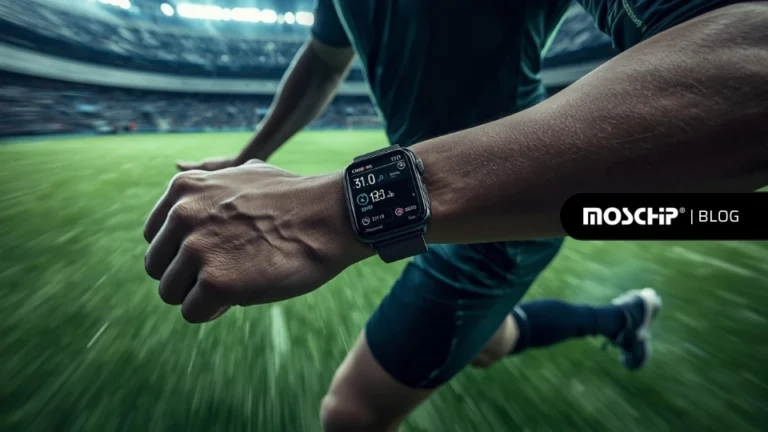
You are on mile 20 in a marathon; you have made good progress, but your body? Well, it’s feeling fatigued. Your strides are shortening. You are out of breath. You mask your fatigue with determination, and in that very moment, the line between peak performance and potential injury becomes dangerously thin. But you try to push through.
For decades, athletes have solely relied on instinct or feeling, experience, and post-run analytics to make sense of what they are experiencing during the run. And that is why athletes end up getting injured. And once you are injured, what follows is rehab and then coming back on track to achieve peak performance is even more challenging. Even with the wearable devices that you use daily often provide delayed alerts, and often track body vitals but it’s unable to interpret there is change in your physiological parametersWhat if your wearable didn’t just track your body vitals but understood it, adapted to it, and intervened at precisely the right moment? It would be a gamechanger, right?
Well, we are at the cusp of making that happen with the power of Agentic AI.
This shift from passive devices that just track health vitals and give you notifications to an intelligent systems or devices that are goal oriented, proactive, continuously learning, adaptive, trustworthy, that will anticipate and assist you intelligently.
Before we delve deeper into understanding how agentic AI helps in fitness and sports performance. Let’s take a quick look what Agentic AI is.
Agentic AI is AI systems that are designed to be coordinated, multi-layered frameworks that combine perception models, LLMs, decision logic, and execution layers that operate to achieve a goal. In an agentic AI setup, LLMs act as the reasoning and orchestration layer interpreting context, decomposing tasks, and coordinating actions across specialized models and system components.
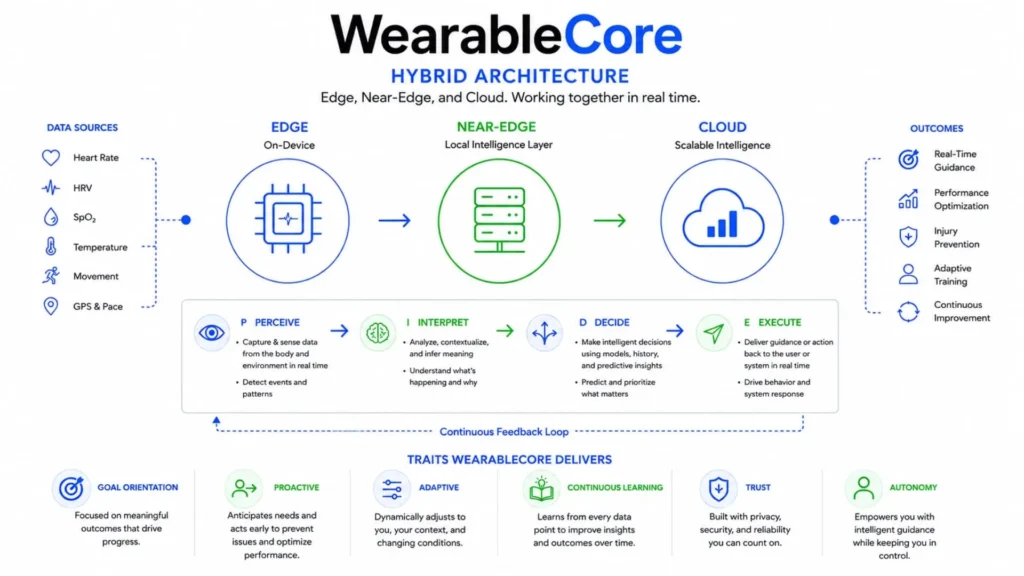
Agentic AI systems normally operate on a hybrid architecture- where you have edge, near-edge, and cloud layers. The critical tasks are run in the edge or near-edge layers and the cloud layer is used for higher-order reasoning, planning, and continuous learning. This is where your LLM layer resides. It operates with context, latency, and compute constraints, the system deploys the appropriate models to achieve the goal.
It operates on a closed loop framework where multimodal inputs are continuously processed, interpreted, and translated into real actions to assist the user.
The power of Agentic AI lies in combining the LLM layer for reasoning with edge-level execution, enabling systems to operate efficiently with precision.
However, building production-ready Agentic AI systems is a time-consuming task. It could easily take up to 12 to 18 months to deliver an Agentic AI system. Most product companies may not have that kind of time to deliver a product in the market. And that is where you can leverage solution accelerators to fast track your product development.
The main advantage is that solution accelerators help bring your innovations to life but at the same time reduce human efforts. Rather than building from scratch you get reusable components that can be fine-tuned to your use-case. So that reduces your development time by 40%, which leads to faster time-to-market.
MosChip AgenticSky is a suite of solution accelerators that is devised to develop futuristic devices, machines, and edge systems powered by Agentic AI. One of the suites of AgenticSky is WearableCore.
WearableCore is purpose-built for wearable devices, designed to transform continuous streams of physiological data into goal oriented actions. Instead of relying on static thresholds or post-activity analysis, it operates through a structured perceive–interpret–decide–engage (PIDE) loop. It captures signals, understands deviations from baseline, determining the right course of action, and delivering guided assistance to the user.
Instead of building the orchestration and decision layers from scratch, WearableCore provides you with reusable and reconfigurable components to build agentic intelligence for your wearable.
Now let’s pick up from where we left off. You are on mile 20 of a marathon and fatigue is setting in. But this is the future. Your wearable is no longer a passive device. It has transformed into an agentic device with the WearableCore. Now your wearable understands what’s happening, interprets it, decides what to do, and guides you to achieve the goal of completing the marathon without being injured.
Phase#1- Interpreting the Breakdown: As you hit the 20-mile mark, your physiological signals begin to shift. Your heartrate is beyond the sustained threshold. The stride efficiency starts to drop, and subtle signs of muscle fatigue begin to surface.
WearableCore doesn’t treat these physiological indicators in isolation, rather interprets it against the known patterns and understands this is unusual from usual exertion experienced by the user. It identifies it as early onset of performance breakdown. It distinguishes between controlled effort and unsustainable strain, understanding exactly where you stand in that moment.
Phase#2- Guiding Your Performance: As the strain continues, the system determines that continuing at the current pace will lead to rapid fatigue in the next few miles. Instead of waiting for performance to drop, WearableCore acts immediately.
A subtle haptic cue prompts you to ease your pace slightly, just enough to stabilize your efforts without losing momentum. At the same time, it guides your breathing rhythm to improve oxygen efficiency under stress. It evaluates multiple possible actions. Maintain pace and risk rapid fatigue, reduce effort to stabilize, or redistribute exertion. Based on your current condition and remaining distance, it determines that a controlled reduction in pace, combined with breathing stabilization, will preserve overall performance.
These are not generic prompts, but precise interventions designed to help you maintain forward progress without crossing into collapse. At this point, you are not thinking about what needs to be done and if I do that will it work or not. The system ensures that the right adjustment is made in time.
Phase#3- Preserving Biomechanical Integrity Under Fatigue: With the pace stabilized and problem mitigated, you continue deeper into the marathon. But then another problem arises. Prolonged load starts to alter how your body moves. Left stride shortens slightly, ground contact time becomes uneven, and a subtle imbalance begins to develop across his hips and knees. These are not signals you can consciously detect. To you, the effort feels consistent. But at a biomechanical level, movement efficiency is beginning to degrade.
WearableCore can be tuned to identify this shift by continuously comparing real-time motion data against the established movement patterns. It recognizes that this is not random variation, but a fatigue-induced deviation that can compound over the remaining miles. Left unaddressed, this imbalance could lead to localized strain, cramping, or even injury before the race ends.
At this point, the system moves beyond energy management into structural preservation. It interprets the deviation, evaluates its progression, and determines that corrective action is required to maintain movement integrity.
The response is precise. You receive a subtle, targeted cue to adjust your stride symmetry small enough to integrate naturally into your running rhythm, but significant enough to correct the imbalance. At the same time, the system helps to evenly distribute the load so that one side isn’t taking too much load.
Phase#4- Sustaining Performance Through the Final Stretch: You are on the last leg of the marathon; the system continues to guide you to finish strong. It continuously monitors your pace variability, heart rate drift, and breathing irregularities. The signals indicate whether you are pushing unevenly or losing efficiency. These factors are very important in the last leg of the marathon.
A subtle haptic cue nudges you to correct your pace, while gentle guidance helps stabilize your cadence and breathing. These micro-adjustments ensure that your effort remains controlled, preserving energy instead of wasting it in uneven bursts.
When the moment is right, and your effort stabilizes with enough reserve left, the system allows you to push. This is not a reckless surge. It is a controlled acceleration that helps you finish strong without risking a late-race collapse.
Now that the race is done, you will resume training in the next couple of days. It can be tuned to interpret your post-run physiological signals such as fatigue levels, recovery rate, and stress markers to determine how your body has responded. Based on this, it adjusts your next day’s training, reducing intensity if recovery is incomplete or maintaining load if your body is ready.
Instead of following a fixed plan, your training adapts to your actual condition, ensuring that recovery and performance remain aligned. Many athletes suffer from injury during training but with Agentic AI, recovery plans are tailored according to the condition.
That’s the power of Agentic AI. It works 24/7 and anticipates and assists users. Want to know more about WearableCore? Get in touch with us today.

Smishad Thomas is a Technical Marketing Manager at MosChip. He has over 13 years of experience in technology marketing, branding, and content leadership. He has a keen interest in product engineering and loves developing convincing stories that translates technical innovations into clear, engaging messaging that resonates with business audiences

Every day, new products are introduced to the market, and the pressure on companies to innovate quickly has never been greater…

MosChip’s AgenticSky helps OEMs move beyond “smart” by embedding agentic traits – autonomy, proactivity, adaptability, and trust – into every product…
Today’s wearables sense and notify while tomorrow’s wearables reason and adapt. Agentic AI enables a layered intelligence model where sensing, near-edge reasoning, and cloud-based agents work together to deliver proactive, personalized outcomes. This marks the transition from threshold-driven tracking to continuous, context-aware companionship…

Modern HVAC systems are more connected than ever. Sensors continuously monitor temperature…

Predictive maintenance is a key component of the Industrial Internet of Things (IIoT), shifting from reactive fixes and fixed schedules to proactive…

Integration of AI, cloud computing, and edge technologies is driving a new wave of innovation in industrial automation. While most…

Join us at India’s premier semiconductor ecosystem event – SEMICON India 2026 to explore our comprehensive...
How can manufacturers transform fragmented operational data into real-time intelligence...

Today’s consumer products respond after something has happened. Your wearable tells you your heart rate is elevated.…
The wearable technology industry has undergone a drastic transformation in recent times. Starting with basic…