

Accelerating AI-Powered Wearable Device Development with a Reusable Blueprint

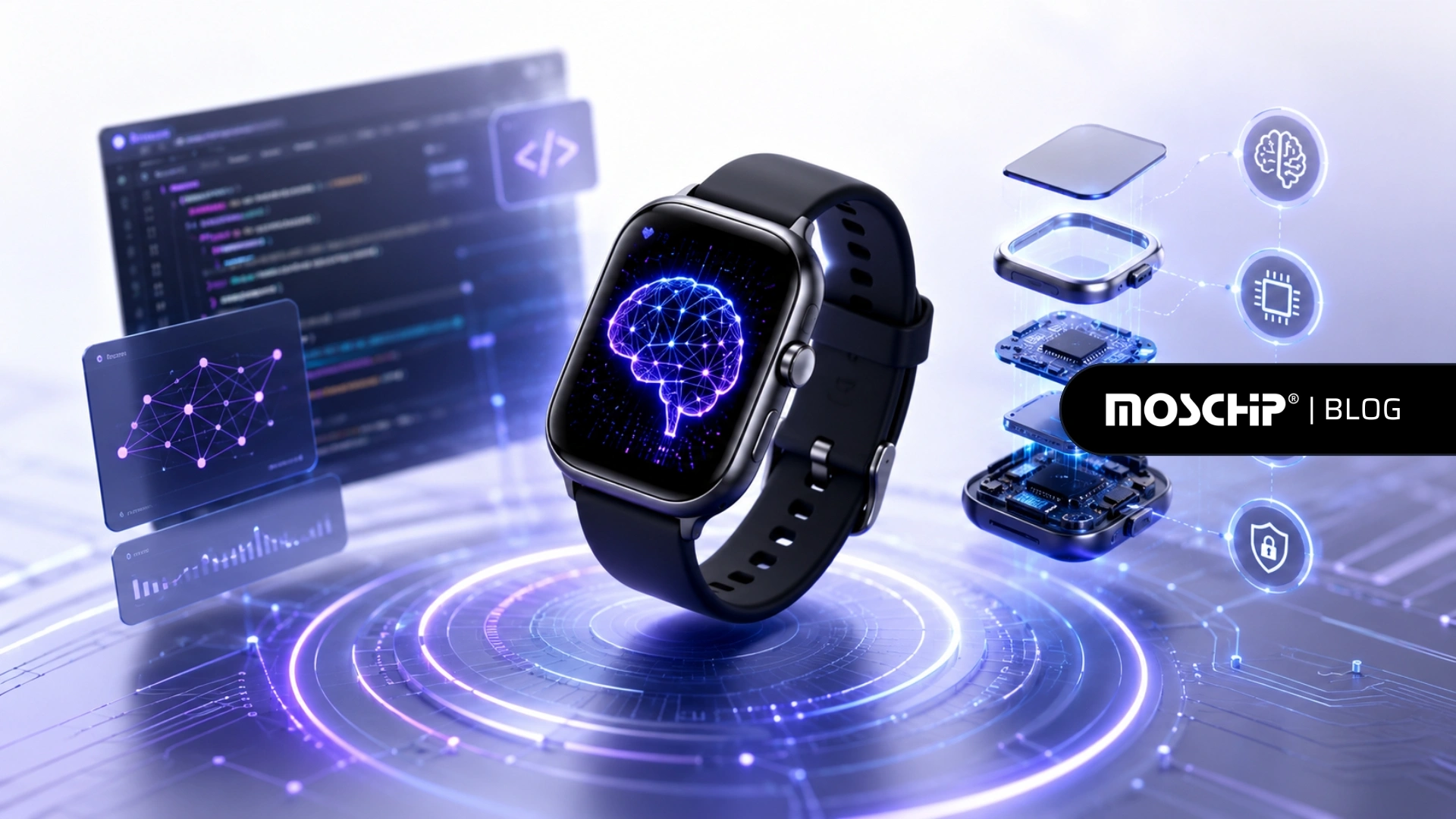
The wearable technology industry has undergone a drastic transformation in recent times. Starting with basic fitness monitors and health trackers, it has slowly but steadily grown into an advanced technological phenomenon. People now demand that wearables not only track health-related information but also offer more than traditional features.
There is a rising expectation among consumers for wearable technology that not only monitors health information but also offers personalized wellness advice, highlights areas of concern, suggests actions, and adapts to one’s needs in real time. This is true whether you want to improve your fitness levels, manage a health condition, recover from an illness, optimize your performance using Sportstech, or adopt a healthy lifestyle.
Moving forward, they will expect more of them.
Future wearable experiences will require devices that will be able to understand the context, predict the needs of the users, and operate independently instead of reacting to each user’s command.
Of course, all these expectations are forcing the wearables industry to rethink wearable device development in a new way.
Meeting such requirements requires much more than simply incorporating AI into the existing product. In today’s world, wearable device development is impossible without combining energy-efficient hardware, embedded software, wireless connectivity, cloud platforms, cybersecurity, lifecycle management, and AI into one ecosystem. Even more important, all these layers affect the end-user experience, which makes their integration an integral part of the product development process.
The problem is that all of this should happen in a battery-powered device.
People want real-time insights and constant health monitoring, but they do not want their batteries to go empty quickly. The truth is that today’s wearables must evolve from simply connected devices into intelligent ones that constantly understand the context and learn about users’ behavior.
Providing such features means performing increased amounts of data processing for sensors, more conventional AI computations, flawless coordination of all technologies used, and real-time response without lowering power efficiency, security, privacy, and reliability levels. This should all be done while fitting all the hardware needed, such as sensors, processors, antennas, battery management systems, and wireless technology, into light and comfortable designs.
The problem is compounded by the fact that every single technical choice will influence the whole wearable platform. Increased AI computations mean increased power consumption; increased sensor data gathering leads to better quality of insights but decreases battery life; and increased security measures require increased computational power as well.
Traditional development methods make achieving the proper balance even more challenging in wearable device development. Numerous engineering groups continue to recreate the same basic functionality from scratch for each wearable application before incorporating hardware, software, connectivity, cloud services, and AI. This strategy is certainly feasible now, but it is becoming increasingly difficult as wearables advance towards greater intelligence and autonomy. Rather than utilizing engineering resources to reinvent the basic functionality of platforms, OEMs require an engineering foundation that will speed up not only current wearables but also future iterations of wearables.
That is why today’s OEMs require engineering foundations that can consolidate the various building blocks required to build wearables in the modern age. Rather than trying to invent every technology stack for every new product offering, OEMs require a robust foundational base that will simplify the process of wearable device development without increasing engineering risks.
It is along such lines that the ProductXcelerate™ Blueprints by MosChip have been designed. These blueprints leverage pre-validated and reusable engineering foundations to enable OEMs to simplify development and accommodate future innovations in wearable devices and AI technologies.
The Wearable Companion Blueprint builds on this concept by applying it in health, wellness, and Sportstech use cases, enabling enterprises to develop connected, AI-driven, and intelligent wearables faster, better, and at scale, to develop the next generation of autonomous wearable solutions.
This is where the ProductXcelerate™ Wearable Companion Blueprint from MosChip comes in.
Instead of expecting engineers to design all parts from the ground up, the blueprint offers an engineering basis that is already pre-validated for developing next-generation AI-powered wearables in the health and wellness space. The blueprint can bring together all the ingredients necessary for designing, developing, connecting, and evolving smart wearable devices.
Instead of keeping the hardware, embedded software, connectivity, cloud platforms, and AI as separate engineering disciplines, the blueprint integrates them all into one engineering discipline: Hardware and Systems Engineering, Device Software Engineering, DigitalSky GenAIoT™, and AgenticSky™ (WearableCore).
Together, these domains ensure that the wearables can continuously track the activities of the user, communicate in a secure manner, derive context-based insights, and initiate proactive interaction with the users.
The diagram presented below shows the role that these engineering domains play in designing intelligent wearable companions.
While the blueprint clearly defines how the different fields of engineering fit together in creating the intelligent wearable, the true power of this is in its application to benefit OEMs.
OEMs will no longer have to invest months in integrating hardware, embedded software, connectivity, cloud capabilities, and artificial intelligence for each new product; rather, they can start off with a validated engineering base, wherein the core components of the solution are already well integrated. This will enable them to focus more on creating innovative functionalities instead of addressing platform-level engineering issues.
This, in turn, means that the Wearable Companion Blueprint can help OEMs address several typical engineering and business problems.
Here are some of the main benefits for business:
By simplifying the engineering process, fast-tracking development, and offering an AI future-proof solution, the Wearable Companion Blueprint enables OEMs to introduce new and innovative wearable products with greater ease, assurance, and scale.
MosChip provides ProductXcelerate™ Blueprints that represent pre-validated and production-ready engineering foundations for next-generation connected and intelligent products. With respect to health and wellness wearables, the Wearable Companion Blueprint combines hardware, embedded software, connectivity, cloud, automation, and AI-powered wearable intelligence in one solution to enable OEMs to develop always-on wellness solutions faster.
To know more about MosChip’s capabilities, drop us a line, and our team will get back to you.
The Wearable Companion Blueprint provides a reusable, pre–validated engineering foundation that simplifies wearable device development from concept to production. It brings together the essential building blocks across hardware, embedded software, connectivity, cloud, AI, companion applications, and lifecycle management into one integrated approach. Instead of developing these capabilities from scratch for every new product, engineering teams can reduce integration complexity, accelerate development, and focus on building differentiated wearable experiences. The blueprint also provides the flexibility to support a wide range of use cases, from today’s connected health and fitness devices to the next generation of intelligent, AI-powered, and autonomous wearables.
Yes. The blueprint is designed as a flexible foundation that can be adapted for a wide range of wearable products, including health and wellness devices, fitness trackers, smartwatches, medical wearables, and future AI-powered wearable applications. This enables OEMs to develop multiple product variants on a common engineering platform rather than rebuilding the underlying technology stack for every new device.
AgenticSky WearableCore adds Agentic AI capabilities by enabling wearables to understand context, reason over multiple data sources, assist in making intelligent decisions, and adapt to their behavior. Instead of detecting an incident, it can anticipate and assist before an incident occurs.
The blueprint reduces engineering risk by providing pre-validated, reusable building blocks across the wearable technology stack. By minimizing repeated component development and simplifying integration between hardware, software, connectivity, cloud, and AI, engineering teams can reduce development effort, improve system reliability, accelerate validation, and bring wearable products to market with greater confidence.

Darshil is a Marketing professional at MosChip creating impactful techno-commercial writeups and conducting extensive market research to promote businesses on various platforms. He has been a passionate marketer for more than four years and is constantly looking for new endeavors to take on. When He’s not working, Darshil can be found reading and playing guitar.
Across manufacturing plants, automation systems have changed and demand higher visibility, faster data exchange, and simpler integration…
In the age of connected devices, where time-to-market and seamless user experience define product success, engineering is no longer…
On a hot summer day in Austin, 72-year-old Arthur is working in the garden. After a while, he starts feeling uneasy as he has been..

Retail success ultimately comes down to customer experience. Today’s customers expect a fast, seamless…

Most AI systems today are still built with a familiar mindset. Train a model, deploy it on the infrastructure and optimize…

The path for a product doesn’t stop once it is ready to be launched. Whether it is a semiconductor powering a mission-critical…
Join us at India’s premier semiconductor ecosystem event – SEMICON India 2026 to explore our comprehensive...

FPGA products are no longer just about getting the RTL right. Building a production-ready FPGA platform...

Today’s consumer products respond after something has happened. Your wearable tells you your heart rate is elevated.…

AI hardware has developed fast. Every new product comes with promises of more power, bigger memory, or better energy use...