

Enabling Wearable Development from Hardware to AI
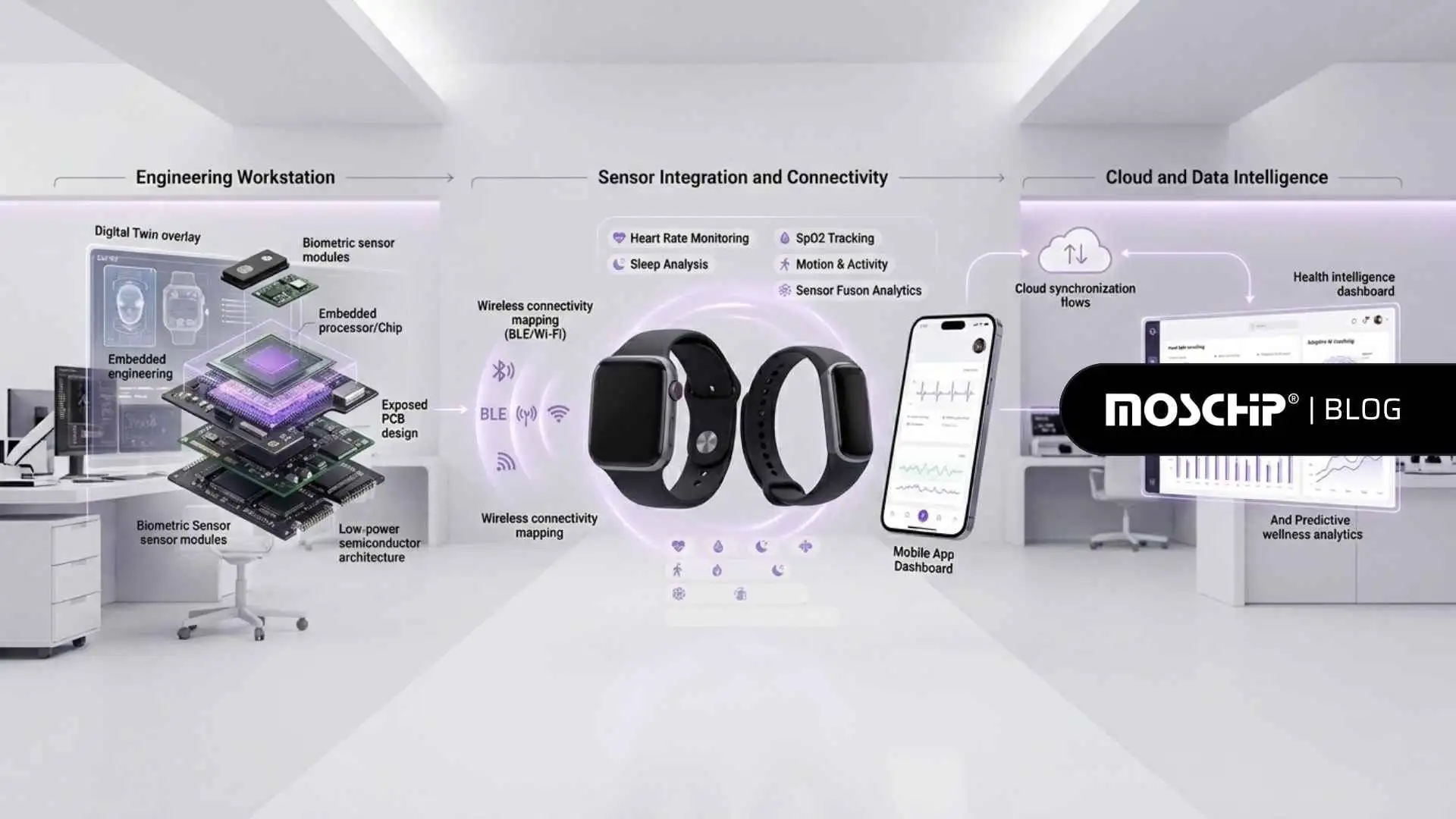
The next generation of wearables will not be defined by sensors, battery life or connectivity. Those are solved problems. Wearables that we use still operate as data collectors. They capture the data and sync it to the cloud.
In the future, wearables will be defined by how they perceive, interpret, decide, and engage to reach the goals assigned to them. This will also call for a change in the approach to modern wearable development.
Conventional wearable development follows a standard sequential model, where each aspect is built one after the other. The architectures were built around a relatively simple flow:
Sense → Sync → Analyze
However, this approach may not work in the future. You may ask why?
The answer is very simple. The wearables of future will be driven by Agentic AI. The nature of Agentic AI is that it continuously percieves signals 24/7, and continuously learns about the user to achieve the set goals. This means that the wearables of the future are built to anticipate events and assist the user to make decisions, unlike its predecessors.
Moreover, Agentic AI operates on a hybrid architecture – where you have edge, near-edge, and cloud layers. As a result, wearable development is no longer about integrating sensors. It is about coordinated engineering approach towards developing a product where intelligence is woven into the experience, in such a way that it’s almost invisible. What it becomes is:
In an Agentic AI system, all the layers are interdependent. For example, hardware decisions directly affect AI performance. Sensor fidelity, sampling rates, power budgets, and local compute capabilities determine whether real-time inference is even possible. Similarly, embedded software can no longer operate only as a control layer. It must function as the first perception layer of the intelligence system.
This is where traditional sequential development begins to fail.
Well, I would say that if you are new to the development of Agentic AI-driven wearables then it is best to go with a blueprint that is readily available, which will help you develop a actionable prototype faster.
MosChip ProductXcelerate Blueprints is one such solution accelerator that provides pre-validated components that will help you build the product up to 40% faster. ProductXcelerate Blueprints provide a pre-aligned engineering foundation spanning:
Instead of treating hardware, software, cloud, and AI as separate workstreams, the blueprint aligns them into a unified operational model from the beginning.
This allows teams to focus less on infrastructure integration and more on building differentiated wearable experiences.
Agentic AI- based wearable development is more than just compact sensors and low-power electronics. The real challenge lies in building a hardware foundation capable of supporting continuous intelligence across edge, near-edge, and cloud environments.
Traditional wearable architectures were primarily designed around signal acquisition and synchronization. Compute was minimal, with most intelligence pushed to smartphones or cloud platforms. However, Agentic AI changes the game completely.
Real-time interpretation, adaptive decision-making, and continuous orchestration require a significantly stronger compute-aware architecture at the device layer itself.
This introduces new hardware requirements across:
These capabilities directly affect how effectively the wearable can support real-time intelligence. For example, embedded compute and edge acceleration determine whether inference can occur locally with low latency, while power-efficient architectures ensure continuous operation within wearable constraints.
Similarly, memory optimization and compute-layer communication become critical as workloads dynamically move between device, near-edge, and cloud environments.
As a result, selecting the right hardware foundation is no longer just a device engineering decision. It becomes a system-level decision that determines how effectively the wearable can support continuous intelligence and adaptive behavior in real time.
In Agentic wearables, software becomes the first operational layer of intelligence.
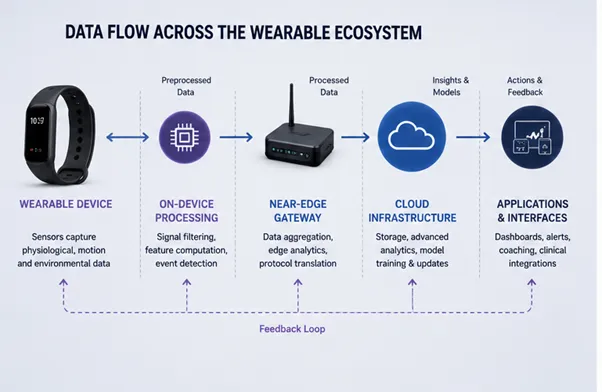
Physiological and motion data generated from wearable sensors must be filtered, synchronized, conditioned, and managed before being transmitted across device, near-edge, and cloud environments. This requires embedded software capable of supporting:
As wearable systems increasingly support real-time inference and adaptive behavior, embedded software can no longer operate only as a device control layer. Hardware and software must evolve together to ensure continuous data reliability, low-latency execution, and operational stability across the wearable system.
An essential part of Agentic AI-based wearable development is the digital infrastructure that connects the devices to various entities in the ecosystem like smartphones, near-edge gateways, cloud platforms, and distributed AI systems.
As wearables evolve into continuous decision systems, maintaining synchronization across these environments becomes critical. Physiological signals, contextual inputs, inference outputs, device states, and behavioral data must move continuously across the ecosystem while preserving low latency and operational consistency.
This makes the digital layer a core part of wearable development itself. Data pipelines, connectivity, onboarding systems, OTA infrastructure, distributed inference workflows, and real-time synchronization mechanisms must all operate as a unified system from the beginning.
Near-edge gateways play an important role within this architecture by supporting intermediate processing, reducing dependency on cloud latency, coordinating workloads across distributed environments, and enabling faster real-time interaction between wearable devices and AI systems.
MosChip DigitalSky GenAIoT provides this connected digital foundation by providing pre-built components for connectivity and device management.
Inference workloads increasingly execute closer to the wearable to support the decision layer.
As wearable architectures become more context-aware, AI layers must support more than prediction and analytics. Agentic AI introduces reasoning and decision-making capabilities that allow the system to evaluate contextual inputs, determine the next best action, and coordinate adaptive responses in real time.
At the AI layer, MosChip AgenticSky provides pre-built agentic WearableCore that can be fine-tuned to meet your use case.
Together, this agentic layer enables wearable systems to operate as continuous real-time intelligence architectures rather than isolated monitoring devices.
To know more about how MosChip can help with Agentic AI wearable development, please get in touch with us.

Smishad Thomas is a Technical Marketing Manager at MosChip. He has over 13 years of experience in technology marketing, branding, and content leadership. He has a keen interest in product engineering and loves developing convincing stories that translates technical innovations into clear, engaging messaging that resonates with business audiences
As the automotive industry is emerging with Software-Defined Vehicles (SDVs) and autonomous vehicles, Advanced Driver Assistance Systems (ADAS) are encountering serious challenges day by day…

For over a decade, ADAS has continually evolved with its focus on improving perception…

MosChip’s AgenticSky helps OEMs move beyond “smart” by embedding agentic traits – autonomy, proactivity, adaptability, and trust – into every product…

Checkout counters have evolved from mechanical cash registers to barcode scanners and then to self-service kiosks…

Launching a product is a significant achievement, but once the product is launched, there are several challenges that companies must face, such as…
Today, almost every OEM is racing to bring intelligent, AI-enabled products to the market across automotive, industrial…
Join us at India’s premier semiconductor ecosystem event – SEMICON India 2026 to explore our comprehensive...
How can manufacturers transform fragmented operational data into real-time intelligence...

Today’s consumer products respond after something has happened. Your wearable tells you your heart rate is elevated.…
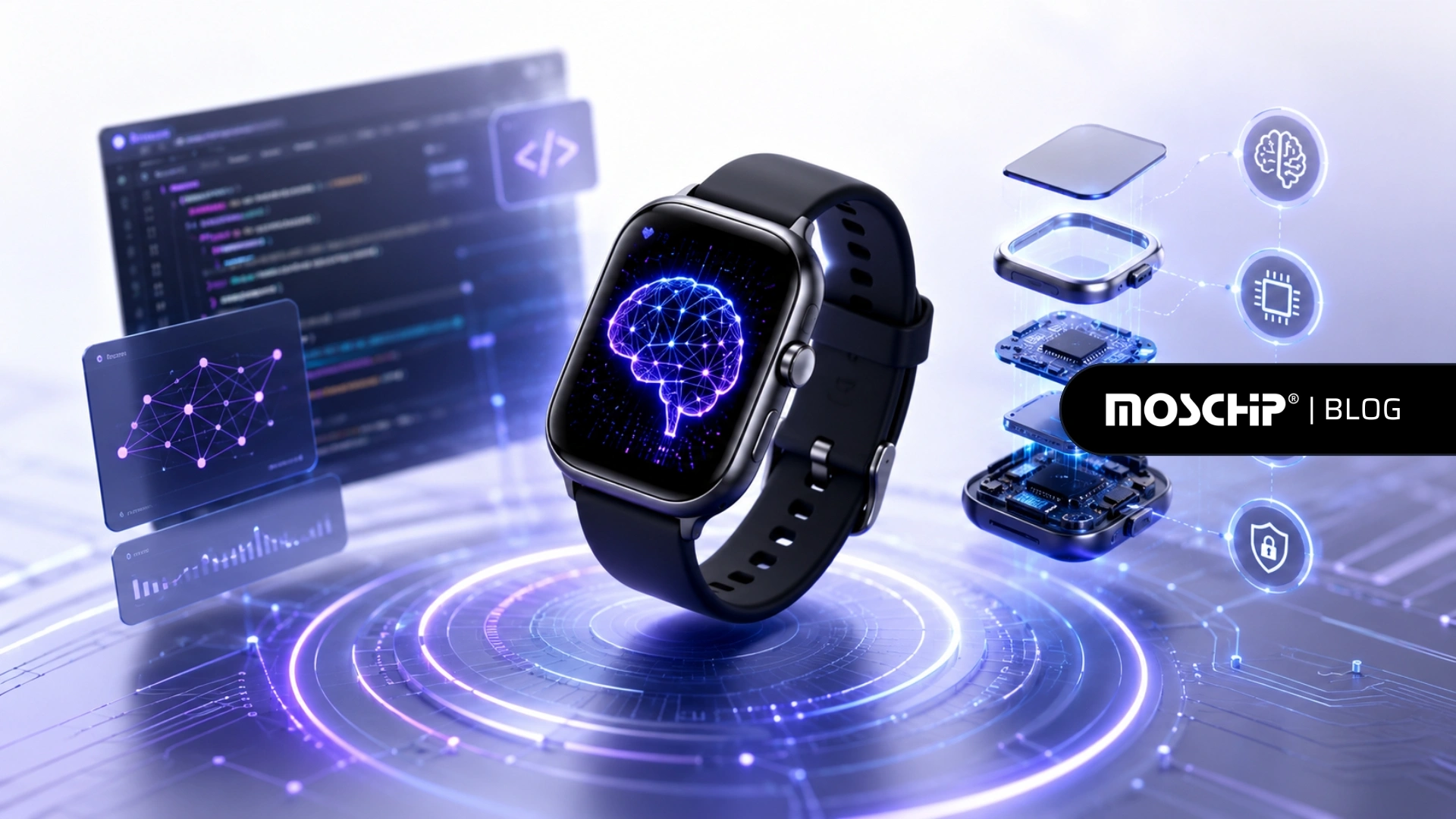
The wearable technology industry has undergone a drastic transformation in recent times. Starting with basic…