

Edge AI-Driven Matter Controller for Next-Generation Smart Homes

The smart home world is changing quickly. The Matter standard is reshaping how connected devices work together, and true interoperability across different ecosystems is finally within reach. Platforms are improving at local automation, and edge AI is slowly entering the picture. But a fully integrated, offline voice-to-action pipeline running natively inside a Matter controller remains largely unexplored in real production environments.
In our previous blog on the Matter Ecosystem, we walked through the core architecture and principles behind the standard. This blog builds on that foundation. It walks through our journey of building Edge AI into a Matter-based smart home system, what we ran into along the way, how we approached the architecture, and what shaped our decisions throughout.
Edge AI moves intelligence directly onto the device, whether a smartphone, a hub, or an embedded platform, removing cloud dependency entirely. That sounds straightforward, but it is not.
Edge devices have hard memory limits, compute, and power, making large models simply not viable. This pushes teams toward lightweight, optimized models that often blend quantization with hybrid approaches that combine rule-based logic and AI.
Platform-level constraints around lifecycle management, audio handling, threading, and memory control add another layer of complexity that directly affects how stable the whole system runs.
Within a Matter-based smart home, Edge AI can show up at different layers depending on how the system is designed and who is making the decisions:
At MosChip, we have built a complete end-to-end Matter smart home ecosystem from the ground up. It includes a custom Android controller application, Matter-enabled devices, and a bridge (for non-Matter products) that ties everything together as one unified platform. The intelligence sits at the controller level, keeping the system practical, scalable, and easy to manage.
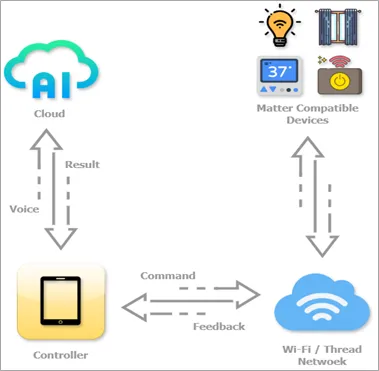
Many smart home implementations are still somewhat inconsistent. They divide the voice processing, reasoning, and device controls into separate layers of implementation.
Historically, smart home voice pipelines have followed this sequence:
Voice → Cloud → Processing → Controller → Device
These layers introduce:
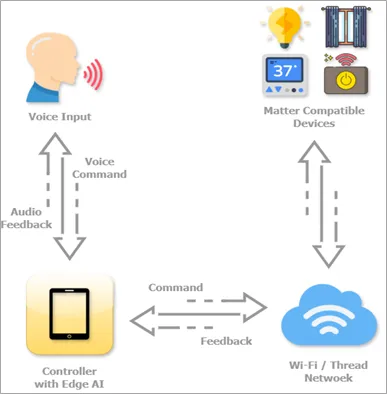
MosChip’s Edge AI solution is built directly into an Android–based Matter controller, pushing all intelligence to the edge and enabling immediate direct interaction with Matter devices.
Inside the Matter ecosystem, this translates to:
Running Edge AI on mobile platforms is not straightforward. Android devices operate under tight resource and lifecycle constraints that server environments simply do not have.
Mobile apps are always competing for limited system RAM. When model sizes push against that ceiling, application stability takes a hit, and the risk of the system terminating the app goes up significantly.
Running continuous voice processing that covers both wake word detection and automatic speech recognition is CPU-heavy by nature. It needs efficient threading and smart scheduling to stay manageable.
Apps switching between foreground and background, combined with system reclaim events and platform-imposed background execution limits, make resource management genuinely difficult to get right.
Low-latency audio pipelines need tight synchronization between speech recognition and text-to-speech components. Without it, the user experience breaks down quickly.
We built our Matter Controller Android App on a solid and scalable architectural foundation.
The application is built on an MVVM-based clean architecture that keeps a clear separation between the UI, business logic, data layers, and Matter openSDK. Leveraging a reactive approach with State-Flow, the UI remains consistently synchronized with underlying state changes while maintaining a clean and maintainable codebase.
The system is organized into well-defined modular components covering voice processing for wake word detection and speech recognition, Edge AI inference, Matter device control, and the UI layer. Each component can be developed and updated independently without touching the rest of the system.
The Matter ecosystem is built on open standards, and this approach leans fully into that by building directly on the open-source Matter SDK. Matter itself moves quickly, with multiple releases every year bringing in new device types, features, and capabilities. Building on top of the SDK keeps the system aligned with those changes while making sure interoperability and long-term scalability are never compromised.
To keep development from getting unnecessarily complicated, complex protocol interactions get wrapped into reusable SDK layers. The low-level details stay buried underneath where they belong, and developers get clean, straightforward interfaces for controlling devices and managing workflows inside the application. Rather than getting tangled up in protocol complexity, app developers can put their energy into building features and experiences that users notice.
Taken together, this architecture makes scaling genuinely straightforward. New Matter-certified devices, UI components, and device operations can be brought in with minimal disruption to existing code. Introducing edge-driven behaviors and picking up new Matter features as they land becomes much less painful as well.
The result is a setup where teams can move faster, test components on their own, and plug in AI capabilities without rebuilding everything around them, keeping the system flexible as Edge AI requirements keep evolving.
The intelligence lives inside the controller itself, making the entire pipeline from voice input to device action happen locally. Rather than spreading processing across external services, the system picks up a command, figures out what it means, and triggers the right device action all on the device itself.
By bringing speech processing, contextual understanding, and inference together inside a single runtime, the controller handles both straightforward commands and more flexible inputs without ever needing to reach out to the cloud. That unified approach cuts down system fragmentation and keeps every interaction direct, predictable, and secure.
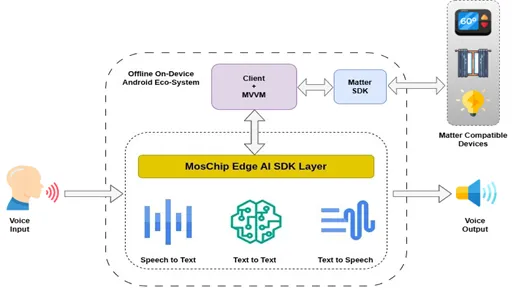
The way we built this is around a tightly coordinated on-device execution pipeline, backed by a dedicated Edge AI SDK layer that holds everything together.
This is a purpose-built Edge AI SDK designed specifically for mobile and embedded platforms. It gives developers a unified interface and a standardized set of APIs to access on-device AI capabilities, including Speech-to-Text (STT), Text-to-Text (TTT), Text-to-Speech (TTS), Large Language Model (LLM) inference, and broader Natural Language Processing (NLP) functions.
Rather than leaving developers to wrestle with the complexity of underlying AI models, the SDK handles all of that in the background. Integration stays clean, and deployment across different devices becomes far less painful. It also picks the right model based on what the hardware can actually handle, so performance does not take a hit just because the device is less powerful.
By cutting out dependencies on platform-specific services, the SDK can be deployed on non-Google mobile and embedded boards, which opens significantly more flexibility and portability across different environments.
The Edge AI Layer consists of the following components.
The system runs an always-on, low-power wake-word engine that listens for a set trigger phrase. It only activates the pipeline when that phrase is detected, keeping unnecessary processing to a minimum while staying fully responsive.
When speech recognition initiates, on-device ASR will turn speech into text. Then, a grammar filtering layer validates the sources to determine the validity of an input and restricts the allowed or valid sources from the filter list, thereby reducing ambiguity and eliminating any additional processing resource requirements.
Commands are handled first through deterministic logic for speed and reliability. When that is not enough, an optional AI fallback powered through the SDK steps in to interpret more complex or flexible inputs, keeping performance and adaptability in balance.
Once a command is validated, it executes instantly through the local Matter controller, talking directly to device clusters. This makes voice-based control work seamlessly across devices from different vendors and allows coordinated commands to run across multiple clusters at the same time.
At its core, the Edge AI SDK is built for performance. Here is what drives it:
Voice processing, AI inference, and device control are handled on optimized threads to avoid blocking the main UI. This ensures smooth execution while maintaining responsiveness across concurrent operations.
The deterministic command validation layer is a filtering layer positioned prior to invoking the AI engine. Therefore, only valid commands will be executed, thus preventing excessive model invocation/updating (and therefore reducing the CPU overhead), and only valid commands will be processed.
Every component is carefully managed around the application lifecycle. Audio streams, threads, and AI resources are properly released or reset at the right moments to avoid memory leaks, crashes, and inconsistent system states.
The end-to-end flow, including wake word detection and device action, has been designed to minimize latency (approximately 8-10 seconds), allowing very fast response times with little or no noticeable lag and maintaining a high level of reliability.
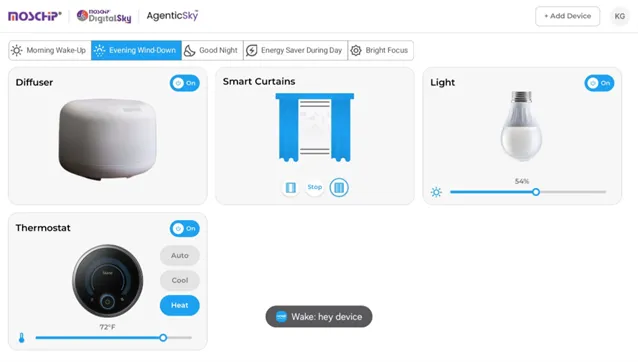
The MosChip Android Matter Controller does more than just control devices. It acts as an intelligent orchestration layer that ties the entire smart home together.
It enables:
Put interoperability and embedded intelligence together, and what you get is a smart home experience that is more responsive, more private, and genuinely built for what comes next.
Edge AI marks a real shift in how smart home systems are built, bringing intelligence closer to where the user is. MosChip brings expertise across device software engineering, digital, and AI to build truly intelligent, smart home ecosystems powered by Matter. We have worked on Matter enablement for devices, hubs, and bridges (designed to connect non-Matter products) solutions. Our experience extends to enabling ecosystems for smart lighting, consumer robots, HVAC systems, garage doors, automated blinds/curtains, and appliances across multi-protocol connected environments.
To know more, drop us a line, and we will get in touch with you.

Sanmesh is a software developer specializing in Edge AI, Smart Home technologies, and connected IoT ecosystems. He has experience in mobile development technologies such as Android, iOS, Flutter, Kotlin, Java, and Firebase. He develops smart applications that bridge mobile platforms, embedded systems, and real-time device communication. He has contributed to Edge AI Powered Smart Home Solution using Matter with voice-based intelligentss control, along with Wearable Healthcare and sensor-based platforms. Throughout his work, he focuses on performance, scalability, seamless user experience, and adaptive resource management for power optimization. Sanmesh continuously explored innovative ways to build smarter and more efficient digital ecosystems while chasing his passion for AI, IoT, and modern connected technologies.
In today’s fast-paced silicon industry, hardware design is under constant pressure to innovate, iterate, and ship faster…
For several years, industries have used traditional AI/ML systems that could classify, predict, and automate, but only with the limits of the data they were taught…
Wireless audio did not change overnight. Progress focused on better codecs, lower power use, and smaller devices…

Deep learning is witnessing a growing history of success, however, the large/heavy models that must be run on a high-performance…

Owing to revolutionary developments in computer architecture and ground-breaking advances in AI & machine learning applications, embedded systems technology is…

In contrast to traditional mass media, such as printed material or audio recordings, which feature little to no interaction between…
How can manufacturers transform fragmented operational data into real-time intelligence...

Industrial machines are evolving from systems that simply report their status to system…

The demand for high-bandwidth communication is increasing…