

How Can Agentic AI Wearables Enable Proactive Health Monitoring and Elderly Care?
On a hot summer day in Austin, 72-year-old Arthur is working in the garden. After a while, he starts feeling uneasy as he has been outside since morning.
He feels physically weaker than what he usually does, and his work is going slowly compared to before. He decides to pause and sit. Arthur thinks that it may be due to the weather or because of his age.
Meanwhile, his tracker is monitoring all of this silently.
His heart rate is high, but it has not breached the threshold to activate an alert. His movement pattern is also a little bit different from how it usually is. Each of these is nothing to worry about by itself. Together, however, they tell a different story.
This highlights a limitation of traditional health monitoring. Wearables collect physiological and activity data and trigger alerts when predefined thresholds are breached. But changes in the human body do not always appear through a single metric. Sometimes, the real insight lies in understanding the relationship between physiology, movement, personal baseline, and environment.
In the United States, around 14 million older people, out of every four people, are reported to fall each year. Small changes in gait, balance, or activity may have occurred prior to the fall, but they may not be substantial enough individually to raise any sort of alarm. (Source: CDC, Older Adult Falls Data)
Arthur’s wearable already has access to this data. But does it understand what the data means?
The same challenge applies to athletes, where precise changes can signal fatigue or performance decline before an alert is triggered. The question is no longer whether a wearable can detect these changes, but whether it can understand what they mean and know when to act.
What if a wearable could understand these changes, interpret the context, and assist before an event could occur?
This is where Agentic AI comes in, moving wearables from passive monitoring toward systems that can anticipate and assist.
Before exploring its impact on continuous health monitoring, let us understand what sets Agentic AI wearables apart.
As we see, Arthur’s wearables already have access to a constant stream of incoming data from the body and the surroundings. The problem is what happens after those signals are collected.
Traditional wearables usually process each part of the data separately, generate a metric, and initiate an alarm signal once a set condition is met. However, Agentic AI wearables move this approach from simply identifying the shifts that happen to interpreting their contextual meaning and reasoning with the right response.
If we say it in simple words, traditional wearables just ask:
“Is a metric above a certain threshold?”
Whereas futuristic wearables, which have their own brain to understand and predict situations with decision-making ability, will simply state:
“What happened in a particular condition & what needs to happen next?”
And this is where the futuristic wearable products begin to take shape with MosChip’s AgenticSky WearableCore.
Building a true Agentic AI wearable in real-time situations is more than just adding a simple AI layer to wearables.
Developers need to develop the reasoning, orchestration, and execution layers properly, which allow devices to constantly understand various changing conditions and suggest what to do next. This enables developers to use these capabilities without designing from scratch, reducing development time and engineering effort.
This is where MosChip’s AgenticSky suite comes in. It is a solution accelerator suite designed to help OEMs to build Agentic-AI-powered products faster. Within this suite, WearableCore is a domain-specific accelerator that is designed for wearable products, which transforms continuous physiological data and signals into goal-oriented actions.
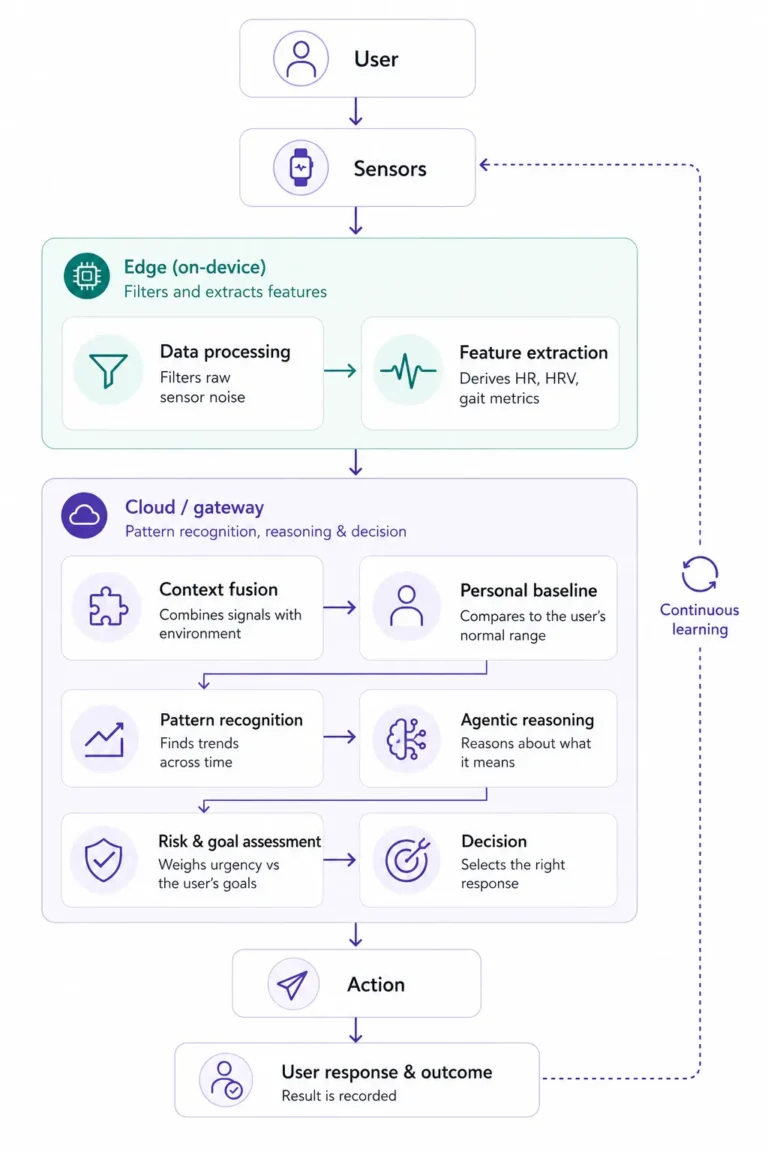
WearableCore takes things to the next level by using the Perceive–Interpret–Decide–Engage (PIDE) framework instead of simply working with a fixed point, as well as getting involved in post-activity assessment.
In this way, the wearable processes physiological signals, identifies significant variations when compared to the user’s baseline, makes sense of the circumstances, finds the right response, and delivers help on its own.
WearableCore also provides reusable and reconfigurable building blocks, minimizing the need to design complex orchestration and decision-making layers from scratch. This helps OEMs to reduce rework efforts and accelerate their futuristic wearable development time by 40%.
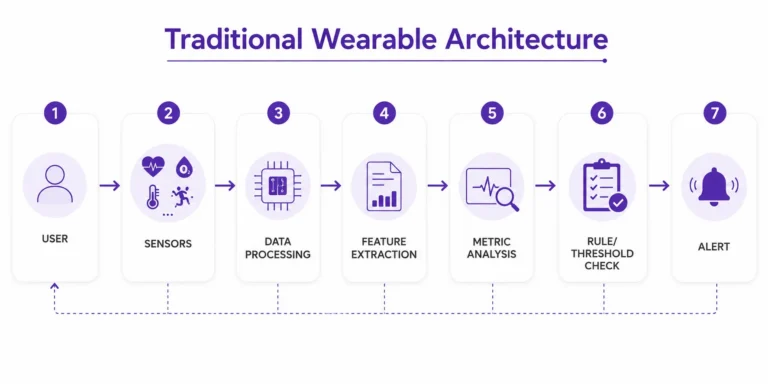
User → Sensors → Data Processing → Feature Extraction → Metric Analysis → Rule/Threshold Check → Alert
This is when the story starts.
Now let’s come to where we left off last.
Let’s look at Arthur’s situation again, but in the future. Wearables are passive devices.
This time, Arthur is using the Agentic AI wearable based on WearableCore, which understands and interprets the situation, decides on the further steps to be taken, and provides situational guidance and assistance.
Arthur keeps working in the heat. Meanwhile, his wearable continuously collects multiple signals such as heart rate behavior, HRV, movement, gait characteristics, activity level, and temperature, or environmental context if it is available.
And that’s not some abstract advantage that HRV tracking might have; that’s something that has been demonstrated in real life.
Apple’s Heart Study stated that wearables can spot heart rate variability patterns.
These patterns can detect COVID-19 up to seven days before symptoms appear. US Govt claims: “Wireless Heart Rate Variability in Assessing Community COVID-19.” That’s just an example of what WearableCore aims to do with Arthur. It decodes HRV and heart rate data before an alarm triggers. (Source: NCBI/PMC)
Instead of just analyzing each signal independently, WearableCore integrates different signals to understand the bigger picture. It looks at the current pattern and Arthur’s baseline and shows the changes in his condition in real-time.
For example, simple shifts in heart rate may be because he is continuously working or due to his age. But if that higher heart rate is because he’s constantly exposed to heat, his movements change, even his gait becomes different, and his behavior moves away from his normal pattern. This is where WearableCore detects that these signals are correlated.
Specifically, gait is an immensely more revealing indicator than we realize.
The study has created a fall risk classifier based solely on gait measurements in a walk test and achieved 81.6% accuracy for those who will have a fall in the future. This suggests that gait is a sufficiently revealing indicator even without any additional measurements. (Source: Scientific Reports, Prediction of fall risk among community-dwelling older adults using a wearable system)
WearableCore doesn’t simply wait for a single metric to cross a fixed threshold but understands that this signal combination change might develop into a serious health risk and raises an alert for urgent attention before the situation gets worse.
For OEMs, Agentic AI wearables are not just adding an intelligent layer on existing wearables or just adding another health-measuring parameter. The real value is enabling the wearable to understand the relationship between continuous physiological signals, user baseline, activity, and environmental context to anticipate what should happen next.
So, the next natural question is:
What does Arthur need now?
Since WearableCore understands the changes developed and believes it must pay attention to the ongoing trend. The next step now is to find out what Arthur needs.
This system can silently monitor the situation, give a warning message, immediately interrupt Arthur or provide him with a slight intervention, and eventually involve someone if required.
WearableCore analyzes the possibilities in relation to pre-defined goals of the product, also its policies and safety standards. The aim is not to make a noisy alert system but to choose the most relevant intervention for the situation.
For Arthur’s case, the decision process begins with an initial haptic signal and an order to pause, take a break, and get away from the heat. If the issue continues, the system can adapt its response and escalate it properly.
The system already detected the changes that happened in real-time. The next phase is deciding whether such a change demands any actions, what kind of actions should be performed, and when they should occur.
For OEMs, wearables have changed their phase from reactive to proactive; instead of simply informing that something has changed, they start to adapt what response to deliver. What should happen next?
And once that decision is made, the next step is to assist Arthur through the situation, rather than simply flagging it.
Once WearableCore figures out what should happen next, Arthur gets an alert or prompt on the wearable that is appropriate based on the situation. Instead of confusing him with the view of a complex dashboard with multiple psychological metrics, the information is transformed in a simple and understandable manner through the available device interface.
So, Arthur receives clear, straightforward information about what to do next.
If Arthur follows the instructions and his signals return to normal, the product can step down. It can go back to continuous monitoring mode. However, if the worrying trend continues, the product could be configured to engage in an escalation process.
For OEMs, this is a closed-loop approach of
Understand → Guide → Observe → React again,
rather than the traditional way of,
Detect → Inform/Notify → Stop, as is done at present.
It’s here that Assist gets shown through the experience, with fewer alerts, contextual coaching, assistive help, and role-based interactions.
Also, this intelligence helps Arthur manage health issue can also help him with another completely different objective: Athletic Performance.
Arthur’s experience has changed, but how has his experience been changed within the wearable?
This is the area where we need to understand what kind of internal changes happened inside the wearable. WearableCore provides the intelligent capability that ties together the sensing, processing, and AI functionalities to create a continuous decision-making process.
OEMs can integrate WearableCore into their existing wearable product lines, without requiring a redesign of the overall architecture of the product. WearableCore uses a hybrid architecture, in which inferences can be shared on the edge, gateway, and/or cloud based on the needs of the product.
This allows the wearable to become a system that makes continuous connections between signals, context, decisions, and outcomes. Important decisions can remain on the wearable, while capabilities that require more processing and a longitudinal view can be handled by the gateway and/or cloud resources.
From the OEM point of view, the potential is to extend their current wearable products with intelligent capabilities without having to develop an intelligence architecture for each individual product.
MosChip developed the AgenticSky WearableCore suite to enable OEMs to develop futuristic wearable devices. This helps OEMs to build intelligent wearables that anticipate potential risks and provide timely alerts to caretakers or family members before issues occur.
Checkout how Agentic AI wearables are working in Sportstech here: Agentic AI WearableCore for Smarter Fitness and Performance
To know more about MosChip’s capabilities, drop us a line, and our team will get back to you.
Traditional wearables primarily collect physiological data and generate alerts when predefined thresholds are crossed. Agentic AI wearables go a step further by understanding context, correlating multiple signals, anticipating potential health risks, and determining the most appropriate action before an incident occurs. Through continuous learning from user behavior, physiological patterns, and historical trends, they become more personalized over time and can proactively assist users with timely guidance rather than simply notifying them about changes.
WearableCore uses a Perceive–Interpret–Decide–Engage (PIDE) approach to continuously analyze physiological signals, user baselines, activity patterns, and environmental context. Instead of reacting only when a threshold is breached, it anticipates potential risks by identifying meaningful condition changes and evolving trends. Through continuous learning, WearableCore develops a deeper understanding of the individual user, enabling more personalized insights, proactive interventions, and contextual assistance that can help prevent health incidents before they escalate.
Yes. While WearableCore supports proactive health monitoring and elderly care, the same intelligence can also be applied to fitness, wellness, SportsTech, rehabilitation, and performance optimization use cases. OEMs can tailor experiences for different user personas without rebuilding the underlying intelligence framework.
WearableCore provides reusable and configurable building blocks for context interpretation, decision-making, orchestration, and user engagement. This reduces the need to develop complex agentic AI capabilities from scratch, helping OEMs shorten development cycles, minimize engineering effort, and bring intelligent wearable products to market faster.

Darshil is a Marketing professional at MosChip creating impactful techno-commercial writeups and conducting extensive market research to promote businesses on various platforms. He has been a passionate marketer for more than four years and is constantly looking for new endeavors to take on. When He’s not working, Darshil can be found reading and playing guitar.

Smart home automation has transformed from a niche market into a mainstream phenomenon, enhancing convenience, energy efficiency, and security in…

Every product begins with an idea, a vision to solve a problem or create something valuable…

Deep learning is witnessing a growing history of success, however, the large/heavy models that must be run on a high-performance…
The increasing demand for sustainable energy management has prompted governments, electricity boards, discoms, and industries worldwide to embrace smarter solutions…

Machine Learning based facial recognition is a method of utilizing the face to identify or confirm one’s identity. Persons can…

Factory floors today are generating more operational data than ever before. From CNC machines…
Android has evolved beyond an operating system into a foundation for building connected, intelligent...

FPGA products are no longer just about getting the RTL right. Building a production-ready FPGA platform...

Today’s consumer products respond after something has happened. Your wearable tells you your heart rate is elevated.…
Designing an FPGA-based product can look straightforward when working within the FPGA development environment…