

Asset Lifecycle Management at the Edge
There is an increase in the amount of operational data that is being produced by factory floors now. This is happening as a result of data generation by all the equipment that we use today, ranging from CNC machines and industrial robots to compressors, pumps, motors, HVAC, and assembly lines.
The goal of increasing efficiency and uptime of factories while simultaneously decreasing the cost of maintenance is no longer met just by collecting the data but by how fast the data can be analyzed.
In several industrial situations, some of these decisions must be made in real-time. Detection of abnormal behavior in the equipment, predicting any failure, or reacting to new operating conditions can be done only through real-time decisions. In cases like this, it is not always feasible to wait for the data to go through the process of being analyzed by different processes.
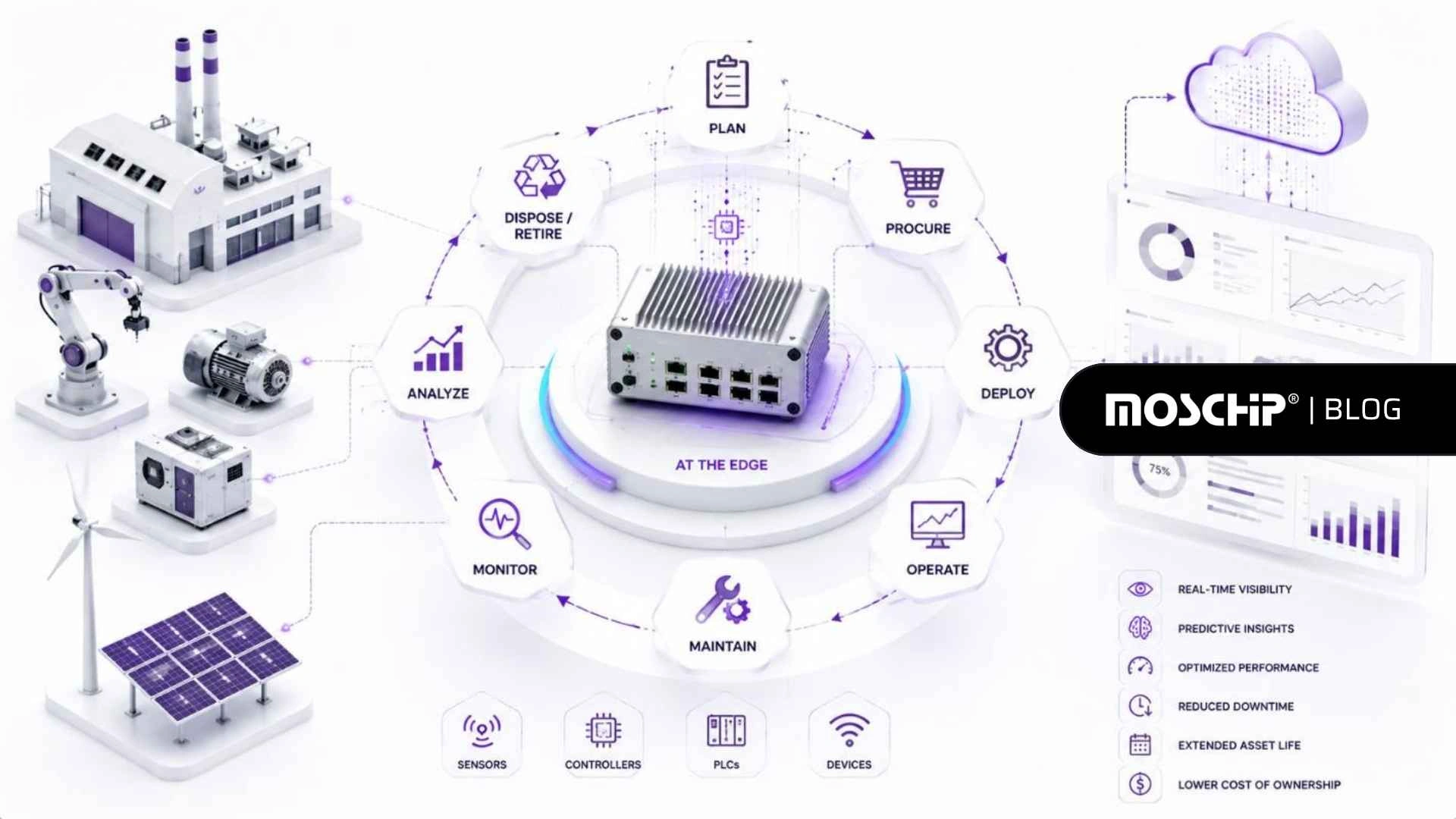
This is because more organizations are now moving intelligence closer to where the assets are located. Through the analysis of data at the edge, the organization can detect abnormal behavior of the assets and react immediately to these insights.
Running intelligence at the edge provides multiple benefits, including:
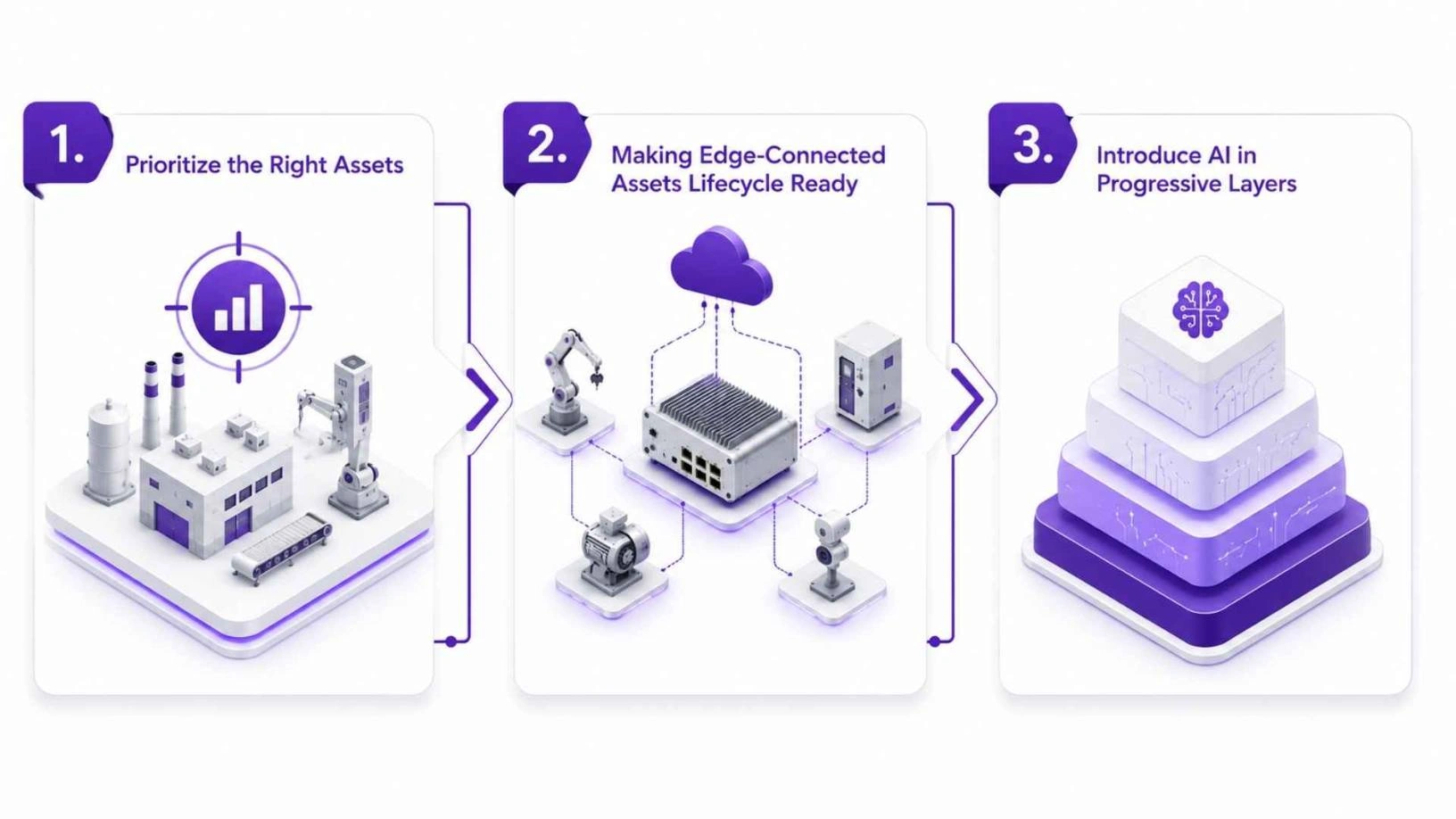
However, the transfer of intelligence to the edge should not be seen as linking all machines or using AI on all assets. The most effective asset lifecycle management programs are those that start with the identification of where edge intelligence can have the greatest business impact.
After all, not all assets need advanced monitoring, predictive maintenance, or even decision-making driven by AI. The important thing is to recognize which assets are most crucial to productivity, reliability, maintenance, and overall business performance.
That’s where the journey starts.
Any effective asset life cycle management procedure starts with the selection of the most ubiquitous assets.
The aim is not to digitize the entire shop floor in one go. Entities must focus on machines that affect key areas of their business. These areas include production, maintenance, security, and other factors.
According to the industries in question, the following can be considered high-value assets:
In selecting the assets for lifecycle management that utilizes edge technology, companies must consider:
By focusing on fewer high-value assets first, factories can validate results faster, generate business value from their activities, and create an expandable model for the future.
Having identified the right assets, it will then be possible for them to turn into intelligent, edge-connected systems.
At present, numerous factory-floor assets are typically connected. Machines all around the production environment are continuously monitored by gateways, controllers, sensors, and industrial networks for operational purposes.
Nevertheless, the connection itself does not lead to intelligence.
To enhance the effective management of an asset’s lifecycle, such connected assets should be able to collect the necessary insights related to operations, carry out the processing of important information in the field, and create valuable knowledge.
This would entail designing the edge architecture for factory floors carefully.
To transform these connected assets into lifecycle assets, some important decisions must be taken:
Selecting operational signals: One must decide which signals represent the health and productivity of the asset. Vibration, temperature, pressure, current, power usage, and utilization of machinery are some common examples of such signals; however, not all data points can be considered valuable. Selecting the most relevant signals can help factory floors simplify the process.
Define the data acquisition strategy: After the right signals are selected, the next objective becomes figuring out how often these signals should be recorded. Some important aspects may require continual or high-frequency signal measurement while others can be recorded periodically. By determining the appropriate data acquisition strategy, timely information can be provided without causing additional operational or communication costs.
Determine the location for processing the signal: Real-time processes including data acquisition, signal processing, event detection and initial assessment are best done at edge points where the issue of time efficiency, time correctness, and time accuracy arises. Depending on the particular deployment, this can take place on the asset itself or appear to be happening in the edge gateway that gathers and processes data from multiple assets and transfers the important information to the system.
Distinguish local workloads from those in enterprises: Although decision-making in the moment takes place on the edge, historical data and trends could be moved to cloud environments to perform analysis and optimize the entire lifecycle.
Managing Loads: With an increase in operational data produced by edge-connected assets, factory floors must be able to manage computing, storage, and networking resources. The distribution of workloads on edge and cloud platforms is necessary to preserve performance and resource utilization while ensuring asset monitoring and analysis runs uninterrupted.
At this stage, factory floors do not merely gather information from connected devices but have built a solid platform for collecting valuable data, computing at the edge, and deriving valuable meaning from it.
But even the most accurate data does not necessarily explain what is going on within a piece of equipment. Voltage spikes, vibration variations and power consumption are some of the signals that may imply different things depending on the way a piece of equipment is used.
In order to advance to the next level and know what the signals mean, AI is supposed to study them in comparison with the operational context.
See how converging your plant floor and IT systems unlocks real-time intelligence, straight from our experts.
When assets can provide consistent data, and this data is supplemented by operational context, then the basis of the AI has been established.
But it would be incorrect to see the implementation of AI as the beginning of asset lifecycle management. Rather, it must be implemented gradually to ensure that models become more accurate with the accumulation of knowledge about operations.
Rather than trying to find answers for all problems at once, factory floors can create intelligent systems progressively in layers:
As organizations improve these functionalities, AI becomes better able to recognize degradation patterns, provide better visibility into the health status of assets, and avoid false alarms. With time, the insights become highly useful input for maintenance, service, and engineering operations.
The following logical step is implementing these insights as actions leading to business results.
Once insights from AI are incorporated into daily activities, the emphasis shifts from understanding how assets behave to getting better business results. After all, simply recognizing a possible problem is of no use unless it is used to motivate action in time.
Thus, the role of asset lifecycle management in providing real business value starts. Instead of regarding health insights as data stored on dashboards, factories need to introduce them directly to maintenance, service, and engineering activities.
When factories use operational intelligence to make decisions daily, they can quickly react to rising issues, improve their maintenance practices, and enhance asset performance throughout its lifecycle.
It allows for:
Over time, this feedback loop allows engineering teams to discover repeated points of failure, learn about design weaknesses, and implement changes for the next product iteration. While the development phase is a place for learning, factory floors keep on learning through the operational lifecycle of the products.
At this point, the concept of asset health management transforms into a closed-loop lifecycle process, wherein deployed assets participate in improving themselves.
The aim here is not to simply link assets, but to enable assets to become smarter and more adaptive during their operational lifecycle. By bringing intelligence closer to the asset in question, cloud dependence can be cut down, and quick action taken at the right place.
Factory floors shouldn’t go for a broad AI transformation from the very beginning, rather they should add AI technologies gradually and integrate tools like predictive maintenance, anomaly detection, contextual intelligence, and prescriptive recommendations into their processes based on their operational and data maturity level.
This practical strategy allows the floor to acquire business value sooner while setting a foundation for scalable intelligent asset lifecycle management.
MosChip assists the factory floors in creating connected intelligent products via expertise in Digital Engineering and AI Engineering. At the same time, we apply our DigitalSky GenAIoT and AgenticSky suites together with tested ProductXcelerate blueprints to help clients run their factories smoothly, reduce downtimes, and manage the entire lifecycle of their assets.
To know more about MosChip’s capabilities, drop us a line, and our team will get back to you.

Darshil is a Marketing professional at MosChip creating impactful techno-commercial writeups and conducting extensive market research to promote businesses on various platforms. He has been a passionate marketer for more than four years and is constantly looking for new endeavors to take on. When He’s not working, Darshil can be found reading and playing guitar.

In contrast to traditional mass media, such as printed material or audio recordings, which feature little to no interaction between…

Every product begins with an idea, a vision to solve a problem or create something valuable…

Showcasing recently launched “MosChip DigitalSky™ – Building Connected Intelligent Enterprises” Santa Clara, California Oct 7, 2024 (Issuewire.com) – Who: MosChip®…
Most industrial asset management systems still follow a familiar approach. Data is captured from machines…

You are on mile 20 in a marathon; you have made good progress, but your body? Well, it’s feeling fatigued…
Across manufacturing plants, automation systems have changed and demand higher visibility, faster data exchange, and simpler integration…

Join us at India’s premier semiconductor ecosystem event – SEMICON India 2026 to explore our comprehensive...

How can manufacturers transform fragmented operational data into real-time intelligence...

Today’s consumer products respond after something has happened. Your wearable tells you your heart rate is elevated.…

Recently, AI processors have seen significant improvements in computing power due to specialized units such as NPUs…