

Industrial Asset Management at Scale using GenAIoT
Most industrial asset management systems still follow a familiar approach. Data is captured from machines, stored across different systems, and reviewed only when needed. This works in small, controlled environments, but falls short as operations scale.
As plants expand and more assets need to be managed, visibility does not scale at the same pace. The real challenge is fragmentation. Asset information is scattered across PLCs, SCADA platforms, spreadsheets, and separate enterprise tools. Each system shows only part of the picture, leaving teams without a complete view.
This leads to inefficiencies. Manual updates slow down operations, insights arrive late, and maintenance often happens only after a failure. Disconnected systems also create inconsistencies, eventually resulting in “ghost assets” that exist in records but not in reality.
The challenge now is not just collecting data but understanding it in real time. Even simple questions, like identifying underperforming machines, require navigating multiple systems.
This is where GenAIoT makes a difference. By combining IoT connectivity with AI intelligence, it brings assets and data together into one unified system, enabling continuous visibility, monitoring, and management, along with informed decisions across the asset lifecycle.
That kind of progress is what is carrying asset management into a genuinely connected, data-driven future.
Modern industrial assets are constantly sending out streams of telemetry, logs, alerts, and operating signals. That information carries real potential to improve efficiency, cut downtime, and support sharper decisions.
But when all that data is fragmented across separate systems, making sense of it gets difficult, and acting on it gets even harder. Teams frequently struggle to draw useful insights in real time simply because nothing is connected.
To overcome this, many organizations are shifting toward a more unified, data-driven approach to managing their assets.
That shift calls for a few things working together:
This is not just about small upgrades. It calls for a connected ecosystem that links assets, centralizes data, and supports operations at every stage.
That is exactly what solution accelerators like MosChip DigitalSky GenAIoT are built for, offering an integrated IoT and connectivity foundation to make this kind of transformation real.
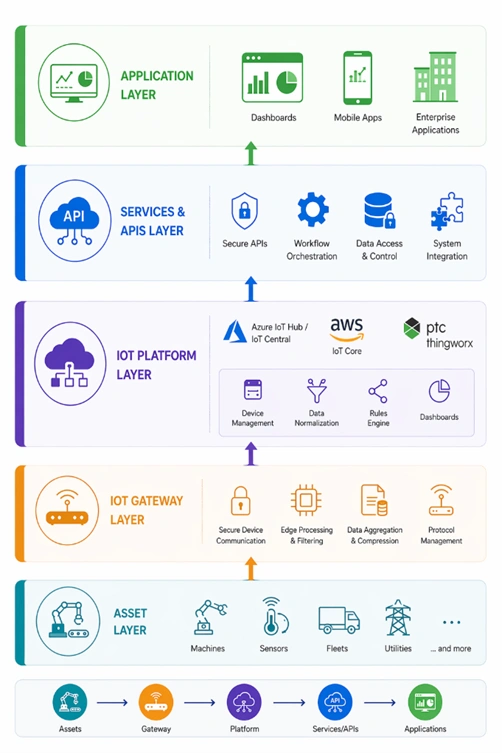
MosChip DigitalSky GenAIoT is designed as a modular, reusable, and scalable solution accelerator built specifically for industrial asset management. It offers an Integrated IoT and Connectivity Suite that ties together assets, gateways, platforms, services, and applications into a unified ecosystem.
Rather than building from scratch, organizations can use pre-built blocks to speed deployment and improve efficiency.
By leveraging ready-to-integrate components, standardized architectures, and reusable services, enterprises can accelerate development cycles and achieve up to 40% faster time‑to‑market.
This enables quicker validation of use cases, faster rollout of connected solutions, and earlier realization of business value.
This approach significantly reduces engineering effort while enabling faster innovation and connected product development, as explored in AI-enabled IoT product engineering with GenAIoT.
This layered approach ensures that data flows smoothly from machines to meaningful business insights, without complexity.
While the architecture sets the foundation, the real impact comes from how these capabilities operate in a live industrial environment, where machines, systems, and teams must work in sync.
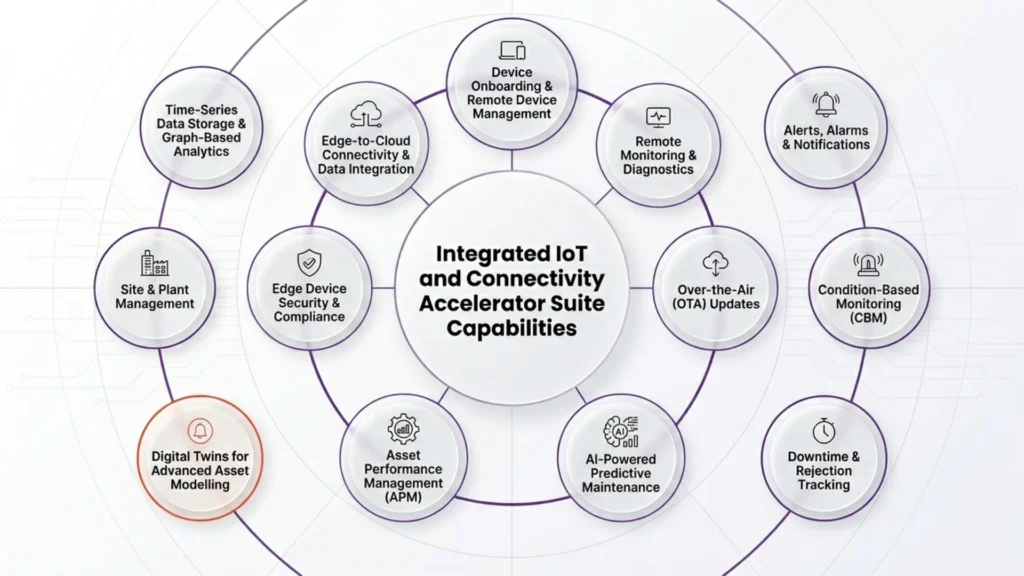
In an industrial setup, every physical asset, whether a machine, sensor, or controller, must first be connected and identified. The platform enables the onboarding of heterogeneous devices by registering each asset with a unique digital identity.
Through IoT gateways and protocol integration, both new and legacy machines are brought into the system. Once onboarded, devices can be centrally configured, monitored, and managed across their entire lifecycle, eliminating the need for manual coordination across sites.
After connectivity is established, continuous monitoring becomes critical. The industrial platform allows teams to remotely access device health, logs, and system status. Whether it is vibration data, temperature readings, or controller logs, everything is available in real time. This reduces dependency on physical inspections and enables faster fault detection and resolution.
Industrial environments often face challenges in updating machine firmware or edge systems. With OTA capabilities, updates can be securely pushed to IoT devices, gateways, and controllers remotely. This ensures systems stay updated without halting production or requiring on-site intervention.
Rather than one large, interconnected block, the platform runs on independent microservices where each piece handles its own job, whether that is pulling in data, running analytics, or managing devices.
In a live industrial setting, that separation matters. One part of the system can be updated or scaled without touching everything else, which keeps things stable as operations grow or priorities shift.
Once assets are connected and data starts flowing, visibility becomes the key. The platform provides a unified interface where all assets across plants and sites can be monitored.
Operators can instantly view machine states, running, idle, offline, or faulted, enabling quicker operational decisions.
Integrated IoT and Connectivity Suite Capabilities
Industrial machines generate high-frequency data continuously. This data is stored as time-series information, capturing every operational parameter over time.
Advanced analytics then map relationships between machines, processes, and events, helping identify patterns, inefficiencies, and dependencies across the production environment.
Large enterprises operate across multiple plants and geographies. The suite structures assets into hierarchical models, plant, line, machine, and component, allowing centralized governance while maintaining site-level visibility and control.
Performance measurement is critical in manufacturing. The platform tracks Overall Equipment Effectiveness (OEE) at machine, line, and plant levels.
It captures production counts, cycle times, and differentiates between good and rejected output, helping teams optimize productivity.
Idle machines and defective output both cost the business in ways that add up fast. When something goes wrong, the system captures it, logging each downtime event and tracing where rejections are coming from.
Teams stop guessing and start looking at real data. Recurring issues get noticed sooner, and there is a clear record of what happened and who needs to address it.
In a connected environment, a timely response is essential. The platform enables rule-based alerts triggered by thresholds, anomalies, or predictive models. Notifications are sent via multiple channels and tracked for acknowledgment, ensuring issues are not overlooked.
Each physical asset can be represented as a digital twin within the platform. This virtual model mirrors real-world behavior, allowing simulation, diagnostics, and performance analysis. Over time, it becomes the foundation for predictive and intelligent operations.
Together, these capabilities ensure that industrial asset management are not just connected but continuously monitored, managed, and optimized across their lifecycle.
With this strong foundation in place, the next step is to make all that data visible and ready to act on, which is exactly where unified dashboards come in.
Within DigitalSky GenAIoT’s Integrated IoT and Connectivity Suite, unified dashboards bring everything together into a single, intuitive interface, transforming complex, high-volume data into clear, actionable insights that teams can easily understand and respond to.
Each site gets its own clear view of machine activity, covering:
This provides a real-time operational snapshot.
Performance gets broken down across every dimension:
Parameters are watched as they move in real time:
Trend dashboards further support historical analysis.
Centralized monitoring of:
Enables:
Provides:
These dashboards convert raw data into actionable intelligence, enabling faster and smarter decisions.
As organizations begin to act on these insights, the impact extends beyond visibility into measurable business outcomes.
MosChip DigitalSky GenAIoT is a modular suite of pre-built, reusable engineering accelerators. Its Integrated IoT & Connectivity Suite acts as a foundational digital backbone, eliminating the need to build connectivity, device management, and data pipelines from scratch, enabling faster development, seamless asset integration, and scalable, lifecycle-driven operations across industrial environments.
To know more about MosChip’s capabilities, drop us a line, and our team will get back to you.

Darshil is a Marketing professional at MosChip creating impactful techno-commercial writeups and conducting extensive market research to promote businesses on various platforms. He has been a passionate marketer for more than four years and is constantly looking for new endeavors to take on. When He’s not working, Darshil can be found reading and playing guitar.

The Industrial Internet of Things (IIoT), through distributed systems, autonomous control, and real-time intelligence, has transformed…

Showcasing recently launched “MosChip DigitalSky™ – Building Connected Intelligent Enterprises” Santa Clara, California Oct 7, 2024 (Issuewire.com) – Who: MosChip®…

As businesses strive to streamline operations, Robotic Process Automation (RPA) is transforming business operations by automating repetitive tasks and freeing…

In today’s rapidly changing technological landscape, organizations are continuously looking for methods to improve operations and promote development. The McKinsey…
The path for a product doesn’t stop once it is ready to be launched. Whether it is a semiconductor powering a mission-critical…
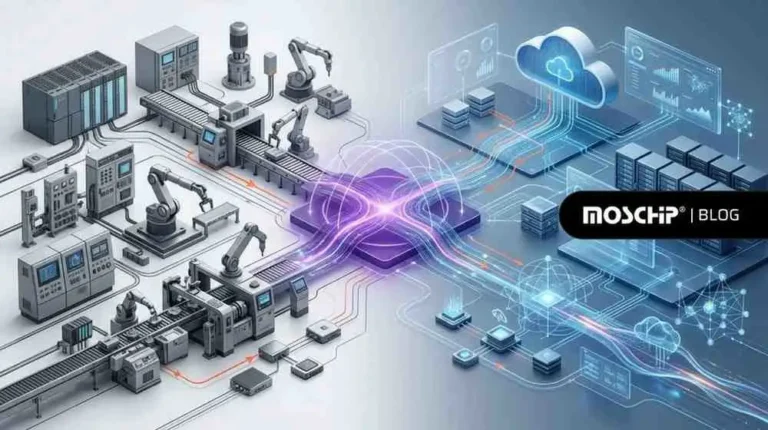
Many organizations across the world have implemented Industry 4.0; however, most of them have not seen complete success…
Join us at India’s premier semiconductor ecosystem event – SEMICON India 2026 to explore our comprehensive...

How can manufacturers transform fragmented operational data into real-time intelligence...

Today’s consumer products respond after something has happened. Your wearable tells you your heart rate is elevated.…

Recently, AI processors have seen significant improvements in computing power due to specialized units such as NPUs…