

Can Remote Equipment Monitoring Move Beyond Alerts to Autonomous Action?
As industries evolve by adopting advanced technologies to meet growing market demands, IoT, cloud, and edge computing have made remote equipment monitoring more connected and accessible than ever. But connectivity alone is not enough to achieve complete plant operational visibility, asset health, operational efficiency, and continuous production.
So, connected ecosystems or connectivity itself does not mean that a plant can automatically work under any situation. Industries are still working with legacy infrastructure, facing connectivity challenges, and not having a skilled workforce, as well as various other challenges which stops modern manufacturers from moving towards fully automated plant operations.
This gap is evident in industry research. Based on Rockwell Automation’s research report (State of Manufacturing Report), more than 40% of modern industries are still struggling to adopt full smart automation across their operations, due to the challenges mentioned above.
These challenges become clearer when we look at what is happening once machines generate data. As we know, machines are constantly generating data, raising alerts based on various abnormal situations, and showing machine health and performance metrics, but machines still require human intervention to solve the challenges and understand the situational context. This creates an open-loop operation and requires human intervention to close the loop, because machines do not have the ability to understand the context and decide what to do next themselves.
As we know, modern plants already use rule-based systems to automate some of these actions. If any known condition occurs, pre-defined rules can respond to the situation and trigger alerts. But the challenge begins when the abnormalities do not fit with pre-defined rules, which leads to delayed decision-making. Because this depends on current machine operations, previous machine behavior, outcome requirements, or information coming from other systems.
This means the next step is not simply creating more rules, but enabling the system to understand changing conditions and decide what action makes sense in that situation.
This is where Agentic AI comes in.
Before exploring this transformation, let us first understand the key challenges faced by industries with conventional remote monitoring.
As we see, machines generate continuous data that flows throughout the plant floor. But data alone does not equate to making better decisions in each situation. The real challenge is putting that data into context and converting it into a timely operational response.
This is where the limitations of today’s AI-enabled remote monitoring systems begin to appear.
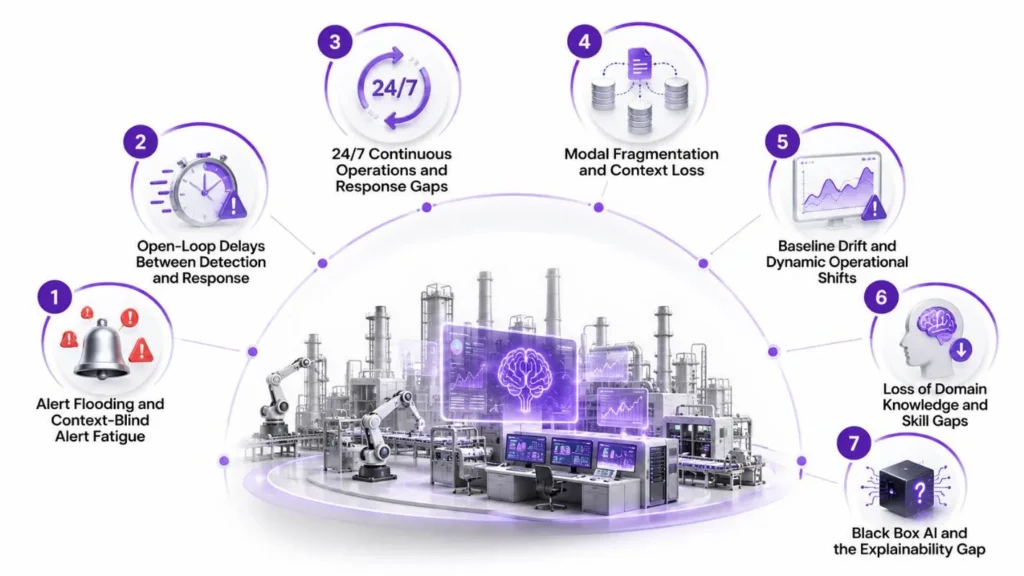
1. Alert Flooding and Context-Blind Alert Fatigue
Remote monitoring systems generate several alerts during abnormalities in real-time running operations for various abnormalities without understanding the actual context or severity.
This breeds confusion in operator brain to fetch actual severe operations and which alert to be answer first; this delay leads to the plant operation in stall condition.
2. Open-Loop Delays Between Detection and Response
Remote monitoring can identify the abnormalities, but the system still depends on human intervention to make decisions and take necessary actions.
This creates an open-loop gap where no direct sensing and continuous learning take place inside the system itself (from detection to response level), where on the plant floor every second matters most.
3. 24/7 Continuous Operations and Response Gaps
The manufacturing plants operate continuously as per the production schedule, where skilled engineers work during specific time periods. But if any abnormality happens when engineers or operators are not available during working hours, traditional systems can simply raise an alert message to the engineer, but they cannot make decisions on their own.
4. Modal Fragmentation and Context Loss
In industrial environments, remote monitoring collects data from several sources, but the collected signals and data operate independently rather than in a connected, process-based way.
It is important to create relationships between various machines’ real-time signals; otherwise, important signals may be missed.
5. Baseline Drift and Dynamic Operational Shifts
After a long run of machines, they start facing operational challenges and physical inefficiencies, so their operational patterns start changing, but the monitoring models might continue with the same baseline or limits that are preset based on their operations. Hence, normal operational variations can be confused with anomalies, which leads to the result of remote monitoring ineffectiveness and plant inefficiency.
6. Loss of Domain Knowledge and Skill Gaps
As we know, remote monitoring is a much more practical activity to understand how machine data is collected, how machines will behave in various conditions, and what corrective actions to be taken while some abnormalities raises, this kind of practical knowledge is gone when an experienced person will retire or change their job.
This creates juggle situation if not any expert is around the plant floor and the need for diagnosis arises in some unusual conditions, which becomes too difficult to handle.
7. Black Box AI and the Explainability Gap
Remote monitoring is able to identify the risk, but it cannot clarify operator and explain clearly about the reason behind how to approach the situation.
So, engineers or operators feels trust gap on the condition or state of machines to take the necessary actions because this remote monitoring is lacking in contextual understanding.
At last, we have seen various bottlenecks of traditional remote monitoring. Their open-loop nature allows them to detect problems and generate alerts, but they cannot assist further. Plant operators still need to understand what is happening, why it is happening, and what kind of actions to be taken. This can lead to maintenance delays, unexpected downtime, and poor operational outcomes.
What plants need now is an agency that can run the whole system of remote equipment monitoring autonomously without any human intervention. Autonomy helps to understand what is happening in real time, anticipate potential changes, and either assist operators or take the appropriate action within preset limits.
This is where Agentic AI comes into the picture to shift remote monitoring from a detection-focused process into a more intelligent and responsive system. To bring this level of autonomy to the factory floor, MosChip developed the AgenticSky suite, an Agentic AI accelerator suite to help machines and systems perceive, understand, decide, and act based on the situation.
MosChip’s AgenticSky Suite is designed to bring intelligence into various industries. This suite is designed based on reusable Agentic AI cores that are specifically dedicated to various industries and operations for intelligent operations. For remote monitoring, two of these cores are specifically used: VisionCore and ControllerCore.
Along with these cores, the AgenticSky suite also has HMICore, WearableCore, and RoboticCore, which support and accelerate intelligent operations in human-machine interaction, intelligent wearable development, and autonomous robotic operations.
AgenticSky suite is built around reusable capabilities, so OEMs need not develop every product from scratch; they can use these cores to accelerate their operations and minimize time-to-market.
Let us see how AgenticSky solves the above-described challenges by using the VisionCore and ControllerCore suites.
Let us first start with the VisionCore suite:
Above all, we saw how MosChip’s AgenticSky suite’s reusable cores help industries to add an autonomous layer to their business operations. While AgenticSky reusable cores add autonomy, MosChip also developed five vertical-ready ProductXcelerate Blueprints that provide pre-validated engineering foundations to OEMs comprising hardware, embedded software, DigitalSky GenAIoT, and AgenticSky cores. OEMs can utilize these proven reference designs to build their desired product outcomes without starting from scratch, accelerating their production on time.
To know more about MosChip’s capabilities, drop us a line, and our team will get back to you.
Traditional AI-based monitoring primarily detects anomalies and generates alerts based on models, rules, or thresholds. Agentic AI goes further by understanding the context around an anomaly, correlating multiple signals, determining the appropriate response, and initiating governed actions. This moves remote monitoring from detecting problems to understanding and responding to them.
AgenticSky provides reusable Agentic AI capabilities that help machines and edge systems perceive operational conditions, interpret context, make decisions, and engage with the appropriate response. For remote monitoring, VisionCore adds contextual visual intelligence, while ControllerCore helps interpret telemetry and coordinate corrective actions within defined policies.
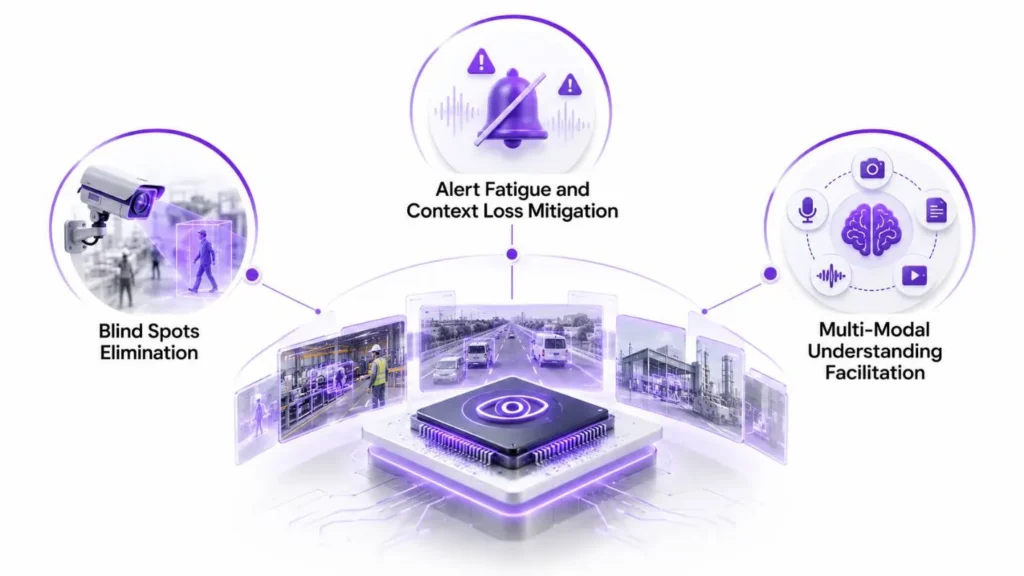
VisionCore adds visual perception to conventional machine telemetry. It can interpret visual information alongside other operational data to identify conditions that may not be visible through scalar sensors alone. This helps OEMs address physical blind spots, context loss, and alert overload by turning visual observations into more meaningful findings and recommendations.
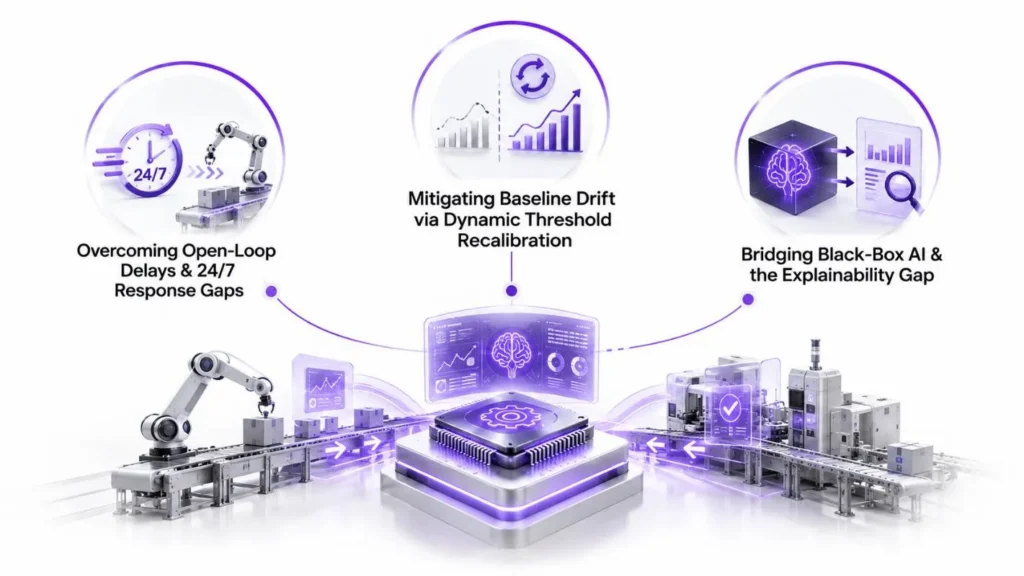
ControllerCore is designed to take remote monitoring beyond detection by interpreting operational conditions and coordinating appropriate responses. It can support capabilities such as recalibration, configuration adjustment, load balancing, and recovery actions within prescribed policies. This helps reduce open-loop delays and supports more continuous autonomous operation.
OEMs can avoid building complex AI reasoning, vision, and orchestration layers from scratch by leveraging reusable Agentic AI frameworks. For example, MosChip’s AgenticSky suite and vertical-ready ProductXcelerate Blueprints offer pre-validated engineering foundations spanning hardware, embedded software, and GenAIoT cores, significantly reducing time-to-market for modern remote equipment monitoring products.

Darshil is a Marketing professional at MosChip creating impactful techno-commercial writeups and conducting extensive market research to promote businesses on various platforms. He has been a passionate marketer for more than four years and is constantly looking for new endeavors to take on. When He’s not working, Darshil can be found reading and playing guitar.
The next generation of wearables will not be defined by sensors, battery life or connectivity.
For several years, industries have used traditional AI/ML systems that could classify, predict, and automate, but only with the limits of the data they were taught…
Many organizations across the world have implemented Industry 4.0; however, most of them have not seen complete success…
For over a decade, ADAS has continually evolved with its focus on improving perception…
As organizations increasingly adopt edge computing and cloud solutions, the convergence of these technologies has introduced new challenges and opportunities…
MosChip’s AgenticSky helps OEMs move beyond “smart” by embedding agentic traits – autonomy, proactivity, adaptability, and trust – into every product…
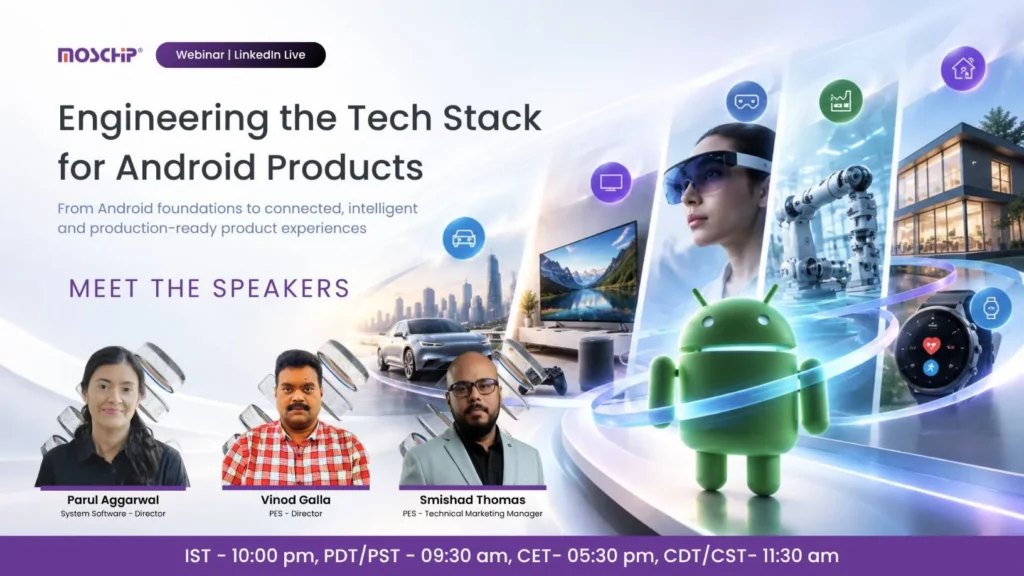
Android has evolved beyond an operating system into a foundation for building connected, intelligent...
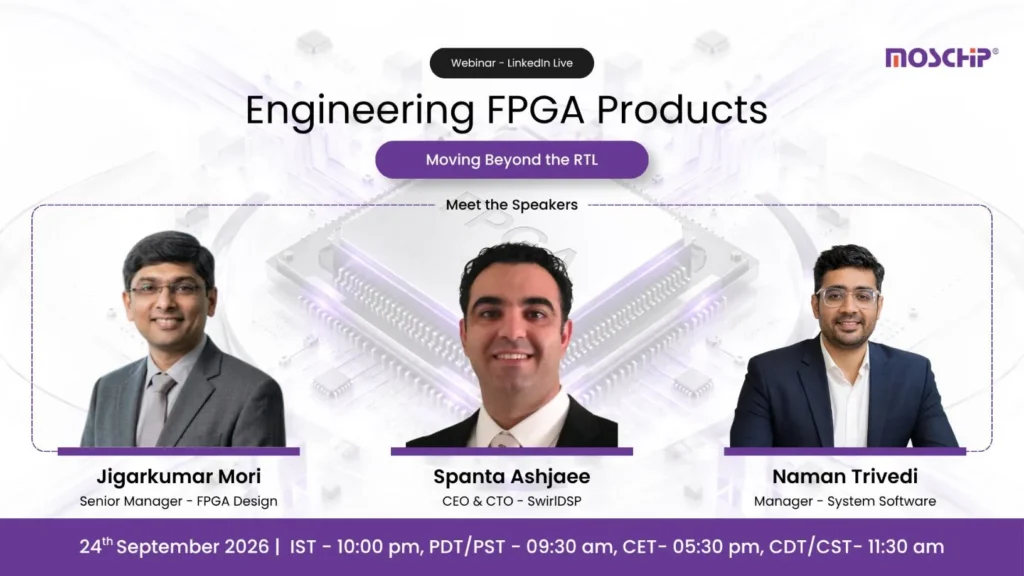
FPGA products are no longer just about getting the RTL right. Building a production-ready FPGA platform...
Today’s consumer products respond after something has happened. Your wearable tells you your heart rate is elevated.…
Designing an FPGA-based product can look straightforward when working within the FPGA development environment…