

Smart OCR solution using Xilinx Ultrascale+ and Vitis AI


Text is one of the most important ways humans share information. It gives detailed information. This helps machines understand their surroundings. It also supports tasks in real-world situations.
Reading text from natural settings, like in photos or videos, is called scene text detection and recognition, or PhotoOCR.
This area has become very important in computer vision.
Scene text recognition is different from OCR. Regular OCR deals with well-organized documents. Scene text recognition must find and understand text in places where things are not always neat.
The problem is harder now because there are many different fonts and styles used in written languages.
Letters can be written in multiple ways. They can be big or small, in different styles. All these differences make text look very different.
When these differences meet real-life situations, like backgrounds, poor lighting, strange angles and movement, it is much harder to find and read the text.
Real-time OCR applications need strong image processing, AI acceleration, and efficient system-level processing.
FPGA-based platforms handle these needs by offering customizable hardware design and embedded processing.
The Xilinx UltraScale+ platform combines general processing with FPGA acceleration, making it great for computer vision tasks that need fast response and efficient processing.
This platform allows heavy image processing tasks to be handled in hardware while application logic runs on the processor.
This mix of hardware and software offers flexibility for building and improving different parts of the OCR system.
The platform can also use Xilinx Vitis AI to run deep learning models and speed up AI operations on compatible Xilinx devices.
Vitis AI is a development environment that helps run AI tasks on Xilinx platforms.
It includes tools, libraries, and components to make it easier to use trained neural networks with the available hardware.
In a Smart OCR system, Vitis AI can speed up the part where the AI model does its work.
Other parts can be handled by the processor or programmable logic.
A typical setup may include:
This mix of different technologies allows the OCR pipeline to be built according to the needs of each step.
Scene text detection finds areas within an image or video that have text.
Some of the main problems include:
Machine learning and deep learning models, like the Connectionist Text Proposal Network (CTPN), can help find text regions in these conditions by suggesting where text might be.
A real-time Smart OCR system can bring together image processing, detection, sequence prediction and recognition into one hardware-based process.
The process can be broken down into these steps:
One important thing to think about in a real-time OCR system is which tasks should be done on the main processor, and which should be handled by the programmable logic or AI hardware.
Image preprocessing and post-processing can be done using high-level synthesis and assigned to FPGA resources.
AI inference can be made faster with Vitis AI, while other tasks and sequence-processing algorithms can be handled by the main processor.
This setup lets the OCR system use the available processing power well and still allows for future changes in models and apps.
The design can be improved by using parallel tasks, managing memory well, optimizing the model, and splitting tasks between hardware and software.
Making a system that can reliably recognise text in real time needs more than picking a good neural network.
The entire system should be tested using real data and in actual situations.
A good dataset that includes different fonts, languages, text directions, backgrounds, lighting, and text sizes can help improve the model.
Once the model is trained, it can be optimised to work well on the target hardware and connected to the video-processing system.
Testing and improving the model over time can make the recognition more accurate and the system more reliable, especially when the app needs to handle live video.
A Smart OCR system that uses hardware acceleration can help in situations where text needs to be identified in real-time.
Parking and License Plate Recognition
OCR can read license plates and compare them with parking or access databases. This can help with automatic parking checks, car entry control, and traffic management.
Mobile Document Scanning
Mobile devices can take photos of papers, receipts, tags, and other printed materials and convert the text into something the computer can understand.
The mobile OCR handles different camera angles, lighting conditions, and image quality.
Digital Asset Management
Images and videos have information that’s not always in the usual metadata.
OCR can extract text from these visuals, making digital files easier to look for, sort, and organise.
Retail and Product Recognition
OCR can read product names, labels, prices, and other text on items.
This helps with tracking inventory, analysing sales, and automatically identifying products.
Transportation and Smart Infrastructure
Signs on the road, station notices, vehicle details, and other text can be useful for smart transport and infrastructure apps.
To conclude, scene text recognition brings OCR to places where text can appear in many different forms, directions, and visual conditions.
Handling these different conditions needs strong AI models and a good processing system.
Using Xilinx UltraScale+ and Vitis AI provides a platform to create smart OCR systems that use hardware to speed things up.
By spreading out tasks like image processing, AI predictions, sequence work, and app features across the system, the setup helps meet the fast response times needed for real-time text detection and recognition.
As AI models, hardware speeds, and training data keep getting better, Smart OCR can support more uses where machines need to pull useful info from what they see.
MosChip team has been working on Xilinx FPGA-based solutions that require hardware design and software framework implementation. Our vast experience with Xilinx and understanding of intricacies ensured we took this solution from conceptualization to proof-of-concept within 4 weeks. Using our end-to-end solution-building expertise, you can visualize your ideas with the fastest concept realization service on Xilinx Platforms and achieve greatly reduced time-to-market.
MosChip can help define the OCR architecture, select AI models, enable hardware acceleration, integrate the appropriate AI frameworks, and develop embedded software.
Yes. MosChip can optimize existing models through quantization, platform-specific AI framework integration, and workload mapping to CPUs, GPUs, FPGAs, NPUs, and other hardware acceleration resources.
MosChip distributes image processing, text detection, AI inference, sequence processing, and post-processing across the processor, programmable logic, and AI acceleration resources. The hardware-software co-design approach helps reduce latency and improve system performance.
Yes. MosChip can tailor the solution to different languages, text formats, image conditions, processing requirements, and target hardware. This supports applications such as license plate recognition, retail, document scanning, and smart infrastructure.
MosChip provides product engineering services covering hardware design, FPGA acceleration, AI model integration, embedded software, and system implementation. This helps customers move from concept to validated and production-ready connected and intelligent systems.

Kaushal Rami is a Senior Developer at MosChip, an AI enthusiast whose mission is to develop, tweak and deploy AI applications for edge devices. He also has vast experience working with electronics and embedded systems and seeks to deliver state-of-the-art AI solutions. He loves to travel in nature and is passionate about aesthetic photography.
Optical Character Recognition (OCR) technology is essential in transforming data management and operational efficiency in the automotive industry. OCR enables…
In the world of extreme technology advancements, each product, system or platform is completely different from another. Hence, the testing…
Getting a machine learning model to work in a Jupyter notebook is easy. The hard part and where most enterprise projects…
The increasing demand for sustainable energy management has prompted governments, electricity boards, discoms, and industries worldwide to embrace smarter solutions…

Checkout counters have evolved from mechanical cash registers to barcode scanners and then to self-service kiosks…
Generative AI is set to revolutionize the landscape of Internet of Things (IoT) devices, introducing unparallel levels of efficiency, adaptability,…

Android has evolved beyond an operating system into a foundation for building connected, intelligent...
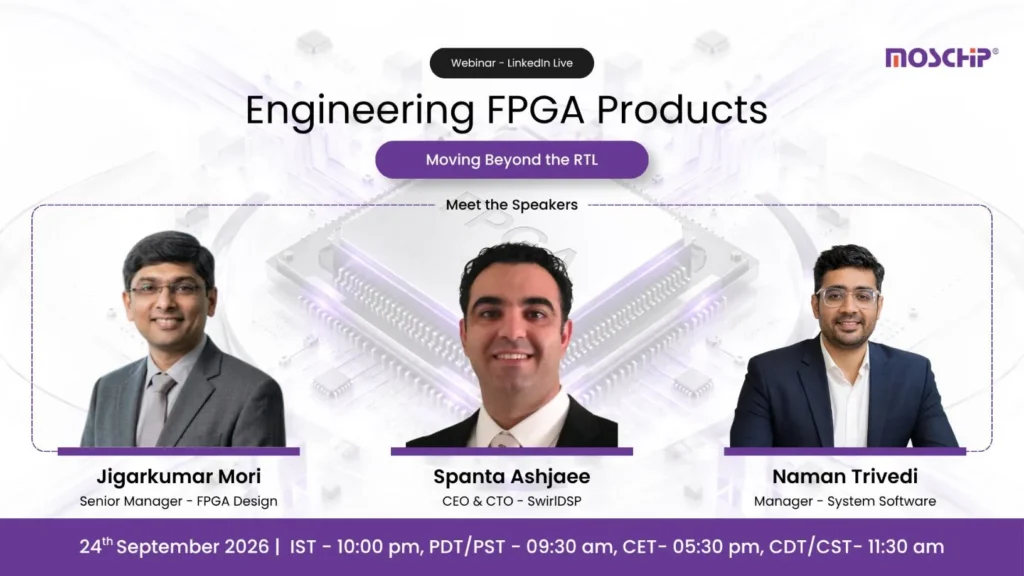
FPGA products are no longer just about getting the RTL right. Building a production-ready FPGA platform...
Today’s consumer products respond after something has happened. Your wearable tells you your heart rate is elevated.…
Designing an FPGA-based product can look straightforward when working within the FPGA development environment…