

Domain
Consumer Electronics, Smart Home Entertainment
Challenge
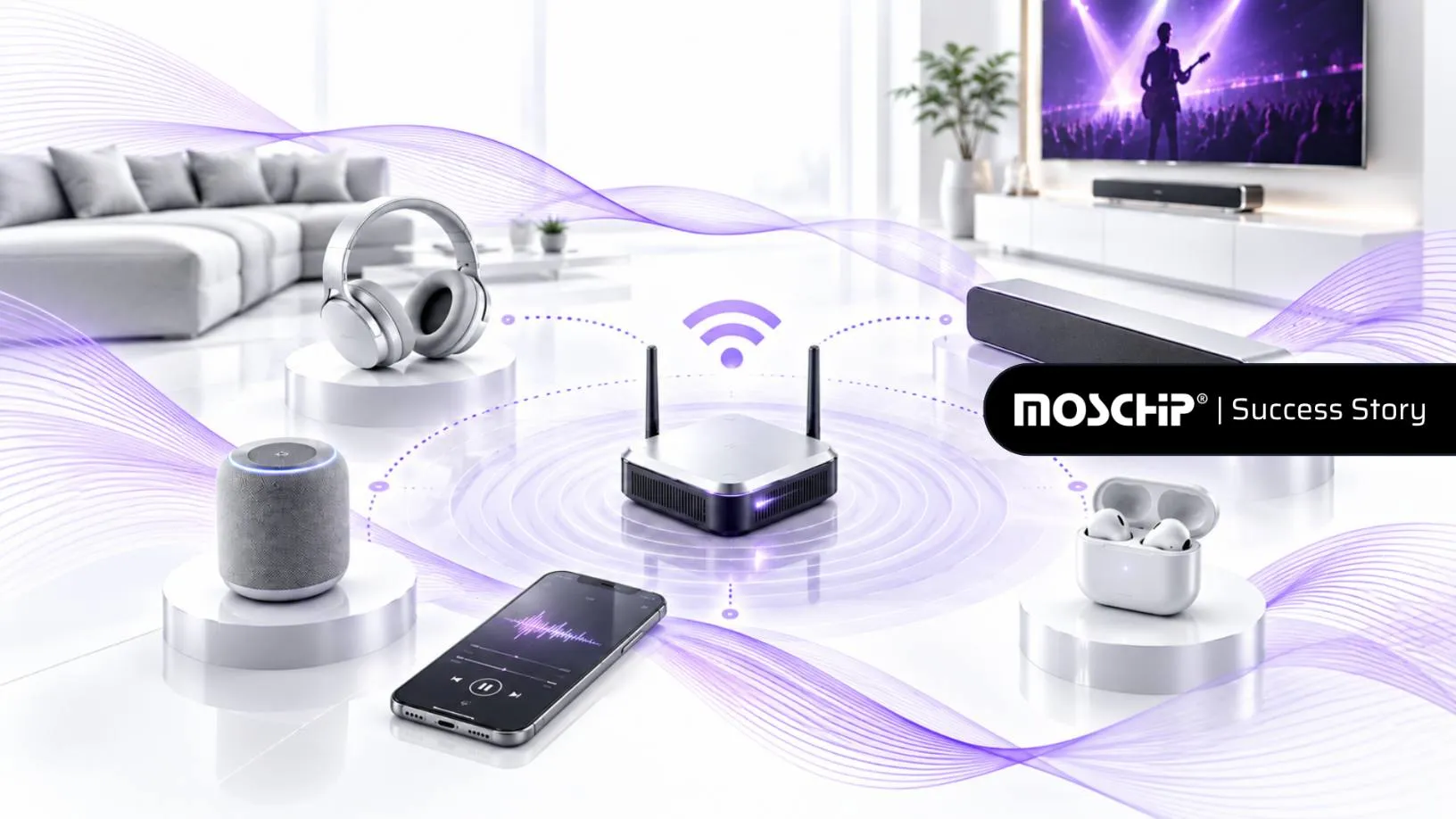
Enable synchronized low-latency multi-channel audio streaming over WiFi. Enable seamless setup of devices for consumers via mobile application. Integrate transmitter into the Android stack to eliminate the need for external physical transmitters
Solution
MosChip integrated wireless audio transmission directly into the Android stack, eliminating the need for a separate transmitter and reducing hardware development and manufacturing costs. Additionally, MosChip developed three Android applications to enable Android TV audio playback, simplify ODM certification, and provide a seamless consumer onboarding experience.
Platform
Android AOSP, Android TV, WiFi, Audio HAL, Android Studio
MosChip helped customer’s wireless multichannel audio IP into the Android stack, enabling wireless audio delivery across homes, hotels, and commercial spaces over WiFi. The engagement focused on bringing the existing audio IP into the Android ecosystem and enabling synchronized, low-latency multichannel audio distribution across connected devices without relying on external hardware transmitters.
MosChip developed three purpose-built Android applications, including an Android TV app for synchronized multichannel audio streaming, a certification app that enables hardware partners to remotely validate and certify audio devices for Wi-Fi-enabled audio streaming, and a consumer app that provides intuitive step by-step guidance for 5.1-channel system setup, configuration, and control. The platform was engineered to support seamless wireless connectivity, simplified device onboarding, and reliable audio synchronization across diverse deployment environments.
THE RESULT
Scalable and cable-free wireless audio ecosystem that brought the existing audio IP together with the Android, WiFi, and Dolby stacks. This simplified device certification workflows for hardware partners, helped reduce certification time, and enabled consumers to easily configure and control high quality multichannel audio systems across residential, hospitality, and commercial applications.
Delivering wireless multichannel audio meant tackling three very different problems at once, each with its own users and its own demands:
The hard part was not solving any one of these challenges alone. It was integrating the customer’s wireless audio IP stack with the Android audio stack and making real-time streaming, device validation, and multi speaker setup work smoothly together as one shared wireless audio system.
The engagement started off with MosChip by eliminating the need for a specific transmitter that was specifically used to transmit audio to the speakers over WiFi. To achieve this, MosChip integrate the transmitter functionality directly into the Android stack, reducing the dependency on external transmitter hardware and reducing the cost of developing and manufacturing a separate transmitter device. The team worked across three layers at the same time. They worked on the WiFi stack to keep a stable, fast connection between the source and every speaker on the network. They worked on the Android stack, customizing the AOSP audio framework and the Audio HAL so multichannel audio was routed and timed correctly at the operating system level. They also worked on the Dolby stack, to keep audio decoding and channel mapping accurate as sound moved through the pipeline.
This work across all three stacks is what made synchronized 5.1 surround playback possible. There were no dongles, no added hardware, and almost no delay, even when WiFi conditions changed or the TV chipset was different. On top of this transmitter-level work, MosChip built three Android applications. Each one let a different group use this capability in the way they needed: OEM engineers, ODM certification teams, and everyday consumers.
The Android TV app used a synchronization mechanism in the modified Audio HAL to keep every speaker in sync and drift-free, and was tested across multiple Android TV chipsets and OS versions. The certification app gave ODM partners a tablet-based way to test transmitters, receivers, and speakers, covering pairing, channel mapping, latency, and sync, with built-in diagnostics and compliance tests that replace external analysers and speed up production-line checks. The consumer setup app auto discovers speakers on the home WiFi network, guides pairing, channel assignment, and zone naming, then runs sync diagnostics, after which users can control volume, switch modes, group speakers, and update firmware from their phone.
| Component | specification |
|---|---|
| IDE | Android Studio, VS Code, Vim |
| Debugging Tools | WireShark, ADB, Audacity |
| Programming Language | C, C++, Bash Script, Java, Kotlin |
| CI/CD | TeamCity |
| Framework | Android, Android AOSP |
| Core Technologies | WiFi, Audio HAL, Multichannel Audio |
Porting the customer’s existing wireless audio IP into the Android stack helped simplify the overall solution, from factory validation to the end-user experience.
This usually happens when audio timing isn’t tightly managed at the operating system level, especially across different chipsets or OS versions. Customizing the audio framework and hardware abstraction layer for precise audio synchronization helps keep speakers in sync with each other and with the video, even when network conditions or hardware vary.
Bluetooth is generally suited for short-range, direct connections between devices, while WiFi can support higher bandwidth and broader network-based audio distribution. The appropriate technology depends on factors such as range, audio quality, number of connected devices, and application requirements.
Synchronization ensures that audio reaches multiple speakers or channels at the right time. Poor synchronization can result in noticeable delays, echo, or audio mismatch, affecting the overall listening experience.
The demand for advanced perception systems is growing across various sectors, and sensor fusion has become essential…

A mid-sized construction company utilizes a 250 KW generator set to power various operations including tower cranes, project offices, labour accommodation, lighting, and….

The client is a leading US-based computing solutions company providing solutions for SoC-based microcontrollers, catering to defense, automotive, and industrial applications. …
Android has evolved beyond an operating system into a foundation for building connected, intelligent...
FPGA products are no longer just about getting the RTL right. Building a production-ready FPGA platform...

Today’s consumer products respond after something has happened. Your wearable tells you your heart rate is elevated.…
Designing an FPGA-based product can look straightforward when working within the FPGA development environment…