


Client industry
Electronics goods warehousing & distribution |
Challenge
No visibility into fuel, battery, engine hours, or location of the forklifts in the warehouse leaving theft, overuse, and breakdowns undetected until costly
Solution
A cellular-based IoT asset monitoring platform, engineered end-to-end by MosChip
Core technologies
RS485/Modbus, GPS, Cellular, AWS Cloud
For this warehouse operator, the forklift fleet moves high-value electronics stock around the clock across a large, high-throughput facility but the fleet itself was a blind spot. Fuel was disappearing without explanation. Machines were run past safe duty cycles. Batteries died mid-shift with no warning. And when something finally broke, it broke without notice, turning routine wear into unplanned downtime.
MosChip engineered a retrofit monitoring module that attaches directly to each forklift, with no modification to the vehicle itself. The module reads engine, battery, and fuel data straight from the machine’s control unit over RS485/Modbus, the industrial standard for machine-level telemetry, while an integrated GPS chip tracks location. Readings are transmitted over cellular to AWS cloud, where they become live dashboards and automated alerts.
THE RESULT
Fuel theft stopped, maintenance became proactive instead of reactive, and the fleet became fully visible and accountable without replacing a single machine.
Beneath the routine hum of forklift operations sat five compounding blind spots, quietly draining margin, safety, and uptime:
At the core of the solution is a compact retrofit module installed directly on each forklift. It taps into the machine’s engine and battery systems over RS485/Modbus, the same industrial protocol used for machine-level diagnostics to capture engine run-hours, battery status, and fuel level at the source, while an integrated GPS module adds real-time location. From there, the architecture carries that data from machine to manager.
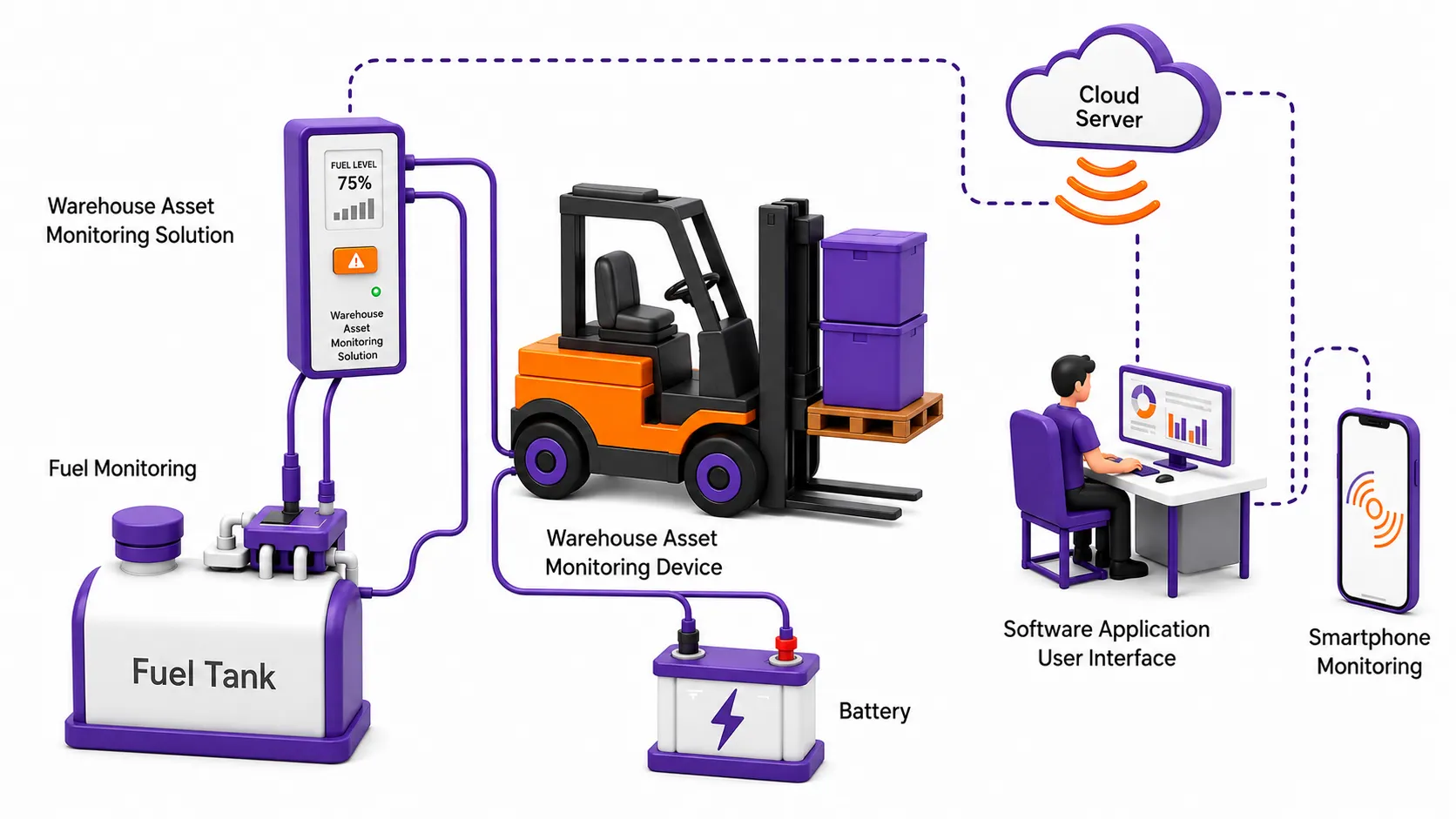
| Technology | Role in the solution |
|---|---|
| RS485 / Modbus | Industrial-standard protocol for direct engine and battery telemetry from the retrofit module |
| GPS | Machine-level, real-time location tracking |
| Cellular | Ubiquitous cellular uplink no dedicated site network required |
| AWS Cloud | Scalable ingestion, storage, and fleet-wide analytics |
Real-time fuel tracking plus instant alerts closed the loop on unnoticed pilferage.
Engine-hour and health data let managers schedule service before failure, not after.
Live location and usage logs give a verifiable record of where every forklift was, and how it was used.
Web and mobile dashboards put the fleet’s status in managers’ hands, anywhere, anytime.
Asset monitoring reduces equipment downtime by continuously monitoring the health, performance, and operating conditions of physical assets across industrial, manufacturing, warehouse, utility, and infrastructure environments. By collecting data such as vibration, temperature, pressure, electrical load, energy usage, and machine utilization, organizations gain real-time visibility into asset performance. AI and machine learning further enhance these insights by identifying anomalies and predicting potential failures, enabling proactive maintenance, improved reliability, and reduced unplanned downtime.
Yes, modern platforms use REST APIs, WebSockets, and middleware to feed real-time machinery data directly into ERP, WMS, or CMMS platforms. When an anomaly is detected, the asset monitoring system automatically generates a work order in your ERP and instantly checks spare-part availability in your WMS. This seamless integration syncs operational health with live inventory and maintenance scheduling, eliminating the need for manual data entry.
Yes. Legacy industrial equipment can be connected for asset monitoring without replacing existing machines. Retrofit solutions use external sensors to capture operational data, while industrial edge gateways collect this information and translate legacy protocols such as Modbus RTU and 4–20 mA into cloud-compatible communication formats like MQTT and OPC UA. This approach helps organizations gain real-time visibility, enable predictive maintenance, and improve overall equipment effectiveness without the cost of new equipment.
Edge AI can enhance asset monitoring by analyzing operational data directly on the equipment. This enables faster anomaly detection, lower latency, reduced cloud dependency and costs, and real-time decision-making even in environments with limited connectivity. It also enhances cybersecurity by keeping sensitive operational data closer to the source, reducing network exposure and helping protect industrial systems from potential cyber threats.
Asset monitoring solutions use a combination of industrial communication protocols, connectivity technologies, and cloud platforms to deliver real-time visibility. At the equipment level, protocols such as Modbus RTU/TCP, IO-Link, and Bluetooth Low Energy (BLE) collect operational data from machines and sensors. Industrial edge gateways then process and convert this data into standard communication formats like MQTT or OPC UA for seamless transmission. Depending on the deployment, data is securely sent over Ethernet, Wi-Fi, LoRaWAN, NB-IoT, or 5G networks to cloud platforms, where it is analyzed and presented through enterprise dashboards and monitoring applications.

The demand for advanced perception systems is growing across various sectors, and sensor fusion has become essential…

A mid-sized construction company utilizes a 250 KW generator set to power various operations including tower cranes, project offices, labour accommodation, lighting, and….
The client is a leading US-based computing solutions company providing solutions for SoC-based microcontrollers, catering to defense, automotive, and industrial applications. …

Join us at India’s premier semiconductor ecosystem event – SEMICON India 2026 to explore our comprehensive...
How can manufacturers transform fragmented operational data into real-time intelligence...

Today’s consumer products respond after something has happened. Your wearable tells you your heart rate is elevated.…

Recently, AI processors have seen significant improvements in computing power due to specialized units such as NPUs…