Open Source IoT Frameworks & How They Accelerate Intelligent Product Development
Engineering teams building connected products spend a significant amount of time solving the same foundational problems for every new device and deployment. These include secure device onboarding, managing device identity, handling multiple communication protocols, transforming raw sensor readings into usable formats, routing events, enforcing security policies, and integrating data with cloud systems.
Without an open IoT framework, these capabilities must be custom-built for each product. This leads to fragmented device management, inconsistent data pipelines, higher maintenance effort, and slower product releases. Instead of focusing on intelligent behaviour, automation, and analytics, teams remain occupied with rebuilding basic infrastructure required just to keep devices connected and operational.
Open-source IoT frameworks change this dynamic by providing standardized, reusable building blocks based on open standards and microservices architecture. They offer ready-made services for device management, protocol interoperability, data processing, security, and cloud connectivity. This reduces development time and cost while allowing engineering teams to concentrate on product differentiation and innovation.
In this article, we examine the core functional components of modern open-source IoT frameworks and explain how they simplify device management and operational complexity. We also show how GenAIoT builds on these foundations to enable advanced, intelligent IoT features aligned with OEM priorities such as faster time to market, efficient OTA lifecycle management, scalable cloud integration, and support for white-label product strategies.
What Are Open-Source IoT Frameworks?
An Open Source Software (OSS) Internet of Things (IoT) framework is a reference runtime built using loosely coupled microservices to address the core foundational requirements common to most IoT systems, including device onboarding, converting protocols, normalizing data from different devices, edge routing, security services, microservices scaffolding, and cloud connectors. Each of these is offered as a modular service with a clear agreement.
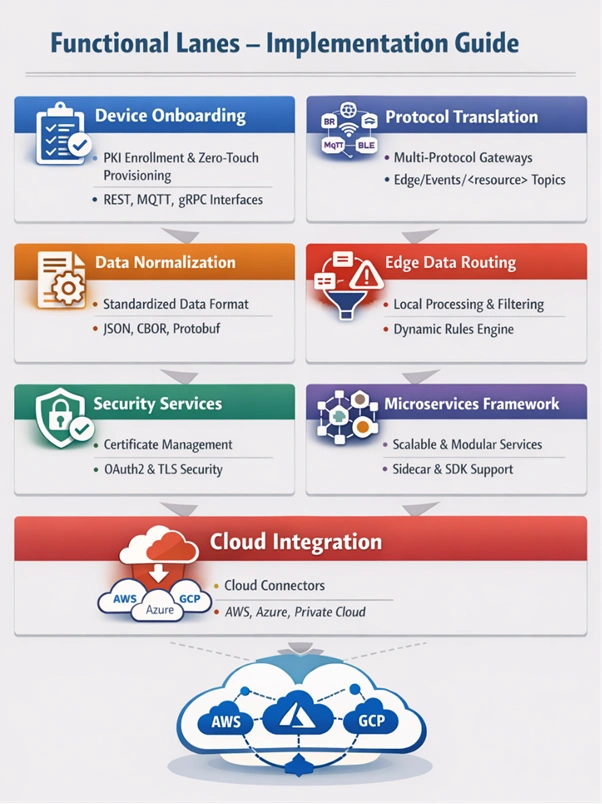
Functional Lanes – Implementation Guide
1. Device Onboarding
Frameworks provide an efficient and standardized way to connect and authenticate devices on a network. Instead of developing onboarding scripts for each individual product, engineers can rely on pre-configured modules that automatically handle provisioning, device identification, and trust establishment. The system is built using PKI-based enrollment, device identity credential provisioning, and bootstrap topic (URI) provisioning, with optional integration of TPM and Secure Elements (SE).
The onboarding process supports multiple interfaces, including REST endpoints such as /devices/register, MQTT topics like $enroll/<deviceId>, and gRPC services for provisioning device information. It operates as a zero-touch mechanism through factory-embedded claims and allows devices to check in using short-term credentials, ensuring secure and seamless activation at scale.
2. Protocol Translation
IoT devices communicate using a wide range of protocols such as MQTT, CoAP, Modbus, BLE, Zigbee, and CAN. Protocol gateways embedded in open-source frameworks unify these communication methods, making integration into applications simpler and more consistent. This capability is built using driver containers that follow a simple read, write, and observe contract with event-based callbacks.
Drivers connect to the internal bus system using well-defined topic structures, such as Edge/Events/<profile>/<resource>, which improves data organization and traceability. The system supports hot plugging, allowing drivers to be connected or disconnected without shutting down the entire platform. Each driver also includes version management through container tags, enabling easy updates and safe rollbacks.
3. Data Normalization
Raw device data often varies across sensors and platforms, which makes analysis and visualization difficult. Open-source frameworks address this challenge by normalizing and standardizing device data into a common format suitable for downstream analytics. This is achieved using declarative device profiles combined with a transformation DSL that supports unit conversion, calibration, and data shaping.
The framework supports structured payloads such as JSON, CBOR, and Protobuf along with resource-specific metadata stored in a Device Profile Registry. Schema versioning is implemented using backward-compatible transformations, ensuring that changes in device data formats do not disrupt existing applications or analytics pipelines.
4. Edge Data Routing
Edge microservices enable data to be processed, filtered, and enriched locally before being transmitted to the cloud. This reduces latency, lowers bandwidth usage, and improves overall system performance. The routing mechanism is built on a lightweight message broker and a rules engine, with optional local persistence such as ring buffers to support store-and-forward operations.
The system provides topic-based routing patterns and Dynamic Data Service Rules, such as triggering alerts when temperature exceeds a defined threshold for a specific duration. It also incorporates circuit breakers, multiple Quality of Service (QoS) tiers, and batching windows to ensure reliable and controlled data flow under varying network conditions.
5. Security Services
Rather than relying on fragmented security implementations, the framework integrates built-in security features such as certificate management, token-based access control, encrypted communication, and secure over-the-air updates. These services are implemented using sidecar or shared identity components, redundant Certificate Authority (CA) rotation, Policy-as-Code models like OPA, and shared key mechanisms.
Security interfaces include OAuth2 and JWT endpoints for token minting and validation, along with mutual TLS verification using Server Alternative Name (SAN) checks. The system enforces service-level agreements for key rotation and maintains detailed logs of configuration changes and command execution to ensure traceability and compliance.
Note: sidecar components = tiny services running next to applications and assisting with functions such as authentication, security, and logging without modifying the source code of the main application.
6. Microservices Framework
Modern IoT frameworks adopt a microservices architecture to achieve scalability and flexibility. Each function, such as device management, data ingestion, or rules processing, operates independently, allowing for faster updates and simpler maintenance. This architecture is implemented using either sidecar patterns or SDKs that standardize service lifecycles, support hot reloading of configurations, and enable structured logging and OpenTelemetry-based tracing.
Deployment strategies such as canary releases and blue/green deployments are used at edge services through Compose or OCI bundles. These approaches minimize downtime and reduce deployment risk while ensuring continuous service availability.
7. Cloud Integration
Many open-source IoT frameworks provide connectors and APIs that enable smooth integration with cloud platforms such as AWS, Azure, Google Cloud, private data centers, and custom enterprise applications. These integrations are built using pluggable connectors that support schema-aware serializers and exponential back-off retry mechanisms for reliable data transfer.
The framework manages routing keys on a per-tenant basis and enforces data protection through compliance with data residency rules and security services. This ensures that data is securely transmitted, correctly routed, and stored according to regulatory and organizational policies.
Without a Standard Open Framework
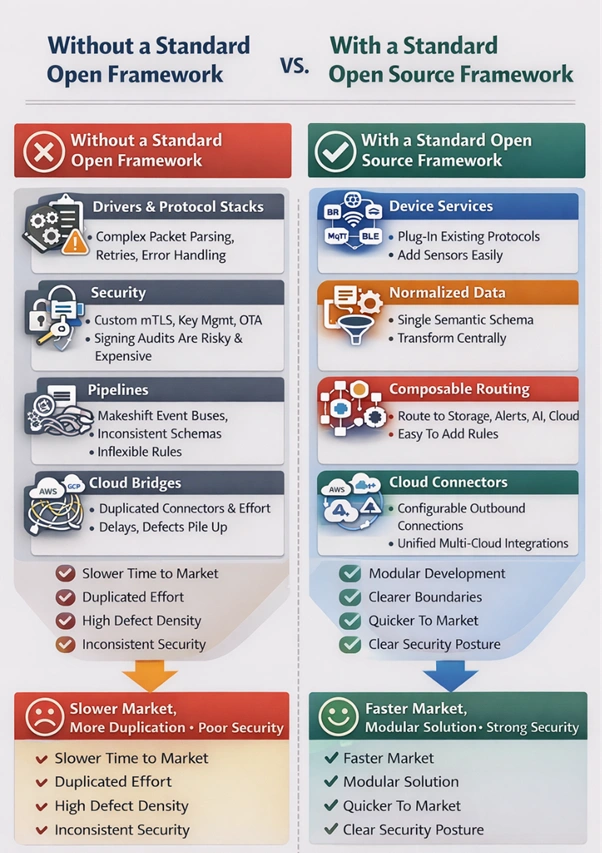
When there isn’t a common foundation to rely on, you might have to recreate several components:
- Drivers and Protocol Stacks: This includes managing packet parsing, timing, retries, and error mapping for each product and protocol.
- Security: With custom mTLS, key management, and OTA signing, system audits are becoming increasingly complex and more costly. Each configuration must be carefully executed and verified through extensive testing. Their implementations must be approached with caution; one slip in execution or missed update could result in a costly breach of security or complete failure of the system.
- Pipelines: This can lead to makeshift event buses, unreliable parsers, and inconsistent schemas.
- Cloud Bridges: Different teams will create various connectors that are only slightly different.
The result is a slower time to market for products, duplicated effort, high defect density, and no consistent security posture. These factors become particularly prominent as you add more SKUs or tenants.
With a Standard Open-Source Framework
A standard framework inverts the default:
- Device Services: You can use already existing protocols for plug-ins and add new sensors using the same protocol without the need to make firmware changes.
- Normalized Data: All resources have only one semantic schema; transformations occur in a centralised way.
- Composable Routing: Create additional rules to deliver streams to storage, alerts, AI inference or the cloud.
- Cloud Connectors: All outbound connections are easy to define in a configurable way, allowing users to easily switch cloud service providers or use multiple cloud service providers without changing the logic on the edge device.
- Add Intelligence: You can place AI microservices next to routing without affecting the core functionality.
The result is modular, quicker development with clearer boundaries and more straightforward SRE operations.
Let us understand first, it’s a technical deep insight:
Correlating This to GenAIoT
Rather than relying on a single proprietary framework, this stack is built on an open, standards-based IoT architecture aligned with proven open-source platforms such as EdgeX Foundry. EdgeX Foundry delivers core edge services for device onboarding, protocol translation, data normalization, security, and routing, making connectivity and data pipelines reusable primitives across edge and cloud layers.
MosChip DigitalSky GenAIoT builds on this foundation with four pre-built engineering suites that extend microservices using GenAI models and automation frameworks, enabling faster deployment, scalability, and zero vendor lock-in for industrial environments.
1. Integrated IoT & Connectivity Suite
- The Integrated IoT & Connectivity Suite forms pre-built digital backbone for connected products, enabling secure device onboarding, multi-device management, and multi-protocol integration across heterogeneous environments. It delivers pre-built, field-tested GenAIoT modules that accelerate IoT project delivery, from device onboarding and remote device management to OTA updates, predictive maintenance, and device decommissioning. The suite provides an edge gateway runtime with built-in diagnostics, telemetry ingestion, and adaptive security mechanisms for scalable edge and cloud deployments.
- Key capabilities include fleet and site management, asset dashboards, time-series data storage, remote device management, alerts and notifications, and IoT cybersecurity. By standardizing connectivity, device identity, and data pipelines, this suite creates a unified substrate for developing and scaling connected products across multiple OEMs and product lines, enabling faster deployment and consistent operations in complex industrial environments.
2. Cognitive Intelligence Suite
- The Cognitive Intelligence Suite brings AI-driven intelligence into IoT systems through reusable core, edge, and generative AI models. It supports text, image, audio, and multimedia use cases, enabling rapid proof-of-concept development and on-device or edge inference.
- With more than 95 foundational AI models, 50+ edge AI models, and around 20 GenAI solutions, this suite supports anomaly detection, vision analytics, speech processing, predictive diagnostics, and closed-loop decision-making. Its modular architecture allows the same AI pipelines to be reused across products and industries, supporting packaged and custom GenAI use cases without dependence on specific vendors.
3. Unified Automation Suite
- The Unified Automation Suite focuses on automating QA and operational workflows across the enterprise. It includes pre-built ready-to-use 10+ automation agents for robotic process automation (RPA), test automation, regression testing, and provisioning.
- This suite integrates EdgeOps, Infrastructure-as-Code (IaC), and ML/Dev/SecOps practices to reduce manual effort and improve reliability across product lifecycles. The suite includes the Product Test Automation Framework (PTAF), enabling cross‑platform automated testing with reusable scripts, event-driven execution, log capture, and intelligent reporting. By reducing operational drag and improving reliability, it ensures consistent, scalable, and high‑quality product releases.
4. Digital-Native Suite
- The Digital-Native Suite provides a cloud-native application stack built on API-first and event-driven microservices architecture. It supports multi-tenant user interfaces for monitoring and control, secure data access, and enterprise system integration.
- This suite enables rapid development of dashboards, mobile and web applications, and digital experiences without rewriting backend infrastructure. It also allows GenAI and automation features to be embedded into existing products with minimal development effort. Through data modernization, cloud security, identity management, and scalable microservices, the Digital-Native Suite ensures readiness for large-scale deployments.
Together, these suites operationalize GenAIoT as a practical IoT enablement piece: open, modular, and reusable building blocks that OEMs can compose, extend, and harden for production.
How It Works for OEMs
1. Faster Productization Cycles
- Before: 6-9 months for setting up drivers, security, and connectors.
- After: Weeks due to the use of established pre-built functional components for onboarding, routing, and connectors, allowing teams to focus on the application level.
2. Reduced Firmware Complexity
Move protocol-specific components into device service containers so that the MCU firmware can remain focused on deterministic and safe control and have a small, stable set of commands.
3. Built-In Intelligence Layer
We provide a basic anomaly detector as a microservice, enabling us to update models for each SKU without modifying the firmware. This means that a model upgrade is simply an OTA artifact rather than a full code release.
4. White-Label Capability
Tenancy is managed through routing keys and branding within the app shell, while maintaining the same core services. This way, customers experience their own platform, but we manage just one codebase.
5. OTA Management
OTA updates cover firmware, containers, and models. We use signed artifacts, staged rollout rings (from development to canary to 10% and then 100%), and automatic rollback if a health check fails.
6. Reduced R&D Costs
Share architecture across product lines. Driver artifacts and rules can be shared between all product lines. Security and compliance are centrally managed and available for audit.
MosChip DigitalSky GenAIoT™ offers a pre-built accelerator suite to facilitate secure onboarding, multi-protocol connectivity, AI-driven intelligence, workflow automation, and cloud-native application layers for open-source IoT enablement. Combined with MosChip Digital Engineering capabilities, spanning cloud-native backend development, OTA lifecycle management, remote diagnostics, digital twins, automation, and full-stack integration services, OEMs can reduce development cycles, streamline firmware/cloud integration, and build scalable, intelligent products faster than ever, without royalties or vendor lock-in.
To know more about MosChip’s capabilities, drop us a line, and our team will get back to you.
-
 View other Blogs
Darshil is a Marketing professional at MosChip creating impactful techno-commercial writeups and conducting extensive market research to promote businesses on various platforms. He has been a passionate marketer for more than four years and is constantly looking for new endeavors to take on. When He’s not working, Darshil can be found reading and playing guitar.