
Redefining Retail Self-Checkout with Agentic AI
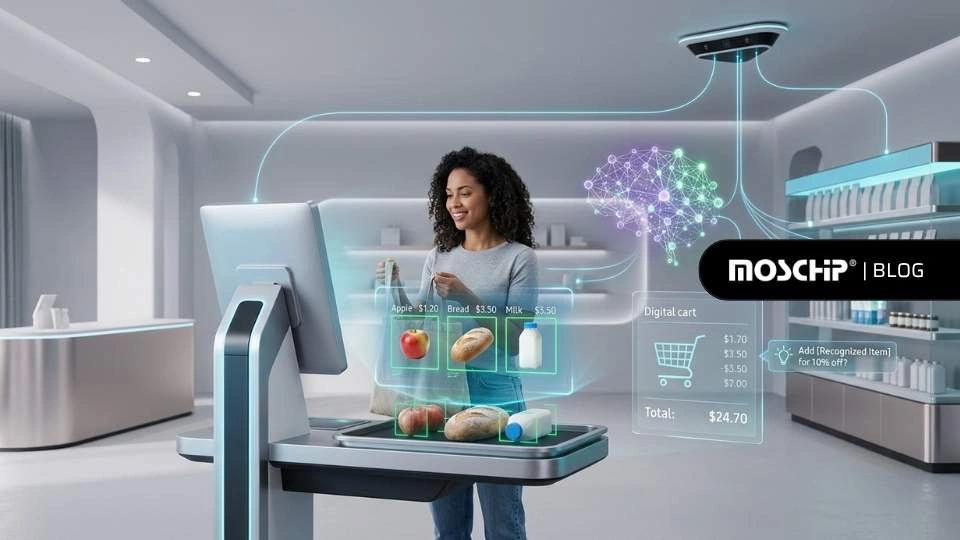
Retail success ultimately comes down to customer experience. Today’s customers expect a fast, seamless, and hassle-free shopping journey where they can move through the store without delays or friction. No matter how strong pricing or product range may be, long queues and slow checkouts can quickly frustrate shoppers.
This growing demand is also driving rapid innovation. According to the market.us report, the global AI-powered checkout market is projected to grow from USD 6.67 billion in 2025 to USD 138.14 billion by 2035, at a CAGR of 35.4%. This is why retailers have focused on making in-store journeys faster and more convenient.
In recent years, many stores have adopted autonomous systems powered by sensors and cameras that track items as customers shop, enabling checkout-free experiences. For retailers who cannot rebuild stores entirely, AI-powered kiosks offer a practical alternative by handling scanning, payments, and basic inventory tasks in one place. RFID technology further simplifies the process by identifying multiple items instantly without barcode scanning.
However, most of these systems are still reactive; they speed up checkout but depend heavily on customer actions. Agentic AI represents the next shift, moving toward a future where systems act proactively.
Instead of waiting for customers to scan or search, it can assist customers, detect relevant products picked by the customer, suggest products, resolve checkout issues instantly, and even automate billing decisions in real time. This ensures customers get a seamless and effortless shopping experience from entry to exit.
Before adopting this shift in technology, many retail stores were facing common challenges that they needed to address. This makes it important to look beyond the surface and understand what is slowing them down, including some key bottlenecks in today’s self-checkout systems.
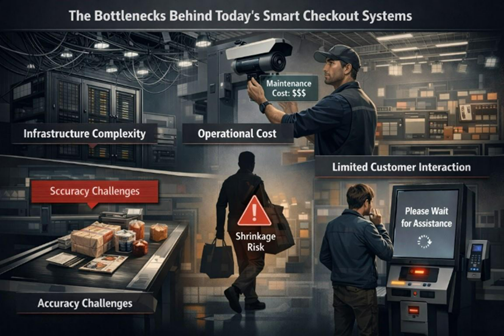
On the surface, self-checkout looks like a solved problem. But look a little closer, and retailers are quietly wrestling with challenges that never make it into the press releases.
Setting up a seamless self-checkout store means redesigning the entire physical space, overhead sensor grids, edge servers, and custom layouts, before the first customer walks in. For large chains, manageable, but for regional or independent retailers, the upfront bill alone kills the idea. It will be very heavy to sustain for small retailers with a limited amount of infrastructure.
Once a camera has been installed, it requires ongoing expenses associated with properly calibrating each camera and retraining AI models with new products. In addition, if the camera’s sensor loses accuracy over time, the camera is unlikely to function properly without a qualified technician to adjust it back to a predetermined state. Multiply these expenses by dozens of sites, and the actual cost of operating these systems will become more expensive than anticipated, thus making the desired operational efficiencies unattainable.
Real stores are nothing like a product demo. Items get stacked, shrink wrap catches overhead lighting at odd angles, and barcodes wear off from daily handling. When that happens, the system either throws an error or silently misses it, and a staff member must step in regardless. As a result, a checkout lane designed to be faster than any cashier slows the entire process.
Retailers are facing rising challenges from shoplifting in self-checkout environments because there is no direct supervision of shoppers using these systems. While designed to provide convenience to the shopper, self-checkouts are often not effective in preventing the intentional or unintentional failure to scan items. Over time, as losses continue to accumulate, some retailers have reassessed their business model and decided to go back to manually operated checkouts to re-establish better control over their inventory and reduce loss due to shrinkage.
These machines process transactions; they don’t help people. They don’t notice confused shoppers, flag unusual patterns, or adapt when something unexpected happens. In recent times, many shoppers have experienced malfunctioning kiosks and have avoided self-checkout simply because it’s slower.
Automated, yes, but genuinely intelligent? Not yet. And closing that gap is exactly where the next generation of retail technology is now pointed.
The core principle behind all bottlenecks is that these systems are designed to manage predictable transactions and not the complexities of real-world situations. What retail requires is not a smarter form of the current system; it needs technology that can function autonomously by thinking, anticipating, and acting. This is where Agentic AI provides a solution.
It’s no longer enough to simply swap out the cameras or upgrade the kiosk software. Each one of the issues listed in the previous section can be traced back to an only source of failure: these systems were built solely for reacting to things within a few feet of them, not thinking beyond those few feet.
Retail is an unpredictable business. The behaviour of shoppers varies greatly and is not easily scripted. The use of retail products causes many exceptions that can produce unsatisfactory results. Losses in retail can happen without any notice of their causes.
Retail stores need rugged solutions that identify store context, repair potential issues before they have time to grow, assist shoppers without any request from them, and provide a means to enable the store operation to continue without needing to be constantly managed by a store manager.
That’s exactly what Agentic AI brings to the table. Instead of waiting for someone to tell it what to do, it can read the situation, identify what needs to be done, and then do it on its own without needing any instructions.
A major shift in retailing is happening as retailers are transitioning from using machines for transaction processing to using systems that fully manage the complete customer experience.
This major shift has a name, and development has already started. That name is called AgenticSky.
That’s the exact problem AgenticSky was built for. AgenticSky is an Agentic AI accelerator suite built around three things that matter: reusable Cores that can be dropped into different products and roles, a reconfigurable Fabric that gives every system a consistent way to think and act, and the kind of engineering that makes genuinely futuristic product behavior possible today.
Everything running on AgenticSky follows the same four-step loop through the AgenticSky Fabric:
Perceive → Interpret → Decide → Engage
The system picks up what is happening, makes sense of it, figures out the right move, and follows through. No waiting for a prompt. No freezing on something unexpected.
What makes this different from the checkout technologies already out there is that AgenticSky was not designed to patch one weak spot at a time. It comes with a set of prebuilt AI cores, each one shaped for a specific job.
Unlike other systems where intelligence feels like an afterthought stuck on top, AgenticSky builds it straight into the device from the ground up. That means faster development, up to 40% quicker to get to market, and real behaviors that shoppers and store operators actually feel day to day: a system that handles things on its own, catches problems before they grow, shifts with whatever the situation demands, and does it all in a way that people can actually rely on.
Three of those cores hit the exact pressure points where retail checkout keeps falling short.
Put them together, and you are not just running a faster checkout. You are running a smarter one.
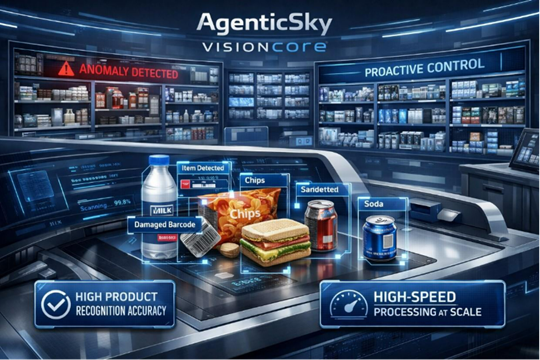
If an intelligence-based checkout system has a flaw in how it perceives things, then none of the intelligence from that checkout system has value. This one flaw in perception causes continuing losses for all retailers. Retailers experience ongoing inefficiencies due to inaccurate inventory records and unreported errors, which inhibit their ability to manage effectively, maintain accuracy, and to minimize shrinkage.
VisionCore can help quickly build applications that can handle real-world retail complexities like overlapping items, damaged barcodes, visually similar packaging, and dynamic lighting conditions. This core can also adopt multi-modal vision capabilities, such as a system that has the potential to achieve high product recognition accuracy while processing items at scale in live environments.
Beyond checkout, VisionCore can be extended to enable real-time shelf monitoring across multiple camera feeds. Instead of reacting to issues after they occur, this approach makes it possible to design systems that identify anomalies and suspicious behavior as they begin to develop, helping retailers move from reactive operations to proactive control.
VisionCore may define what the system sees, but accurate perception alone does not solve the real problem at checkout, the human experience. Shoppers still face moments of confusion, hesitation, or disengagement. That gap is often larger than retailers anticipate.
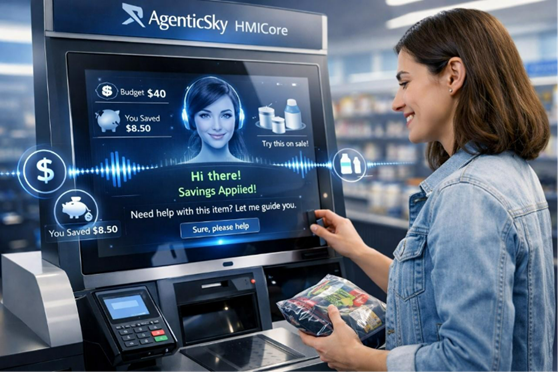
A significant share of customers leave self-checkout interactions feeling frustrated, and only a small portion believe current kiosks truly support their needs. The limitation is not always technical; it is experiential. Machines often fail to communicate, guide, or respond in ways that feel intuitive or human.
HMICore can help design solutions to enable the creation of more responsive, assistive checkout experiences tailored to specific retail environments.
With HMICore, retailers can develop systems that interpret shopper intent, adapt to context, and align suggestions with real-time availability. Instead of rigid workflows or static interfaces, the checkout experience can evolve into one that feels guided and supportive. Whether it is surfacing better options, applying savings seamlessly, or assisting step-by-step during exceptions, the goal is to reduce friction and simplify decisions.
The outcome is not just a smarter machine, but the potential to create a more human-centric interaction, where technology supports rather than obstructs. And while enhancing the shopper journey is critical, ensuring operational efficiency behind the scenes remains equally important. That is where ControllerCore comes into focus.
VisionCore defines what the system can see. HMICore shapes how shoppers interact. But the real challenge in retail doesn’t sit at the surface; it lives in the operational layer underneath, where fragmented systems, device failures, and real-time disruptions quietly impact performance and revenue.
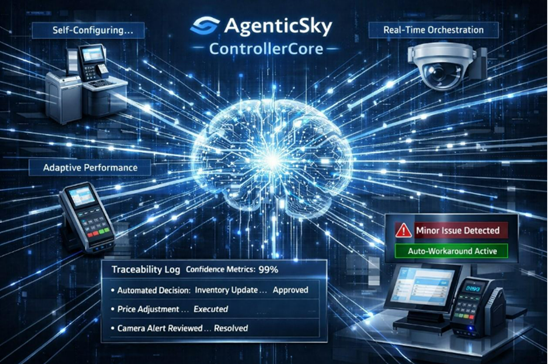
ControllerCore can be used to build products that can help retailers build a resilient, self-optimizing control layer tailored to their ecosystem. It provides the foundation to unify devices, sensors, and systems across the store, from kiosks and cameras to POS and payment terminals, into a single, intelligently managed network.
With ControllerCore, retailers can enable capabilities such as automated configuration, real-time orchestration, and adaptive performance management. For example, if a checkout terminal begins to fail, the system can be designed to detect anomalies, assess impact, and reroute operations without disrupting transactions. Similarly, calibration drifts, device inconsistencies, or sudden spikes in store traffic can be handled through dynamic load balancing and self-healing logic.
More importantly, it allows organizations to build predictive intelligence into operations, identifying early warning signals, estimating risk propagation, and triggering preventive actions before issues escalate. Every action can be logged with traceability and confidence metrics, ensuring operational transparency.
In essence, ControllerCore enables retailers to architect a stable, scalable, and intelligent operational backbone customized to their specific store environments quickly rather than relying on one-size-fits-all solutions.
Ultimately, retail checkout has spent years chasing speed. What it needed all along was something that could think. The real problems were never about how fast a barcode scans; they were about how poorly these systems understood the world around them. AgenticSky does not put a bandage on that. It rebuilds the thinking from the ground up. The future of checkout is not on its way. It is already being engineered.
MosChip developed the AgenticSky accelerator suite with one clear purpose: to give product teams a reusable, reconfigurable foundation for building genuinely futuristic products without starting from scratch every time.
MosChip offers various prebuilt cores within the AgenticSky suite, each designed to embed autonomy, proactivity, and trust directly into machines and devices at scale. The reusable AgenticSky Cores enable OEMs to move past isolated AI features and establish a consistent, configurable foundation for genuine agentic behavior.
To know more about MosChip’s capabilities, drop us a line, and our team will get back to you.

Darshil is a Marketing professional at MosChip creating impactful techno-commercial writeups and conducting extensive market research to promote businesses on various platforms. He has been a passionate marketer for more than four years and is constantly looking for new endeavors to take on. When He’s not working, Darshil can be found reading and playing guitar.

Today’s wearables sense and notify while tomorrow’s wearables reason and adapt. Agentic AI enables a layered intelligence model where sensing, near-edge reasoning, and cloud-based agents work together to deliver proactive, personalized outcomes. This marks the transition from threshold-driven tracking to continuous, context-aware companionship…
The path for a product doesn’t stop once it is ready to be launched. Whether it is a semiconductor powering a mission-critical…

Checkout counters have evolved from mechanical cash registers to barcode scanners and then to self-service kiosks…

Launching a product is a significant achievement, but once the product is launched, there are several challenges that companies must face, such as…

MosChip’s AgenticSky helps OEMs move beyond “smart” by embedding agentic traits – autonomy, proactivity, adaptability, and trust – into every product…

I have always thought that a surveillance system is only as good as its ability to quickly turn vision into timely insights…


Know how we have helped our client get more safety rating for their latest auctomobiles launched!