
Envisioning The Future of Wearables: From Trackers to Companions
Just the other day while I was working in my office, I got a notification on my smartwatch, reminding me to walk as I had been sitting for a couple hours with hardly any movement. When I was looking at the notification, a thought triggered in my head. What would the future look like for wearables a decade from now?
Imagine this, in the future your wearable no longer waits for your input. It anticipates your fatigue or anxiety before it occurs. It understands a drop in hydration or a lack in movement.
It adjusts your work-out plan mid-way through your morning run by understanding your fatigue levels or your vitals.
For an athlete, it can predict their fatigue levels and formulate recovery plans based on their current conditions and stats.
This means that you are no longer wearing trackers, you will be wearing a companion, a device that perceives, interprets, reasons, and acts with purpose.
Let’s think about this for a second. The wearable devices we use right now are reactive. These devices have one thing in common- AI as an add-on functionality.
We are living in a time where AI can no longer be an add-on. It must be an integral part of your product development. Which means it could do more than just measure vitals and count your steps.
The wearables that we use now in the form of smartwatches, fitness bands, and health trackers can monitor and track body vitals, sleep quality, step count, calories burnt, give hydration reminders, and even give alerts if your vitals show abnormalities.
Despite these functionalities, they are still reactive devices and not proactive. You may ask, what do you mean by proactive devices?
Well, what I am trying to say is that the current generation devices cannot interpret or decide. Intelligence they possess is limited to the set thresholds and rule-based triggered alerts.
Let’s try to understand this with an example; your smart wearable will notify you if your vitals are elevated, but it cannot really interpret what caused the spike or what you should do next because they lack contextual awareness.
They can respond to events but lack intelligence to understand patterns of behavior or emotional context. This is made possible by Agentic AI. Many OEMs have started adopting agentic AI and started developing products that are autonomous and goal oriented. And the ones who will be left behind will eventually play a catch-up game.
Next-gen wearables based on agentic AI must behave less like passive devices but more like an intelligent and proactive companion. The idea is to avoid a critical situation from occuring rather than merely to events.
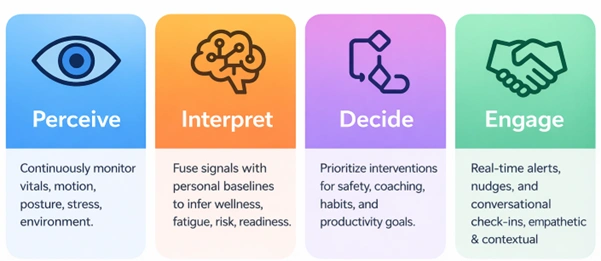
An agentic AI-based wearable work on a four-layer framework:
How would this translate into real-world use cases?
What if your agentic AI-based wearable could be your health coach while you are working-out? The device alerts when the user exerts beyond the threshold or hasn’t met their goals based on the number of reps that was set based on previous activity of the user.
In case of elderly care, the agentic AI-based wearable continuously reasons over physiological trends and behavioral patterns. Instead of reacting to isolated threshold breaches, it anticipates risk and autonomously alerts caregivers when meaningful deviations occur.
The future of wearables lies in proactive, autonomous systems which helps users to maintain their health, performance, and safety without initiating explicit commands.
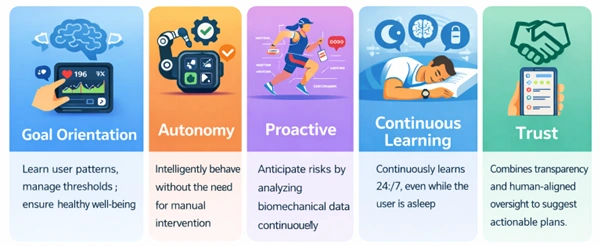
To deliver the level of intelligence we discussed in the previous sections and beyond, wearables must embody specific agentic traits.
Goal Orientation: The device can learn user patterns, manage thresholds via continuous monitoring, and ensure healthy well-being of the user.
Autonomy: Devices that behave intelligently and reliably without manual intervention.
Proactive: In sports tech, the device may anticipate potential risk and foresee by continuously analyzing biomechanical data such as motion trajectory, muscle load, acceleration, and heart rate variability.
Continuous Learning: The wearable continuously learns 24/7 about the user even while they are asleep.
Trust: For a device to be truly agentic and trusted, it must combine clarity, transparency, and human-aligned oversight. Wearable with agentic traits will not only know that you slept poorly it will correlate that with your recent stress levels, hydration, and activity, then suggest an actionable recovery plan.
This shift will mark a fundamental transition to wearables that perceive, interpret, adapt and engage.
Before we delve into developing wearables with Agentic AI, let’s try to understand how agents operate. Firstly, agentic AI is not a single model. It is a coordinated system of multiple models orchestrated by agents. In this architecture, agents act as decision-makers and coordinators, while multiple AI models optimized for a particular task, work together to support agency.
This may include time-series models, anomaly detections models, object detection and recognition models, LLMs etc. for reasoning, contextual understanding, and human-centric interactions.
LLMs play a critical role in enabling agents to move beyond rule-based logic. They support:
Obviously, the next question would be how we develop such futuristic product.
If we have to think about building agentic wearable devices, we need to start by knowing that agentic wearable development cannot rely on a single layer of compute. Not at least for now.
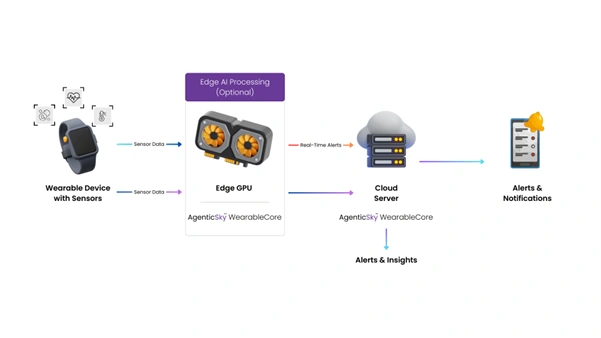
A wearable companion with agency requires a hybrid intelligence architecture across the edge, near-edge, and cloud scenarios. Each layer has its own ability towards enabling agentic behaviour.
Wearable Data Intelligence (on device): You may not be able to run critical functions on the edge, since wearables lack computational power to run an agent independently. However, you can run activities such as sensor data filtering, noise removal from accelerometer, gyroscope or microphones, classification under learned thresholds for body vitals can be performed at this layer.
Near-Edge Intelligence: While agents mostly work on the cloud, wearable devices can become part of local mesh networks. Certain scenarios benefit from (optional) near-edge acceleration to enable richer, low-latency decision making.
On-demand compute near-edge systems act as optional local intelligence hubs, extending the wearable’s capabilities when higher-order reasoning, multi-modal fusion, or rapid adaptation is required.
These near-edge nodes could be smart home gateways, monitoring systems in hospitals, industrial edge devices etc. When equipped with on-demand computing capabilities, they provide processing headroom necessary to execute complex models and agent workflows.
Within this layer, data from multiple sources are aggregated and correlated including signals from body sensors, beacons, cameras, or caregiver systems. When present, this layer enables agent workflows which will enable richer situational intelligence while keeping computation close to the user, with reduced latency.
Cloud-based Intelligence: Within a wearable ecosystem, the cloud layer serves as the aggregation, learning, and agent orchestration plane.
For a wearable to become a companion, the system needs to continuously learn about the user, adapt and make decisions autonomously.
In a wearable ecosystem, it continuously gathers the vitals of the user and analyzes them to understand the user more efficiently. Instead of static thresholds, cloud engines run causal reasoning models to understand why changes occur and how they relate to past patterns.
Rather than relying on static thresholds, cloud-based intelligence employs causal reasoning and temporal modeling to understand why changes occur, how they propagate over time, and how they relate to historical patterns, habits, and external factors.
Agents can evolve with the user, recalibrating baselines, refining personalization parameters, and updating decision policies based on sustained behavioural evidence.
The cloud function becomes the wearable’s memory, holds historical data, and strategist complementing real-time edge intelligence with deep temporal understanding.
MosChip AgenticSky is a suite of Agentic AI accelerators developed to drive the next wave of adaptive, AI-led product transformation across machines, devices, and edge systems.
Through this offering, MosChip introduces the Agentic Fabric and AgenticSky Cores. The Fabric is a four-layer framework which helps in creating the agentic cores.
Each Core is powered through the MosChip AgenticSky Fabric, an intelligent, reconfigurable four- layer framework that systematically delivers single or multi-agent workflow-specific capabilities.
The Wearable Core can be integrated to any wearable device such as fitness trackers, elderly care, industrial safety, healthcare wearables.They are reusable and reconfigurable accelerators that provides product teams the ability to embed true Agentic AI traits as we discussed in this blog for trusted human-centred interactions.
It can be used across industries by fine-tuning the agents to support various use cases. Let’s take a look at some of these use cases.
Healthcare: In a healthcare scenario, the WearableCore continuously measures vitals of a patient in context and corelates quality, stress, activity, and medication adherence. Instead of static alerts, the agent reasons over deviations from personalized baselines, anticipates deterioration, and proactively triggers interventions, escalations, or caregiver notifications. This is particularly valuable for conditions like cardiac monitoring, diabetes management, and post-operative recovery.
Elderly Care: Agentic AI can function as autonomous companions for the elderly. By fusing motion patterns, vitals, gait stability, and environmental signals, the agent can detect early indicators of fall risk, mobility degradation, or fatigue. It can autonomously engage caregivers, place distress calls, adjust daily activity goals, and provide contextual nudges while maintaining continuous learning tailored to the individual.
Sports Performance & Athlete Conditioning: Agentic AI-based wearables with the WearableCore can continuously reason over biomechanical and physiological signals like motion trajectories, muscle load, heart rate variability, and recovery indicators.
The agent dynamically adapts training intensity, recovery windows, and workload distribution based on real-time fatigue inference and long-term performance baselines. This enables injury risk mitigation, adaptive coaching, and personalized training cycles without manual intervention.
Industrial Safety & Workforce Monitoring: For industrial and hazardous environments, AgenticSky WearableCore enables real-time worker safety intelligence.
The agent reasons over physiological stress, exposure levels, motion anomalies, and location context to anticipate fatigue, unsafe behavior, or risk escalation. Proactive alerts, task reassignment recommendations, or automatic escalation to supervisors can be triggered before incidents occur.
Get to know more about AgenticSky and get to know how we can help you build wearables with agentic AI faster and at scale. Drop a email to us.

Smishad Thomas is a Technical Marketing Manager at MosChip. He has over 13 years of experience in technology marketing, branding, and content leadership. He has a keen interest in product engineering and loves developing convincing stories that translates technical innovations into clear, engaging messaging that resonates with business audiences

In recent years, the development of video analytics based video solutions have come up as a high-end technology that has…
The Artificial Intelligence of Things (AIoT) is revolutionizing industries by combining the power of Artificial Intelligence (AI) and the Internet…
Optical Character Recognition (OCR) technology is essential in transforming data management and operational efficiency in the automotive industry. OCR enables…

In the world of extreme technology advancements, each product, system or platform is completely different from another. Hence, the testing…

Edge computing appeared as a transformative approach for handling data closer to its source, minimizing latency, reducing bandwidth usage, and…

In recent years, voice technology has steadily increased in popularity, from voice control in vehicles to smart speakers in homes….


Know how we have helped our client get more safety rating for their latest auctomobiles launched!