Why Obsolescence Management Is Critical for Long-Term Product Success?
Launching a product is a significant achievement, but once the product is launched, there are several challenges that companies must face, such as, e.g., Component End of life (EOL), Suppliers stopping parts, Toolchain and Operating System Updates, and Increased Regulation. At the same time, Service Desk teams will continue to experience increased volume from all deployed products requiring support.
A company’s ability to navigate through the complexities of these challenges will have a significant impact on its overall success. Production halts, expensive redesigns, and compliance risks can erode profitability and damage customer trust. If not addressed, these problems can increase the total cost of ownership and threaten long-term success.
This is why organizations need more than just reactive solutions; they require a proactive, data-driven approach to foresee and manage obsolescence before it disrupts their operations. A solid Obsolescence Management Plan (OMP) helps ensure that essential products remain supportable, compliant, and profitable throughout their entire lifecycle.
Let’s take a closer look at the obsolescence risks first.
Understanding Obsolescence Risks
Obsolescence Risks threaten product lifecycles when hardware parts and software updates become unavailable via Product Change Notifications (PCNs) or silent market withdrawals, disrupting supply chains unexpectedly.
For product companies, impacts peak 7-15 years post-launch during extended support, causing spare part shortages that erode customer satisfaction, spike service costs, and damage brand reputation through downtime or returns.
Electronics manufacturers face rapid semiconductor obsolescence, with average 5–10-year lifecycles. Flash, microcontrollers, and passives are obsolete at >20% annually in high-volume BOMs.
Conversely, automotive and industrial sectors demand 15-20+ year lifecycles for ECUs and PLCs under ISO 26262, and IEC 61508 safety mandates: a single EOL component triggers full redesigns and costly recertification.
When a component is no longer viable, emergency redesigns, like re-engineering circuit boards or updating firmware, can take up 10–20% of the original Non-Recurring Engineering (NRE) budget. The rush to source discontinued parts, often through brokers or gray markets, can increase procurement costs by 5–10 times.
Other actions include last-time buys without proper forecasting and reverse engineering of outdated components. A real-life example is the global chip shortage in 2021, which disrupted automotive production worldwide and resulted in significant delivery delays, ultimately affecting market share.
Proactive obsolescence management counters this. Platforms like SiliconExpert and PartsLife deliver real-time, multi-vendor data on components, covering lifecycle statuses (Active, NRND, EOL), compliance information, and AI-generated predictions for Mean Time to Obsolescence (MTTO).
SiliconExpert is well-regarded for its electronic component intelligence and risk analysis capabilities, whereas PartsLife is dedicated to lifecycle extension strategies for essential parts in the defence and industrial sectors. These tools enable manufacturers to foresee risks, plan last-time buys, and sidestep costly redesigns. In fluctuating markets, advanced monitoring transforms anxiety into a strategic edge, ensuring profitability and driving innovation.
Core Steps for Implementation
Local programs truly benefit from structured actions starting on day one of a product launch. These sequential steps form a framework that guides the product throughout its entire lifecycle.
Step 1: Build and Maintain a Comprehensive BOM
Handling and updating a Bill of Materials (BOM) is the key to managing obsolescence efficiently. A BOM serves as the single, authoritative reference for every component in a product, capturing details for active parts like microcontrollers and ASICs, passive components such as resistors, capacitors, connectors, and non-electronic elements like PCBs, enclosures, adhesives, fasteners, and software versions.
Each entry should contain data fields: MPNs, approved suppliers, lifecycle status (Active, NRND, EOL), lead times, MOQs, historical pricing, and compliance certifications such as RoHS and REACH. Every design review, ECO, or post-launch revision requires updates, frequently automated by PLM tools such as Siemens Teamcenter or PTC Windchill to ensure no version drift.
Categorization and Risk Scoring
Categorize components by criticality. A risk-scoring matrix evaluates single-source dependency, usage volume, replacement costs, and redesign efforts. High-impact components like custom ASICs with 18–24-month lead times or sole-source MCUs need Level 1 attention with daily monitoring and dual-sourcing. Standard resistors (Level 3) may need annual review.
Real-Time Lifecycle Data Integration
Incorporate real-time lifecycle data from SiliconExpert, IHS Markit Gold, or Component Search Engine. These platforms compile supplier PCNs and use AI analytics to forecast Mean Time to Obsolescence (MTTO). Use dynamic tags, Active, NRND, EOL, for planning redesigns or last-time buys.
BOM Audits for New Product Launches
For new products, conduct a BOM audit in the first quarter. Cross-verify with supplier portals and run a “what-if” obsolescence scan. This uncovers hidden risks like outdated firmware or obsolete oscillators, which could stop production and cause costly delays. Strong BOM practices ensure supply chain resilience for 10–15-year lifecycles, especially for RISC-V SoCs.
Step 2: Deploy Early Warning Systems
Use automated methods to track obsolescence and develop a strategy to mitigate supply chain risks. Work with distribution partners using supplier portals, Product Change Notifications (PCNs), and an internal obsolescence database by linking these systems.
Regularly evaluate products and prioritize components based on lead times and volumes. For embedded products with RISC-V or Audio Processors, suppliers like NXP and Renesas provide real-time updates regarding lead times and component availability, enabling critical decisions during design and production phases.
ERP integration creates a central dashboard for procurement teams to act before inventory depletion, reducing redesigns and production delays. Case studies show the value: a major electronics manufacturer avoided a $2M loss by receiving an EOL alert six months early; automotive suppliers using proactive monitoring report savings and fewer delays.
Automated early warning systems shift businesses from reactive fire drills to strategic planning, ensuring long-term resiliency and cost reduction.
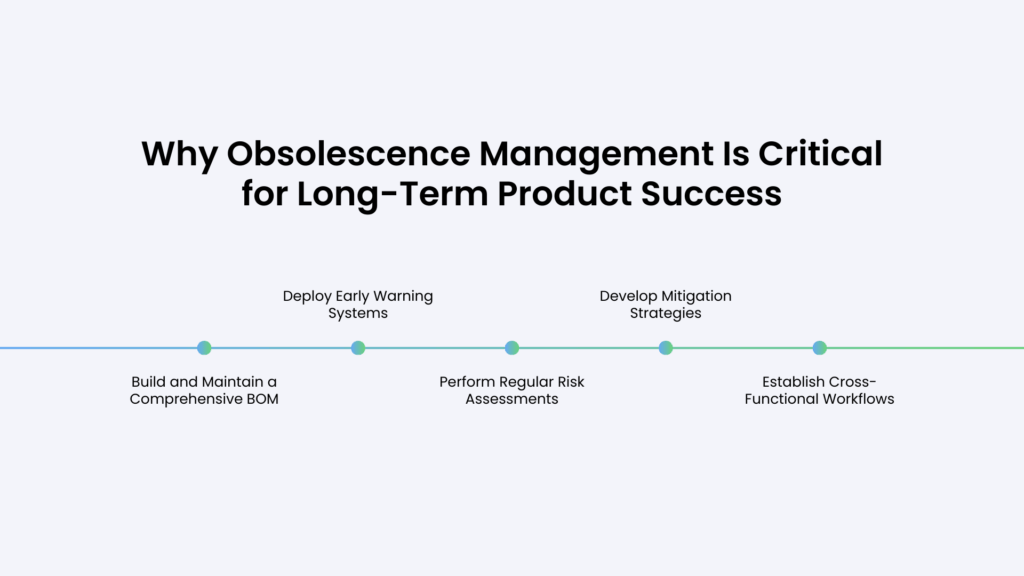
Core Steps for Obsolescence Management
Step 3: Perform Regular Risk Assessments
To effectively manage obsolescence, regular risk assessments are a must. Conducting quarterly reviews allows you to evaluate components using a matrix that looks at availability risk, cost impact, and redesign feasibility. For items deemed high-risk, such as sole-source microcontrollers, it’s crucial to have immediate action plans ready to avoid costly delays.
Apply quantitative models to bolster decision-making. Calculate the Mean Time to Obsolescence (MTTO) by utilizing historical lifecycle data and predictive analytics. Don’t forget to factor in external influences like geopolitical shifts in the supply chain, which have led to major disruptions during the recent chip shortages.
Cross-functional teamwork is vital. Engineering, supply chain, and finance teams should come together to set clear escalation thresholds, such as keeping 80% stock coverage before initiating mitigation strategies. This approach allows for timely responses and prevents last-minute efforts.
Risk assessments play a crucial role in effectively prioritizing resources. By pinpointing vulnerable components early on, companies can make informed decisions about last-time purchases, qualify alternative suppliers, or start redesigns well ahead of EOL announcements that could disrupt production.
In the rapidly evolving electronics market, structured risk reviews turn potential obsolescence from a reactive challenge into a strategic opportunity, helping to protect profitability and maintain smooth product lifecycles.
Step 4: Develop Mitigation Strategies
Effective obsolescence management is vital, and each response should fit specific circumstances. When products near end-of-life (EOL), make last-time buys (LTBs) and maintain safety stock for 2–3 years to ensure a smooth transition while seeking alternatives. Second sourcing is key; identify and evaluate drop-in replacements to meet performance standards, reducing redesign costs and speeding implementation.
If replacements aren’t viable, explore redesign options such as bridging modules or shifting to platforms with longer lifecycles. Industry 4.0 modular designs simplify component changes without full system redesign. Document all strategies in a mitigation playbook and review annually to stay ahead of risks.
Proactive measures like LTBs, second sourcing, and modular redesigns deliver cost savings and supply chain stability. For example, a leading OEM cut support costs by 30% by qualifying alternatives before EOL notices. Implementing these strategies protects supply chains, lowers expenses, and ensures product reliability across extended lifecycles.
Step 5: Establish Cross-Functional Workflows
Strong cross-functional workflows are key to sustainable obsolescence management. Embed the process into governance by forming steering committees that meet twice a year and assign clear ownership for tasks like BOM maintenance, lifecycle monitoring, and mitigation plans.
Consistency comes through SOPs, set timelines for PCN assessment, require notifications acknowledged within 48 hours, and conduct post-mitigation audits. Frequent workshops with real-world disruption simulations prepare teams for actual events.
Integrating PLM systems is vital. Linking workflows to PLM ensures smooth transitions from design to sustainment, bridging engineering and procurement, enhancing visibility, and speeding decisions.
Governance, standardized processes, and PLM tools shift obsolescence management from reactive to proactive. Establishing an Obsolescence Management Office (OMO) centralizes governance, uniformity, and transparency, driving continuous improvement and building long-term resilience.
Under the Product Engineering Services BU, MosChip offers an Obsolescence Management solution as part of the Product Sustenance practice. We enable continuity, compliance, and upgradeability for long-term products.
We focus on providing Platform Porting, Feature Re-Engineering, EoL Management, and BOM continuity, Sustained QA and Certification Support. Our product sustenance services include Functional Safety Validation, Regression Testing, and maintaining industry standards compliance through continued support.
To know more about MosChip’s capabilities, drop us a line, and our team will get back to you.