Matter Smart Homes: Enabling interoperable and reliable device integration
The smart home technology promises greater convenience and control, but the interoperability between multiple devices makes it tough to streamline the connectivity via a single channel. Devices from different brands or ecosystems often require separate apps or platforms, leading consumers to juggle multiple apps and feel frustrated, which takes away from the very convenience smart homes are meant to deliver.
This is where Matter steps in. Matter is a universal, open-source standard designed to ensure that smart home devices from different brands can work together seamlessly. Instead of switching between multiple apps, consumers can control everything through a single, trusted ecosystem. Matter smart home devices can be easily integrated and managed through the same platform, making the user experience smoother, simpler, and more reliable.
As per recent market reports from Statista, the global smart home market is set to reach around USD 174 billion by 2025, and it is expected to continue growing steadily at nearly 10% annually, surpassing USD 250 billion by 2029. With household penetration projected to climb from 77.6% this year to over 90% by 2029, the United States emerges as a leading market, generating an estimated USD 43 billion in revenue in 2025 alone.
What does Matter bring?
Matter is a new initiative led by major companies such as Apple, Google, Amazon, and Samsung, which are collaborating through the Connectivity Standards Alliance (CSA).
A key insight is that Matter-based smart home success depends heavily on well-designed hardware. Design decisions made early in the hardware phase can either create a great user experience or cause problems that are difficult to fix later.
How does Matter work?
Instead of introducing new, proprietary connections, Matter builds on proven technologies such as Wi-Fi, Thread, and Ethernet. This means:
- Devices communicate directly over local networks, reducing latency
- Smart devices remain functional even if the internet is unavailable
- One device design can interoperate across all major ecosystems (Apple HomeKit, Google Home, Alexa, and Samsung SmartThings) without requiring separate versions
This approach reduces product complexity, firmware fragmentation, and certification hurdles, allowing OEMs to focus on delivering differentiated experiences.
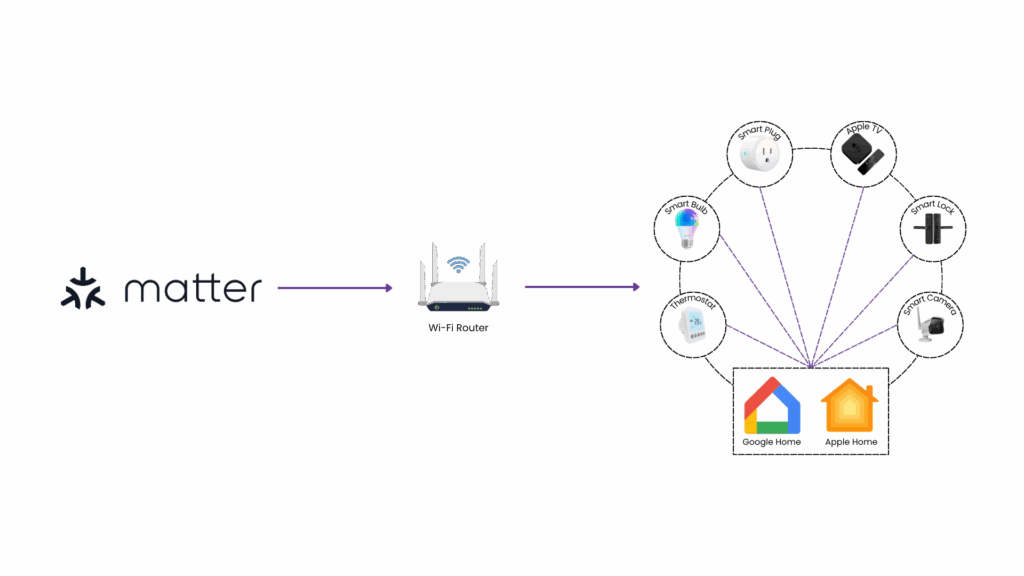
Matter smart home interoperability
Hardware design considerations for Matter integration
Seamless Matter integration depends on solid hardware foundations. The right design choices at the chipset, memory, power, and RF levels not only determine device performance but also ensure smoother certification, faster market entry, and long-term reliability. Designing hardware for Matter smart home devices involves selecting chipsets that support Wi-Fi, Thread, and BLE to ensure reliable connectivity and optimized energy consumption, which is critical for high-performance Matter devices. By aligning hardware decisions with Matter requirements early in development, especially in embedded systems. Companies can deliver products that consistently perform across ecosystems and exceed user expectations.
- Chipset selection: Opting for SoCs with native support for Wi-Fi, Thread, and BLE enables reliable connectivity and optimized energy consumption, making it critical for high-performing Matter devices.
- Memory and compute resources: Provisioning sufficient flash and RAM ensure devices can handle secure communication, OTA updates, and evolving Matter protocol upgrades without hardware limitations.
- Power management: Low-power architectures and energy-efficient wireless modules maximize battery life for sensors, locks, and remotes, reducing maintenance and improving user satisfaction.
Thoughtful integration of these hardware factors translates into devices that are not only Matter-ready but also market-ready, positioned for scalability, user trust, and long-term success.
Use Cases of Matter Integration
- Smart lighting systems:Matter-enabled smart bulbs work seamlessly across ecosystems such as Apple HomeKit, Google Home, Amazon Alexa, and Samsung SmartThings, eliminating the need for separate apps. Users can control lighting through any supported platform effortlessly, including voice commands and scheduled automation.
- Smart locks: Matter-compatible smart locks allow users to lock/unlock doors from any certified app or voice assistant. Multi-admin support lets multiple family members manage access permissions with reconfiguration.
- Cross-platform device control: Devices like smart blinds, thermostats, and media players integrate easily with various ecosystems without additional firmware, providing a seamless user experience across platforms.
- Smart hubs and controllers: Matter-enabled hubs such as Apple HomePod Mini, Google Nest Hub, Amazon Echo, and Samsung SmartThings allow centralized onboarding, management, and control of diverse Matter-certified devices on the same local network.
Future opportunities for Matter-enabled devices
Matter’s future device expansion offers a lot of opportunities by extending support to more categories like robotic vacuums, refrigerators, security cameras, smoke detectors, energy meters, and advanced HVAC systems. This broader device ecosystem will enable unified control, smarter automation, and improved energy management across homes, optimizing convenience and sustainability.
Also, emerging features such as multi-border Thread routing and enhanced energy reporting will allow large-scale deployments and better grid interaction. As Matter continues to evolve, manufacturers can innovate with seamless cross-platform interoperability, enabling intelligent, secure, and reliable smart environments that integrate diverse devices into one cohesive system.
Ultimately, Matter is moving the smart home market toward sophisticated, interoperable systems. Success depends on understanding that seamless integration starts with thoughtful hardware design. Companies that recognize and invest in the fundamental hardware will be the ones to deliver effectively on Matter’s capability.
MosChip® is well-positioned to support businesses in designing Matter-certified smart home devices by offering silicon design and product engineering services. With deep expertise in IoT, AI, wireless technologies, and hardware-software co-design, MosChip® helps companies design the right hardware, with native connectivity options to develop secure, scalable, and easily certifiable devices.