
Key Recommendations for Low Power Design in Thermostats – From Device Hardware to Firmware


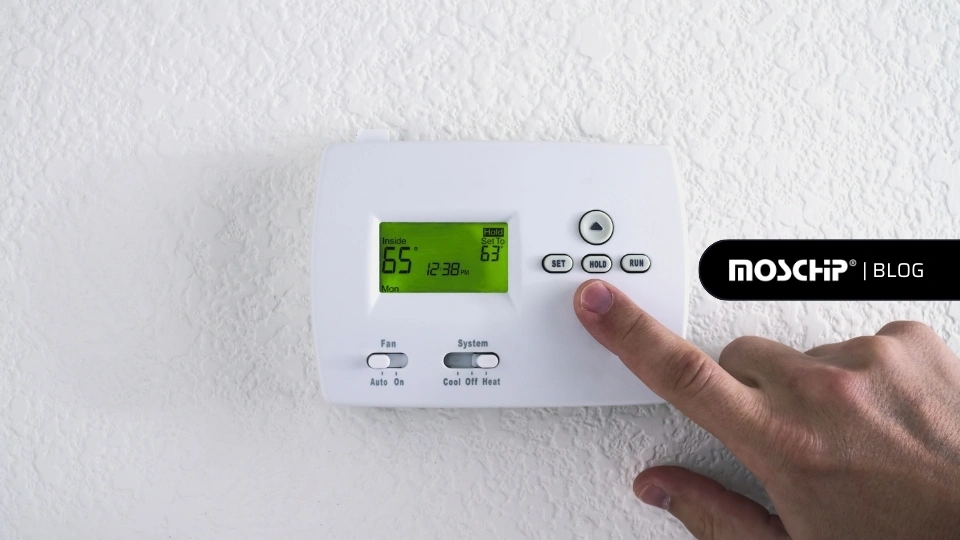
This blog explores key strategies for designing ultra-low-power thermostats, focusing on both hardware and firmware optimization. It covers component selection, power-efficient sensor integration, and hardware and firmware techniques. The goal is to extend battery life, reduce maintenance, and improve overall device efficiency in IoT-based thermostat applications.
Smart thermostats play a key role in modern homes and buildings, offering comfort, automation, and energy savings. Ultra-low-power design becomes essential nowadays as many thermostats are battery-powered and expected to last 3–5 years without maintenance.
Achieving this requires smart choices at both hardware and firmware levels: selecting energy-efficient MCUs, sensors, and radios, and designing firmware that leverages deep sleep, interrupts, and duty cycling to minimize active time. Together, these strategies ensure reliable, long-lasting performance.
Energy saving is not just about cutting electricity; it’s key to longer battery life, lower maintenance, and a better user experience. Industry data shows that smart low-power IoT design can extend battery life by up to 4x.
For instance, instead of keeping motion sensors or displays always on, modern thermostats use event-driven triggers like Passive Infrared (PIR) sensors and segmented LCDs that activate only when needed or only when some motion (person occupancy) is detected. Wireless connectivity uses low-power protocols like Zigbee or BLE that keep the device asleep most of the time and wake it briefly to send or receive data, helping save energy.
This blog explores key hardware and firmware strategies to help engineers design energy-efficient, long-lasting smart thermostats.
Let’s explore the key hardware-level strategies for power-efficient thermostat design.
1. MCU Selection for Power Efficiency
Selecting an ultra-low-power microcontroller (MCU) is essential for minimizing energy consumption in smart thermostats. Popular choices like an ARM Cortex-M0+ or Cortex-M4, with options such as MCU deep sleep mode, wake-on-intercept functionality, and dynamic voltage and frequency scaling (DVFs) to only operate when a sensor reading is required. The Cortex-M0+ is ideal for simple, downright tiny signal processing, but the M4 is better suited when needing smart sensor readings, as it has more processing capability.
In addition, turning off or disabling power or clock signals whenever possible also plays a role in reducing energy waste. When picking your microcontroller, again, minimizing design complexity and energy consumption by picking components that already feature integrated support, such as ADCs, communication ports, or timing, etc., provides a significant energy cut advantage.
2. Sensor Integration
To reduce the power used in thermostats, it is important to use low-power sensors for motion, temperature, and humidity. Digital sensors are preferred with I²C or SPI interfaces because they are accurate and easy to integrate; they might use some more power, although that small increase should be compared with the constant use of energy occurring with the Analog-to-Digital Converter (ADC) internal sampling of analog sensors.
Analog sensors are a simpler solution, but they will require the MCU (microcontroller) to be active with continuous sampling through the ADC, which creates additional time the MCU is ‘turned on.’
A better approach would be to use digital sensors with sleep modes, interrupt-driven wakeup, or data batching. With these sensor configurations, you can keep the MCU out of active states for an extended period and be active for shorter time segments in shared wakeup periods, which will eventually lead to improved battery life in smart thermostat product design.
Motion sensors, such as PIR or MEMS-based devices, should support low-standby current and interrupt-powered activation. Choosing a sensor with the capacity of the underlying sleeping or batch data often reduces the need for MCU Wake-up and expands the battery life in the wireless thermostat design.
Hardware Level Design Considerations
3. Display Technologies
The choice of display significantly affects the thermostat’s energy profile. E-ink displays only consume power during content refresh, making them ideal for static display states. However, they have a slow response time and are not suitable for high-frequency updates. LCDs and OLEDs provide real-time views but especially consume continuous power with backlighting.
Among these, segmented LCDs are highly power-efficient, which provide clear, readable information at very low electric levels. They are especially useful for battery-operated thermostats where the display refresh frequency is low, and information such as temperature or mode conditions is timely updated.
4. Power Management ICs and Regulators
Efficient power control is important to make a thermostat’s battery last longer. Low-dropout regulators (LDOs) are easy to use and give a steady voltage, but they waste more power if there’s a big gap between input and output voltage. Switching regulators, like buck converters, save more power in high-energy tasks, but they can create electrical noise while working.
Integrating a battery management IC helps to monitor the charge levels and optimize energy use. For extended lifetime and sustainable operation, energy harvesting modules (eg, solar or thermoelectric) can complement the power, especially in the atmosphere with variable light or heat, and reduce dependence on battery replacement.
1. Low Power Wireless Protocols
It is important to choose the right wireless protocol in smart thermostats to reduce power consumption. Protocols such as BLE, Zigbee, and Thread are adapted for low-power operations-Zigbee, for example, uses low radio signals and supports Aries networking with a specific category of 10–100 meters, which is ideal for home automation.
On the other hand, Wi-Fi provides huge bandwidth but draws extra power. The use of efficient energy also depends on duty cycling and how often the device connects, which helps reduce the radio how long it helps to reduce it. How the radio is operated by selecting the right communication protocol and fine-tuning, the thermostats can remain connected when using very low power.
2. Edge Intelligence
Integrating edge intelligence in thermostat firmware enables local processing of sensor data, reduces the need for continuous cloud communication. This not only improves the response time, but also preservations the energy used in wireless data transmission. Using an event-trigger communication-where data is sent only when significant changes occur and can be more efficient than much of more broadcasts, which consume electricity even when there is a meaningful update.
Processing functions such as temperature thresholds or motion detection locally ensure that only the required data reaches the cloud, making the system intelligent, sharp, and much more power-skilled.
1. Microcontroller Power Management
Efficient microcontroller power management is required for low-power thermostat design. Taking advantage of deep sleep, stop, and standby modes allows the MCU to enter ultra-low power states during inaction, which reduces energy consumption. These modes are particularly beneficial in a battery-powered system where the runtime should be maximized.
To achieve a harmonious balance of performance and energy use, Dynamic Frequency and Voltage Scaling (DFVS) works by tweaking the clock frequency and core voltage in real time according to the processing load. Moreover, firmware can phase out unused components like ADCs, UARTs, or timers to reduce power consumption. Using these innovative strategies, systems significantly cut power waste when not at full capacity or when demand is low.
2. Sensor and Peripheral Activity Control
To minimize power consumption in thermostats, sensors should employ event-driven wake-ups through interrupts instead of continuous polling. This way, I²C or SPI devices that have interrupt lines will allow the sensors to stay in sleep mode until they are triggered in case of temperature, reducing the frequency of CPU wake-ups and minimizing energy consumption most efficiently. In general, this ensures that beans are only counted when necessary.
Time-slicing sensor activity defines the length these sensors can be active; in other words, each sensor’s scheduled measurement is a short time segment. Peripheral modules such as PWM, RTC, and GPIOs will inherently power manage based on actual work being accomplished. PWM does not need to be powered when displays or actuators are not being driven. GPIO states can also be low-power states unless a signal is being transmitted.
Firmware Level Component Centric Design Considerations
3. Power Management in Wireless Communication Modules
Effective power coordination of wireless modules is integral to a low-power thermostat design. Bluetooth Low Energy (BLE) and Zigbee offer low-energy sensing and periodic advertising, low-power sleep cycles, and end-device configurations that greatly decrease active radio time. Fully utilizing these capability configurations will allow thermostats to stay in the ultra-low-power states while residual, and only “wake up” for a short communication.
Firmware must have great control over communication timing to save energy. Limiting data transmissions to short durations and maximizing the radio-off periods will also gain the greatest reduction in average current.
The firmware should also be able to switch off or isolate the wireless modules when inactive by either GPIO or PMIC to reduce energy drain, even when the device is responsible for waking on and enabling these communications.
To attain the highest energy efficiency in thermostats, a tight coupling of hardware and firmware must be realized. Be prepared to have to come up with energy-saving measures at the beginning, so firmware will have the ability to control hardware such as voltage regulators, clocks, and peripheral states. A part of the designed-in device savings will depend on how timed the transitions are between the active and sleep cycles, so the energy lost during the idle time will be mitigated.
Designing a modular system allows for precise power control at the component level. This can be accomplished utilizing an RTOS like FreeRTOS with low-power ticking timers, allowing efficient task scheduling and idle-time monitoring. Independent Power-down of components (Modules such as sensors, radios, or displays) is possible via power management capabilities of the peripheral APIs, reducing battery consumption while maintaining system availability.
As smart buildings increasingly rely on intelligent, battery-operated devices, the future of thermostats will be shaped by ultra-low-power microcontrollers, edge AI, and adaptive firmware that adjusts to real-world conditions. Advancements in intelligent sensor fusion, wireless communication, and energy harvesting will further minimize power consumption and extend device lifespans. These innovations will drive localized, real-time decision-making with reduced dependency on frequent maintenance. Ultimately, smart thermostats will evolve into autonomous, self-sustaining systems at the heart of connected environments.
MosChip brings deep expertise in embedded hardware and firmware design to enable ultra-low-power solutions for smart thermostats and connected devices. Also, MosChip DigitalSky™ AI/ML platform supports intelligent edge processing for real-time decision-making with minimal power usage. With strong IoT capabilities, including sensor integration and wireless connectivity, MosChip accelerates product development from concept to deployment.
To know more about MosChip’s capabilities, drop us a line and our team will get back to you.

Darshil is a Marketing professional at MosChip creating impactful techno-commercial writeups and conducting extensive market research to promote businesses on various platforms. He has been a passionate marketer for more than four years and is constantly looking for new endeavors to take on. When He’s not working, Darshil can be found reading and playing guitar.
Smart home automation has transformed from a niche market into a mainstream phenomenon, enhancing convenience, energy efficiency, and security in…

In today’s time where data is frequently compared to the “new oil”, it is crucial for businesses to adjust their…

Digital health solutions have emerged as a crucial element in the medical industry. Telehealth systems are not just for handling…

In today’s world, Artificial Intelligence (AI) continues to be a hot topic of discussion, with industries across the globe rapidly…

The Industrial Internet of Things (IIoT), through distributed systems, autonomous control, and real-time intelligence, has transformed…
In the current landscape of swift technological evolution, businesses are reconfiguring their strategies to maintain a competitive edge. Central to…


Know how we have helped our client get more safety rating for their latest auctomobiles launched!