
DevOps Implementation for Continuous Testing and Quality Assurance

In traditional software development, Quality Assurance (QA) was treated as a final phase after coding was complete. This siloed approach caused defects to appear late in the cycle, resulting in costly fixes, delayed releases, and workflow bottlenecks. In fast-paced digital environments, the pressure to deliver quickly often came at the expense of software quality.
To solve these challenges, organizations adopted DevOps, a culture and set of practices that integrates development and operations teams to enable faster, more reliable software delivery. DevOps shifts QA from a reactive checkpoint to a continuous, shared responsibility. Through shift-left testing, quality checks are embedded into every stage of the CI/CD pipeline, enabling rapid feedback and early defect detection.
This transformation is powered by Continuous Testing, which provides automated, real-time validation for every code change. It keeps applications in a deployable state while reducing manual effort and business risk.
Together, DevOps and Continuous Testing make it possible to achieve speed and quality simultaneously. This foundation leads directly into how Continuous Testing fits in a fast-paced CI/CD environment, where automation and continuous validation are essential for modern software development.
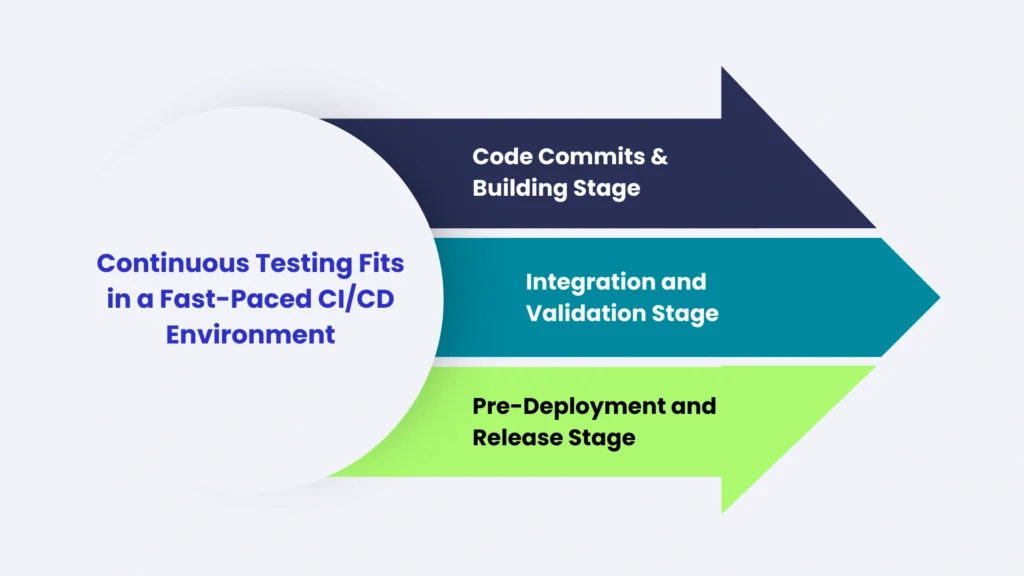
Let us look at how Continuous Testing fits in CI/CD environments.
Continuous Testing is integrated into every stage of the DevOps lifecycle and is a key part of establishing Quality Assurance early on and maintaining it throughout the entire process until deployment. The emphasis throughout all stages is on quickly gathering feedback, reducing uncertainty-related risk, and minimizing the number of faulty products that advance to the subsequent development stage. Let us make it clear with the following stages details:
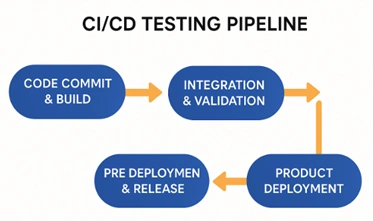
CI/CD Testing Pipeline
1. Code Commits and Build Stage
This stage offers the maximum protection from bad products; thus, it utilizes the fastest and most automated methods of testing to provide developer feedback as it happens.
The pre-commit and commit hooks are an important component of maintaining the linting standards, performing static code analysis, and executing security scans (Static Application Security Testing – SAST). These hooks help developers identify problems with code style, complexity, and other common vulnerabilities prior to the code being pushed to shared repositories.
The unit tests are fast and reliable, and help to validate the business logic and functional limits to ensure that everything functions as expected at a very low level. After the unit tests, the next step should be to perform the Build Verification Tests (BVT tests) to determine if the application’s components are functioning and ready for deployment.
This methodology gives developers timely, localized feedback. Early detection of failures allows us to stop the progression of bad changes in the pipeline and save substantial time later by preventing the need to fix problems.
2. Integration and Validation Stage
As more individual components are brought together, the likelihood of failures increases, especially in microservices and cloud-native environments where there are many closely connected dependencies.
This highlights the critical role of integration testing. It involves checking how data flows and how services interact through integration and contract tests. Meanwhile, API testing and schema validation ensure that users downstream can still rely on backward compatibility. Moreover, scanning container images can uncover vulnerabilities in dependencies and configuration problems before they are deployed. Managing test data effectively is essential for keeping datasets consistent and compliant with privacy laws, which helps ensure that the results are reliable and can be repeated.
By validating system setups early, teams can prevent the annoying “it worked on my machine” issues, which greatly reduces unforeseen challenges during the final integration phase.
STAGES FOR CONTINUOUS TESTING
3. Pre-Deployment and Release Stage
Before you launch a product, it’s important to ensure system-level assurances are in place. Automated end-to-end (E2E) testing replicates actual user workflows in environments that closely resemble production. Performance testing, which includes load, stress, and soak tests, assesses the system’s resilience, latency, and throughput. Dynamic security testing (DST) helps identify vulnerabilities that could emerge during runtime, while risk-based testing focuses on the areas that might have the biggest impact.
Methods like canary releases, feature flags, and progressive delivery checks, along with observability and synthetic monitoring, help confirm that everything is ready for launch. This shift allows releases to move from being large, high-risk events to more controlled, verifiable steps based on measurable signals rather than just guesswork.
Quality assurance is not replaced by DevOps; rather, it is reconfigured. Historically, QA had traditionally served as the last stop in product development, the end of the line where products are validated, defects are reported, and products get signed off for release. QA was built on stable requirements, long release cycles , and no ambiguity in hand-offs. In a DevOps environment, all these assumptions hold.
QA as a Continuous Enabler
DevOps changes the role of QA professionals from an inspector looking at results to a creator of quality through the design of the system. The role transforms into one of working collaboratively with developers during the design process, having defined a testing strategy early in the process, and ensuring that automated testing frameworks are integrated into the pipeline.
QA professionals are no longer solely responsible for quality; there are other teams involved in creating and improving quality, including developers, who write unit and integration tests, and operations, who validate deployments, observability, and resilience. QA professionals are responsible for orchestrating this ecosystem by ensuring coverage, relevance, and risk to determine appropriate actions moving forward.
Shared Responsibility for Quality
Silos no longer exist with the use of DevOps, as quality will encompass all three areas (Development, Quality Assurance, and Operations). Although the technical challenges faced by teams through this change will be difficult, it will be through collaboration and communication (instead of just using milestones) that teams will be able to create shared standards for completion (definitions, metrics, etc.).
By incorporating Quality Assurance testing earlier in the project lifecycle, design decisions will be influenced, and the systems created will provide greater testability, observability, and resilience through tested engineering processes rather than reactive ones.
The most significant point to remember throughout this discussion is that DevOps does not just move Quality Assurance to the left; it eliminates the line that separates the two teams altogether.
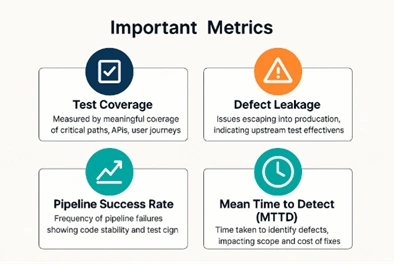
When continuous testing creates measurable outcomes, it adds value to the software development process. Organizations with mature DevOps practices measure both delivery and quality metrics to connect how well software is built (technical performance) to its usage (business impact).
Important metrics include:
Standard Metrics for Continuous Testing & DevOps Practices
The above metrics should not be treated as vanity metrics. These metrics will provide insight as to how to allocate resources and/or funding for automated testing, and to help identify areas that have systemic deficiencies.
If done right, Continuous Testing can dramatically improve:
In time, as organizations adopt a quality-first DevOps culture, teams will stop asking “Did we test this?” and start asking “What is the risk that this change will create?” This change in mindset is where the real value of DevOps occurs.
Quality will have an autonomous, continuous, and predictive (rather than reactive) future within DevOps. With the increase of distributed software to operate in AI-Driven environments and shortened release cycles of the software, the way to perform continuous testing will change to an intelligent feedback loop that is implemented across the full Software Development Life Cycle (SDLC).
Companies that consider quality an engineering discipline should be integrated into their engineering teams through automated processes and be risk-aware, and can deliver at higher speeds without sacrificing trust. The focus for quality in the future will therefore move towards the idea that speed and stability support each other, rather than conflicting with each other.
MosChip’s digital engineering service expertise enables DevOps continuous testing and quality assurance within modern software by embedding automated testing inside CI/CD pipelines using AI to optimize tests, automated testing of cloud-based applications using APIs (such as in a cloud native environment), shifting left and shifting right strategies on the software development lifecycle, and continuously monitoring quality. This will lead to faster defect discovery, less leakage from production, more reliable pipelines, and greater digital experience scalability and quality.
To know more about MosChip’s capabilities, drop us a line, and our team will get back to you.

Darshil is a Marketing professional at MosChip creating impactful techno-commercial writeups and conducting extensive market research to promote businesses on various platforms. He has been a passionate marketer for more than four years and is constantly looking for new endeavors to take on. When He’s not working, Darshil can be found reading and playing guitar.

Test automation is the practice of automating test execution using frameworks and tools to carry out tests more quickly and…
As AI integrates across business operations today, companies are shifting from experimental pilots to full-scale deployments. The evaluation needs to become…

Intelligent Automation is seen as an optimistic innovation for manufacturers in the current competitive market. It combines different intelligent methods…

Quality Assurance (QA) is entering a new phase of evolution, drawing from the strengths of manual testing and conventional test automation…

Automated testing in digital transformation Benefits of automated testing in digital transformation The several benefits of automated testing plays in…

The modern world is based on embedded systems, which are a rapidly developing field of technology. Embedded systems are the…


Know how we have helped our client get more safety rating for their latest auctomobiles launched!