
Product Sustenance Engineering: Enhancing Product Performance and Longevity
The path for a product doesn’t stop once it is ready to be launched. Whether it is a semiconductor powering a mission-critical operation or embedded software that enables connected devices, the challenge has changed. Success is no longer just development speed; success is success through product operational efficiency, security, and competitiveness in both the market and ecosystem landscape.
With the rapid pace of change in technology, industry standards shifting, and newer interdependencies, Product Sustenance Engineering (PSE) represents an increasingly important aspect of the product lifecycle. PSE is concerned with product and systems performance and reliability after initial release and considers component obsolescence, changing compliance obligations, and even cybersecurity intrusions and complex interdependencies, which can only be resolved with redesigning the product or releasing additional product versions.
PSE provides ongoing usability and relevance through maintaining the hardware, continuous software updates, toolchain improvements, and compliance maintenance. PSE is part of the overall ongoing maintenance of the program and provides a lifecycle strategy that balances cost, functionality, usability, continual design improvements, interoperability updates, and ongoing revalidation.
To understand why PSE is becoming increasingly significant, we look at its role in resolving operational, technological, and business challenges, which will lead to the sustainability of product success, especially in an evolving market.
Product Sustenance Engineering (PSE) refers to an ongoing, evolving engineering process and culture dedicated to the long-term well-being and advancement of deployed products. PSE goes beyond the limitations of traditional maintenance by serving as the backbone that enables ongoing optimization of performance, management of defect resolutions, cost-effective uptime, and a proactive approach to the continual refresh of technologies. The ongoing engineering process ensures that products remain durable, contemporary, and competitive during an evolving industrial ecosystem and product lifecycle.
We can evaluate Product Sustenance Engineering (PSE) across its dimensions of hardware sustenance, software sustenance, and system integration.
1. Hardware Sustenance
Hardware Sustainability is essential in the lifecycle management area of physical components that are being challenged by obsolescence and better performance. When a critical component, such as an End-of-life (EOL) microcontroller in the PLC, is not available, an engineer must determine a suitable substitute. Before this can occur, a critical validation process must be performed to determine that the new parts are equal to the previous component with respect to form, fit, and function.
Moreover, any Bill of Materials (BOM) changes must be managed to ensure that expense systems are tracked while managing the introduction of substituted components. Sustainability of end products, even with substitutions and modifications, means ensuring that overall costs are kept low due to optimized procurement, the cost impact resulting from redesign, and ensuring compliance with the original, all to extend product life without a meaningfully increased expense.
In addition, maintaining product reliability frequently requires performance upgrades. For example, advanced thermal modelling approaches, such as computational fluid dynamics (CFD), can enhance heat dissipation in compact industrial control enclosures. Compliance may require, in addition to updating the design of the control enclosure, shielding or other protections that comply with new electromagnetic compatibility (EMC) regulations by the International Electrotechnical Commission (IEC).
New hardware infrastructure may also be required. This may include the introduction of current communication standards, such as moving from legacy I/O modules to something like PROFINET. Each upgrade requires extensive documentation about the devices involved, including mechanical tests, communication performance tests, and, potentially, the addition of sensors and interface modules.
In the workspace of industrial automation, proactively upgrading control systems by replacing existing PLC hardware with newer hardware that can support new communication protocols and offer better power/thermal management would suffice in helping to maintain reliability, compliance, and support for the next generation of technology while limiting any disruption to current operations.
2. Software Sustenance
Software sustenance is essential for navigating the ever-changing technological landscape, ensuring deployed codebases stay healthy, secure, and adaptable within industrial automation. Traditionally, many industrial control systems relied on monolithic software architectures, such as legacy SCADA systems, which are large and tightly integrated.
Modern software sustenance shifts focus to breaking down these monolithic systems into modular, microservices-based architectures. This transition to loosely coupled services improves maintainability, scalability, and resilience while preserving the system’s external behaviour. Engineers carefully apply design patterns and develop automated unit and integration tests to manage ongoing changes while reducing risk.
Sustaining engineers document requirements throughout the process using a traceability matrix, maintaining transparency and accountability. Proactive upgrades include updating critical security protocols, for example, moving from outdated Transport Layer Security (TLS 1.0/1.1) to the latest and more secure TLS 1.3 to keep cybersecurity compliance aligned. After operating system or middleware updates, extensive regression testing ensures applications like Human-Machine Interfaces (HMIs) remain functional and reliable.
Software sustainability also involves creating new ecosystems, such as cloud environments, to address growing storage and processing demands tied to edge computing. For instance, transitioning communication from Bluetooth to Wi-Fi or 5G requires careful validation to maintain operational baseline integrity without disruption.
In summary, software sustainability is a team effort that leverages modularity and cloud integration alongside continuous testing and updates, making industrial products resilient and future-ready.
3. System Integration
System Integration is a vital pillar for product sustainability, connecting a product’s components, including internal databases and third-party software, to ensure adaptability and market relevance. It plays a crucial role in managing legacy products and strategically reducing technical liability, allowing engineering teams to shift focus from constant fixes to innovation.
Integration involves four key types:
Different approaches suit different needs. For a few connections, point-to-point integration works, but it can become complex with scale, known as “spaghetti integration.” A better alternative is horizontal integration, using a common interface layer such as an Enterprise Service Bus (ESB) or integration platform as a service (iPaaS).
A valuable approach is the Hybrid Integration Platform (HIP), which securely connects modern cloud apps with legacy systems. HIP enables adding new technologies like IoT or AI without replacing entire infrastructures, preserving investments while driving innovation.
The sustainable integration process follows a lifecycle:
This disciplined lifecycle extends product life, boosts efficiency, enhances customer satisfaction, and lowers costs by minimizing reactive fixes and reducing technical liability.
Sustenance engineering in today’s product lifecycle goes far beyond simple bug fixes. It acts as a stabilizing force that enables continuous adaptation to changing market dynamics. The main reason sustenance matters is to keep products aligned with new standards, evolving user expectations, and regulatory compliance.
This involves navigating complex and shifting rules such as the latest cybersecurity regulations, multi-generational platform compatibility, and updated electrical codes for energy efficiency. Sustenance engineering provides the necessary control to balance these external pressures while maintaining core product functionality and timely market delivery.
From an engineering perspective, sustenance is vital for managing the complexities of modern systems and global supply chain realities. Teams face challenges like outdated toolchains, compiler deprecations, software license changes, and obsolete third-party components. Sustenance engineering proactively addresses these by redesigning and revalidating systems.
For example, redesigning industrial automation controllers to be RoHS compliant or embedding low-power processors requires careful considerations of timing accuracy, I/O integrity, and multi-vendor dependencies amid supply uncertainties.
The justification for effective sustenance engineering lies in optimizing economy and competitive advantage. Proactive sustenance maximizes return on investment (ROI) and extends the productive lifespan of products while reducing total cost of ownership (TCO). By managing performance, security patches, and key enhancements, organizations delay costly redesigns or replatforming, allowing R&D to focus on innovation and new product development—fueling long-term sustainability and competitiveness.
Extending on the rationale of why sustenance is critical in today’s product lifecycles, the actual work behind Product Sustenance Engineering is both technical and ongoing. This begins with,
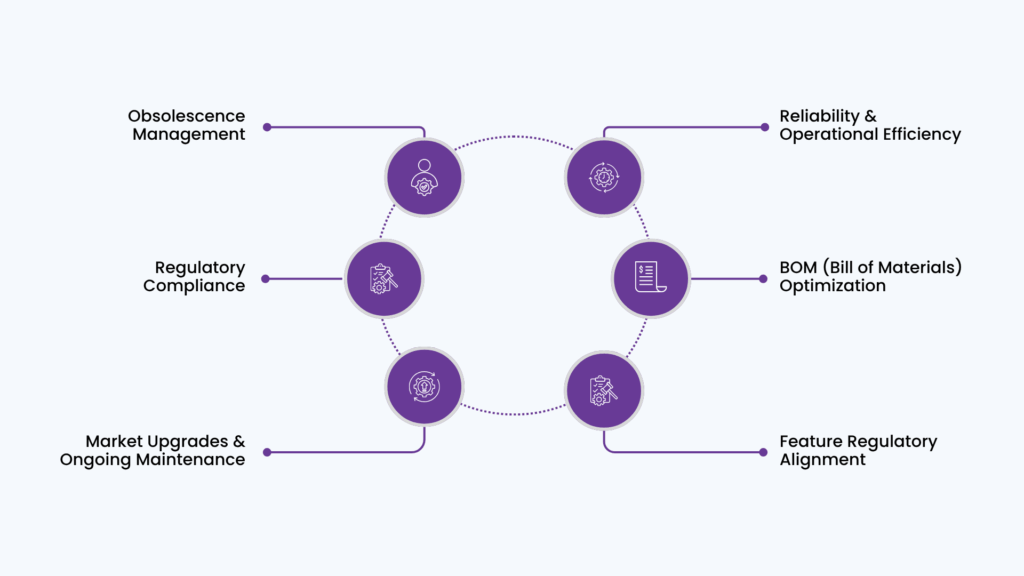
1. Obsolescence Management
Maintenance begins with looking forward to the point when parts will become obsolete. Engineers watch the lifecycle data, evaluate the risks, and incorporate new sources of information, while not changing the original design. For example, suppose the motor driver IC used in the controller for a robotic arm has gone obsolete; the engineers will qualify the new part, provide the revised PCB layout, and evaluate EMI and thermal compliance tests. They will also confirm electrical characteristics to maintain the same performance level. This forward-thinking strategy helps avoid production delays and maintains a steady supply chain, using lifecycle monitoring tools and alternative sourcing methods to keep industrial operations running smoothly.
2. Regulatory Compliance
Compliance is constantly changing, driven by standards such as Conformité Européenne (European Conformity) (CE), Federal Communications Commission (FCC), Underwriters Laboratories (UL), and Restriction of Hazardous Substances (RoHS). Engineers in the field regularly review design files, update schematics, and go through re-certification processes to ensure they can sell their products globally. As an example, a PLC must satisfy EMC standards to ensure that it does not interfere with another nearby system. If you are not compliant, you may not be able to ship your product to your customer, and you can also hurt the persona of your brand in the market.
3. Market Upgrades & Ongoing Maintenance
This pillar emphasizes the importance of keeping products competitive and dependable throughout their entire lifecycle. Sustenance engineering integrates new features and technologies based on customer feedback and market trends, like incorporating Ethernet/IP, PROFINET, or OPC-UA support into industrial controllers to improve interoperability in smart factories. It also includes regular updates, patches, and bug fixes across hardware, firmware, and software layers to tackle vulnerabilities and enhance performance. These measures help prevent system failures, boost security, and ensure operational efficiency in critical environments. Ongoing upgrades guarantee that products meet Industry 4.0 standards and adapt to changing automation requirements.
Product Sustenance: Key Lifecycle Practice
4. Reliability & Operational Efficiency
To ensure reliability, it’s important to have effective maintenance procedures and make performance adjustments as needed. Technical support teams consistently perform firmware updates, resolve bugs, and make improvements to prevent future issues. For example, addressing memory leaks in SCADA software was crucial to avoiding significant downtime in chemical plant control systems. Moreover, adopting predictive maintenance techniques helps prevent downtime and lowers the risk of operational failures. These efforts not only ensure compliance with safety regulations but also help cut maintenance costs and maintain uninterrupted operations in essential industrial environments, where even a few seconds of downtime can lead to considerable financial consequences.
5. BOM (Bill of Materials) Optimization
Optimizing the Bill of Materials (BOM) is essential for cutting costs enhancing component availability, and stabilizing inventory control. Engineers aim to refine part choices, substitute outdated components, and identify alternative suppliers. For example, in servo drive assemblies, several discrete components can be merged into integrated ICs, simplifying design, easing inventory management, and enhancing reliability. This method achieves cost efficiency without sacrificing performance. Optimizing the BOM is an important and effective strategy for any automation system used in large-scale or mass production sectors like automotive, packaging, and high-volume manufacturing.
6. Feature Regulatory Alignment
When discussing operator safety and legal compliance, every product feature must adhere to strict safety and functionality standards. In the realm of industrial automation, these standards typically begin with guidelines such as ISO 13849 for machine safety, IEC 61508 for functional safety, and IEC 60204-1 for the electrical equipment of machines.
For instance, emergency stop circuits in robotic arms must undergo verification, fault tolerance analysis, and be properly documented to achieve the required Performance Level (PL) or Safety Integrity Level (SIL) standards. Engineers conduct compliance testing to ensure that records remain up-to-date and that designs are adjusted to align with changing regulations, including UL 508A for control panels and EN 62061 for machinery safety. These practices ensure safe operations in risky environments, foster customer trust, and help secure global certifications, making it essential to adhere to regulations for the longevity of products.
To summarize, the evolution of Product Sustenance Engineering (PSE) combines AI analytics, predictive intelligence, and automated lifecycle optimization to create an environment for sustaining product life beyond traditional boundaries. As edge systems, sensors, connected devices, and semiconductors rapidly advance, sustenance will transition from a support function to a sophisticated and continuous intelligent engineering discipline. By leveraging data-driven feedback loops, digital twins, and cloud-based PLM systems, PSE will not simply allow products to react to technology, but will enable products to thrive in each cycle, thus creating smarter, improved, and sustainably produced products.
MosChip is a Silicon-to-AI engineering company specializing in Product Sustenance Engineering. We ensure reliability, compliance, and future-proofing across generations of product lifecycles. Our capabilities include platform porting, feature re-engineering, and obsolescence management with minimal redesigns to extend product longevity. By enabling seamless modernization and reducing the total cost of ownership, we help customers sustain and evolve their products efficiently.
To know more about MosChip’s capabilities, drop us a line, and our team will get back to you.

Darshil is a Marketing professional at MosChip creating impactful techno-commercial writeups and conducting extensive market research to promote businesses on various platforms. He has been a passionate marketer for more than four years and is constantly looking for new endeavors to take on. When He’s not working, Darshil can be found reading and playing guitar.
Launching a product is a significant achievement, but once the product is launched, there are several challenges that companies must face, such as…

In automotive systems, where milliseconds define safety, and compliance defines credibility, the foundation of reliability…

In the rapidly evolving landscape of the Internet of Things (IoT), communication protocols are crucial in enabling devices to communicate…

Integration of AI, cloud computing, and edge technologies is driving a new wave of innovation in industrial automation. While most…

Embedded systems have become an integral part of our daily lives, from smartphones and home appliances to medical devices and…
Across manufacturing plants, automation systems have changed and demand higher visibility, faster data exchange, and simpler integration…


Know how we have helped our client get more safety rating for their latest auctomobiles launched!