
Digital Twin for OEMs: Lightweight Edge-First Implementations

Digital Twin is a dynamic, software-defined representation of a physical product or system that continuously reflects its state, behaviour, and operating context using real-world data. OEMs use Digital Twins across product design, validation, manufacturing, in-field monitoring, predictive maintenance, and lifecycle optimization, connecting engineering intent with operational reality.
Traditionally, Digital Twins began as simulation and visualization constructs, primarily used for design validation, what-if analysis, and performance modelling in controlled environments. These early implementations were largely static, cloud-centric, and retrospective in nature.
Digital Twins have now moved beyond simulation and visualization. For OEMs, they are increasingly expected to operate in real time, adapt to changing conditions, and actively participate in decision-making at the machine level.
Yet many Digital Twin initiatives stall because they are built as cloud-heavy replicas that have large data pipelines, high latency, and limited real-world actionability. This approach breaks down in environments where bandwidth is constrained, response times are critical, or systems must operate independently of constant connectivity.
An edge-first Digital Twin architecture changes this equation. Instead of mirroring everything centrally, intelligence is distributed closer to the physical asset, making the twin lighter, faster, and operationally relevant. To understand deeper, let us first discuss the limitations of cloud-centric digital twins for OEMs.
Let us first define what Edge-First Implementation is.
An Edge‑First implementation places the Digital Twin’s core intelligence, decision logic, and system awareness directly at the edge, close to the physical product, rather than exclusively in centralized cloud platforms.
An “Edge First” digital twin can:
While cloud‑only twins observe and analyze systems through centralized processing, an edge-based twin is part of the physical product itself.
The introduction of Edge-First Digital Twins represents an evolution in design methodologies. Edge First Digital Twins are lightweight and operate using local processing. Edge First Digital Twins will allow OEMs to operate without relying on the cloud.
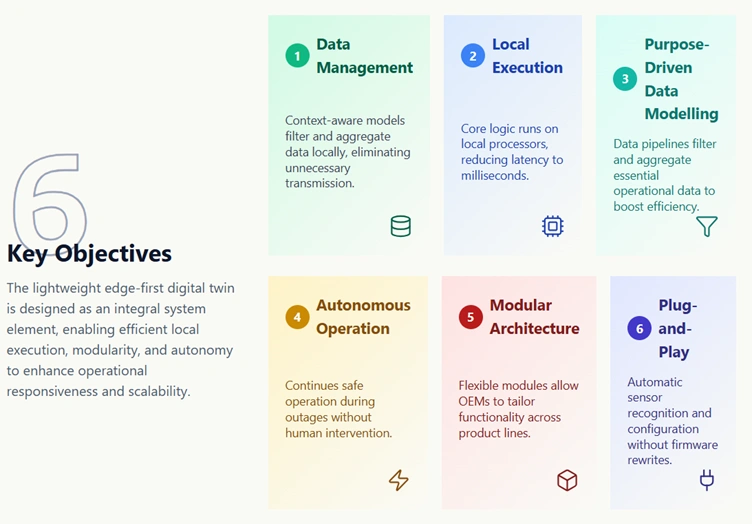
Let us discuss its core objectives here:
The digital twin is an integral component of the overall system, rather than just a remote viewer of the system’s status. It has been developed to fulfil the following key objectives:
Ultimately, an edge-first digital twin values practical use over perfect accuracy. It is built to function, make decisions, and adapt in its operational context, shifting the twin from being just an observer to becoming an essential element of the product itself.
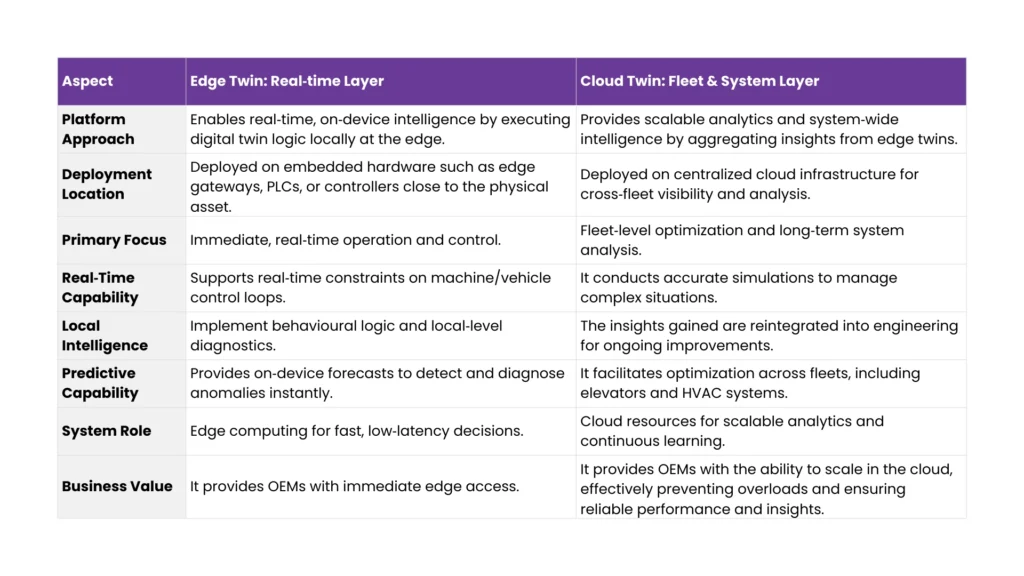
When it comes to traditional cloud-centric digital twins, they often encounter problems such as latency, dependency on bandwidth, and scalability issues in real-time operational systems, particularly where decisions must be made in milliseconds. The delays from centralized processing can limit responsiveness and put a strain on cloud resources as fleets grow.
Edge Digital Twins provide a solution by executing intelligence locally on the device, which allows for immediate control, diagnostics, and anomaly detection directly at the asset. By integrating Edge and Cloud Twins, we establish a hybrid intelligence model where real-time decisions are made at the edge. In contrast, learning and optimization are seamlessly integrated into the cloud, as detailed in the comparison below.
OEMs benefit from having lightweight, edge-first digital twins that provide measurable strategic advantages by embedding intelligence directly in both products and workflows through the development process. Digital twins not only provide operational efficiencies but also change the way products are designed, designed for use, and change throughout their lifecycle (deployment; evolution).
1. Accelerated Time‑to‑Market
Using digital twin intelligence at the edge provides OEMS instant access to real-world product behaviour while developing or early deploying their products. Validating design assumptions in live operating conditions will accelerate iteration through the product development process due to an inability to contest the validity of designs at late-stage development.
OEM benefit: Quicker time to market with fewer post-deployment corrective actions.
2. Reduced Operational and Lifecycle Costs
Data filtering at the edge and decision-making at the local level can help to significantly lower the amount of cloud bandwidth being used; this, in turn, will reduce costs associated with compute time and data storage. At the same time, early detection of anomalies (or potential failures) can help to reduce the amount of unplanned downtime and service calls/visits by being able to predict when an anomaly is going to occur.
OEM benefit: Reduced Total Cost of Ownership (TCO) for the entire product lifecycle.
3. Improved Product Reliability and Safety
Monitoring in real time of operational parameters through an Edge-First Digital Twin to establish safety boundaries. Instantaneous autonomous responses to abnormal operational parameters can stop failures before they reach a point of failure.
OEM benefit: more reliable and safer products, particularly in the case of safety-critical and mission-critical systems.
4. Stronger Engineering Feedback Loops
With built-in intelligence in deployed products, engineering teams have access to continuous contextual feedback, not just delayed aggregated reports. This will shorten the gap between what was designed to happen and actual performance in the field.
OEM benefit: Better-designed decisions/more qualified next-gen products.
5. Scalable Product Differentiation
Edge-First Digital Twin Technology allowed manufacturers to create products with intelligence as a produced function; thus, allowing for some combination of autonomy, adaptive operation, and customisation in the field for their products, which will give attorneys the clarity of differentiation but doesn’t require redesign of existing hardware platforms.
OEM benefit: Creating a competitive edge by providing intelligent and adaptable products to consumers.
6. Reduced Dependency on Connectivity
Because of the core intelligence residing at the perimeter, products will continue to work correctly in low connectivity or offline situations. Performance is enhanced via cloud platforms now, but the cloud is no longer the only point of failure.
OEM benefit: Resilient products developed to be deployed in actual usage environments.
7. Foundation for Autonomous and Software‑Defined Products
Digital twins focusing on edge technology create a scalable path to automated products, using a software-defined approach. As intelligence is added, products develop without needing complete redesigns of the architecture.
OEM benefit: Future‑ready platforms capable of continuous innovation.
In the future, OEM products will require autonomy and intelligence built into their design and development process; hence, digital twin technologies must steer into the edge-first direction. Edge-first digital twins will serve as a real-time guide for OEMs during product development, providing an embedded intelligence layer that allows for rapid launch of new products, on-site customization of existing products, and ongoing improvement of products throughout their usable life cycle.
When hardware and software intelligence are integrated at the edge, original equipment manufacturers (OEMs) can develop systems that monitor, decide, and act in real time on-site. This results in distinct product advantages, quicker reaction times, context-sensitive control, and autonomous optimization, all while avoiding the pitfalls of cloud dependency, including network latency, bandwidth constraints, and diminished relevance during connectivity interruptions. The result is robust, high-performance products.
MosChip delivers end-to-end product engineering services that facilitate seamless implementation of IoT by linking the edge devices to the cloud. As part of the Digital Engineering services portfolio, we design and deliver digital twins to OEMs, equipped with powerful data modelling, enhanced visibility through real-time and simulation-based environments, and customized dashboards that improve asset visibility and drive data-driven decision-making. Scalable architecture and intelligent analytics enable OEMs to implement IoT solutions, facilitating remote monitoring, predictive insights, and continuous product optimization from inception to end of life.
To know more about MosChip’s capabilities, drop us a line, and our team will get back to you.

Darshil is a Marketing professional at MosChip creating impactful techno-commercial writeups and conducting extensive market research to promote businesses on various platforms. He has been a passionate marketer for more than four years and is constantly looking for new endeavors to take on. When He’s not working, Darshil can be found reading and playing guitar.
Engineering teams building connected products spend a significant amount of time solving the same foundational problems…

Smart home automation has transformed from a niche market into a mainstream phenomenon, enhancing convenience, energy efficiency, and security in…

Nowadays, industries are increasingly relying on real-time data, which is driving the demand for systems that can collect data and…

In today’s time where data is frequently compared to the “new oil”, it is crucial for businesses to adjust their…

Every day, new products are introduced to the market, and the pressure on companies to innovate quickly has never been greater…

In the rapidly evolving landscape of the Internet of Things (IoT), communication protocols are crucial in enabling devices to communicate…


Know how we have helped our client get more safety rating for their latest auctomobiles launched!