
Matter Ecosystem: Advancing Smart Home Interoperability


This blog is a continuation of the Matter blog published earlier, and it explores the core components of the Matter ecosystem, commissioning methods, and key architectural concepts that enable seamless connectivity across modern smart homes. It also highlights MosChip’s practical experience in building and demonstrating the Matter ecosystem.
Matter is an open, IP-based application-layer protocol designed to enable secure, reliable, and interoperable communication between smart devices across vendors and ecosystems. It operates over standard IP transports such as Wi-Fi, Ethernet, and Thread, and uses well-defined data models, interaction protocols, and security mechanisms to ensure consistent device behavior and seamless integration.
Within the Matter architecture, a Matter Node is any logical participant on a Matter network. Nodes can function as Devices (endpoints that implement Matter device types and clusters), Bridges (which expose non-Matter devices as virtual Matter devices), or Controllers (which commission devices, manage fabrics, and issue commands). Each node is uniquely identified within a Matter fabric and communicates using secure, certificate-based authentication and end-to-end encrypted messaging.
Matter Devices: Matter Devices are endpoints such as lights, switches, etc. That natively supports the Matter specification. They incorporate built-in security through device attestation, certificate-based identity, and fabric-scoped encrypted communication. Once commissioned by the Controller, these devices communicate securely over the Matter network.
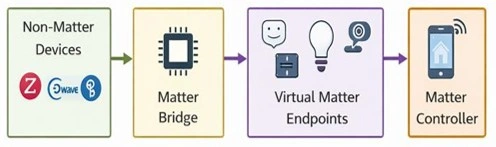
Matter Bridge: A Matter Bridge enables interoperability by integrating non-Matter devices into the Matter ecosystem, allowing existing Zigbee, Z-Wave, BLE, proprietary, and Thread-based networks to coexist without device replacement. To onboard non-Matter devices through a Matter Bridge, the devices are first commissioned using their native onboarding methods and then integrated into the Matter ecosystem via the bridge. The bridge exposes these devices as virtual Matter endpoints by translating native capabilities into standardized Matter clusters and attributes.
Matter Bridge Architecture for Non-Matter Devices
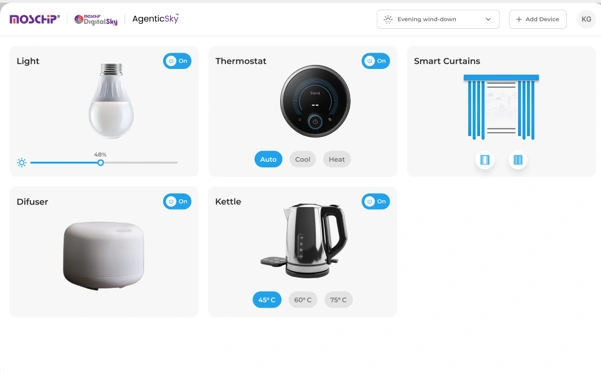
Matter Controller: A Matter Controller is a node that manages and operates Matter-enabled devices. It handles device commissioning, secure communication, and Matter fabric management. The controller enables command execution, device monitoring, and seamless interoperability across ecosystems. The Matter controller stack can be ported to the Android platform to enable the development of a unified HMI and device controller.
Matter Controller Application Dashboard
Commissioning is the process of securely onboarding a device into a Matter fabric, where a Matter fabric represents a secure, cryptographically defined trust domain that links devices and controllers under a single administrative authority and establishing trusted communication. Matter defines multiple commissioning methods as described below.
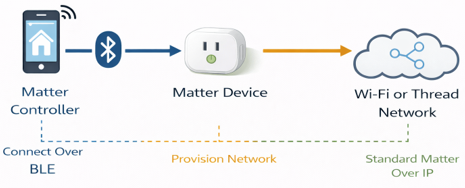
BLE-Based Commissioning: BLE-based commissioning is commonly used for devices that lack network credentials or IP connectivity during initial setup. BLE serves as a temporary communication channel between the Matter device and the controller. During commissioning, the controller connects to the device over BLE, securely exchanges network credentials and fabric information, the device joins the target Wi‑Fi or Thread network, and communication transitions to the IP layer.
Matter BLE Commissioning Process
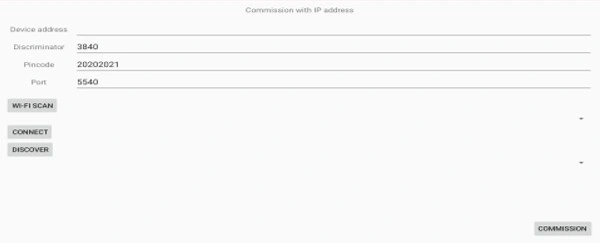
Code or Pair Based Commissioning: Matter supports standardized code-based commissioning using QR codes or manual pairing codes. These codes encode device identification and onboarding parameters required to establish trust. Both the controller and the bridge/device must be on the same network.
Matter Commissioning Using Device IP
When scanned or entered into a controller application, a secure commissioning session is initiated that cryptographically verifies the device’s authenticity and securely adds it to the Matter fabric.
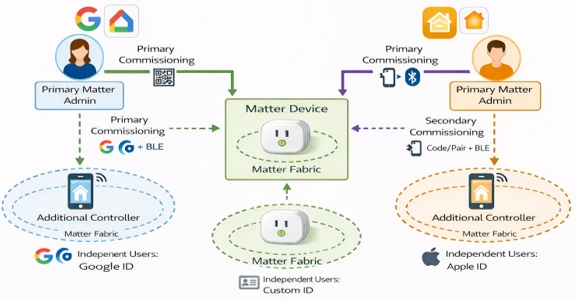
Multi-Admin Commissioning: Multi-admin commissioning allows a Matter device that is already commissioned by one controller (Primary Administrator) to be securely shared with additional controllers without performing a factory reset.
After the initial commissioning, the first controller initiates a sharing or open commissioning window on the device. This action authorizes the device to accept a new administrator. The second controller then uses a standard Matter commissioning method (QR code, pairing code, or BLE-based flow) to establish trust and join the device. So, each controller will be assigned with the new fabric, and each one can control the devices, through its own access rules and separate cryptographic keys.
Multi-Administrator Device Provisioning
Data Modelling and interaction fundamentals form the core of Matter’s interoperability framework. The Data Model defines how device capabilities are structured and exposed, while the Interaction Model specifies how controllers and devices securely read, write, invoke, and subscribe to that data consistently.
Node and Endpoint: A node is the top-level, uniquely addressable entity in a Matter network that represents a complete functional device or logical instance. Endpoints are individually addressable components within a node that define specific functions or services using device types and clusters.
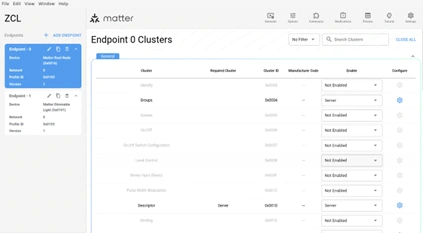
ZCL Clusters: Matter uses ZCL (Zigbee Cluster Library)–based clusters to describe device functionality. A cluster groups attributes (state), commands (actions), and events (notifications) for a specific feature such as lighting, locking, or temperature measurement. Instead of interacting with vendor-specific APIs, controllers communicate using these standardized clusters.
Fabrics and Fabric Identifiers: A fabric is a secure administrative domain formed during commissioning and defined by a unique trust relationship, identified by a Fabric ID under a Root Certificate Authority. A single device can join multiple fabrics at the same time, enabling multi-admin control while keeping each administrator strictly isolated.
Device, Vendor, and Product Identifiers: Matter uses standardized identifiers to clearly identify devices and their origin. The Vendor ID (VID) uniquely identifies the manufacturer, the Product ID (PID) defines the product type under that vendor, and the Node ID uniquely identifies a device instance within a fabric. Together, these identifiers enable controllers to understand device identity, capabilities, and compatibility without proprietary mechanisms.
Group Identifiers and Group Communication: Matter enables efficient multicast control using Group IDs (GIDs), which represent a set of nodes within a fabric and can be scoped to specific endpoints. Universal Group IDs such as All Nodes or All non-battery Nodes are predefined, while security credentials and multicast behavior remain fabric-specific to maintain isolation and security.
Command and Attributes: Commands are messages exchanged between a client and server to trigger actions or behaviours. Attributes represent the readable or writable state and configuration of a cluster, reflecting the device’s capabilities and status.
Read and Write Interactions: Read interactions allow a client to fetch current device state such as attributes or events, while Write interactions allow controlled modification of writable attributes to change configuration or behavior. Both follow strict access control, path resolution, and validation rules to ensure safe and predictable data exchange.
Subscribe and Report Interactions: Subscribe interactions establish an ongoing relationship where the client requests continuous updates for selected attributes or events. Report transactions are then used by the server to push changes or periodic updates, keeping the client synchronized without repeated polling.
Invoke Interaction: Invoke interactions are used to execute device commands, triggering defined behaviors on the target device. Commands may be unicast or group cast and can return command-specific responses or status feedback.
Status Handling: Status responses provide clear success or error information for all interactions, using standardized global or cluster-specific status codes to ensure consistent error reporting and reliable interaction flow.
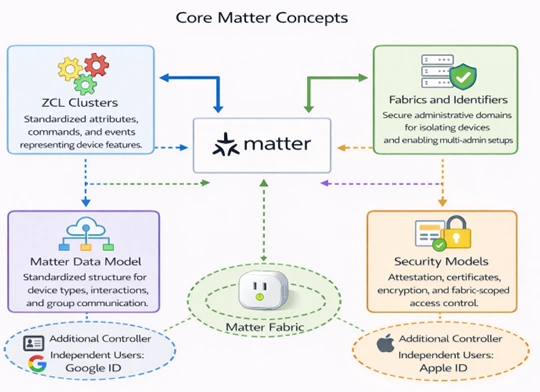
Core Matter Concepts
Security is fundamental to Matter and is enforced across the entire device lifecycle, from commissioning to operational communication. Matter relies on well-defined cryptographic primitives, including elliptic curve cryptography based on NIST P-256 for authentication and key exchange, AES for message confidentiality and integrity, and SPAKE2+ for secure, passcode-based commissioning.
All operational node-to-node communication within a fabric is encrypted, authenticated, and protected against replay attacks. Secure group messaging over IPv6 multicast is also supported, enabling low-latency control across constrained and low-power networks while maintaining fabric-level isolation.
The Secure Channel and Message Layer provide a consistent and secure communication foundation. Secure sessions are established using certificates (CASE) or shared passcodes (PASE), with discovery mechanisms used to determine peer addresses and operational parameters. Messages include session identifiers and counters to ensure proper authentication, decryption, and duplicate detection.
Unsecured communication is strictly limited to discovery, user-directed commissioning initiation, and secure session establishment. Matter also supports TLS for secure communication with external services outside the Matter fabric, enabling interoperability with cloud and non-Matter systems while preserving strong identity and certificate management.
MosChip brings deep expertise in device software engineering to enable truly interoperable smart home ecosystems powered by Matter. We design, port, and integrate Matter‑compliant devices, bridges, and controllers by seamlessly combining multiple connectivity protocols such as Wi‑Fi (IEEE 802.11), Thread, Ethernet, and Bluetooth Low Energy (BLE). Our end‑to‑end capabilities span device firmware, protocol stacks, secure commissioning, data modelling, and controller applications, helping customers build reliable, vendor‑agnostic, and future‑ready smart home solutions.
To know more about MosChip’s capabilities, drop us a line, and our team will get back to you.

Suhas Suresh Jarande is a Senior System Software Engineer with 4+ years of experience in embedded software and Android AOSP development. He has expertise in Linux and Android BSPs, kernel device drivers, Android framework and HAL customization, and system bring-up on multiple hardware platforms. His work spans GStreamer clock synchronization on Xilinx platforms, multimedia codecs, wireless audio systems, and IoT and Matter-based home automation, with experience in Yocto. He is proficient in C, C++, and FreeRTOS.
Outside of work, he enjoys playing badminton, trekking, exploring new places, and listening to music.
Wireless audio did not change overnight. Progress focused on better codecs, lower power use, and smaller devices…

Know how we have helped our client get more safety rating for their latest auctomobiles launched!